


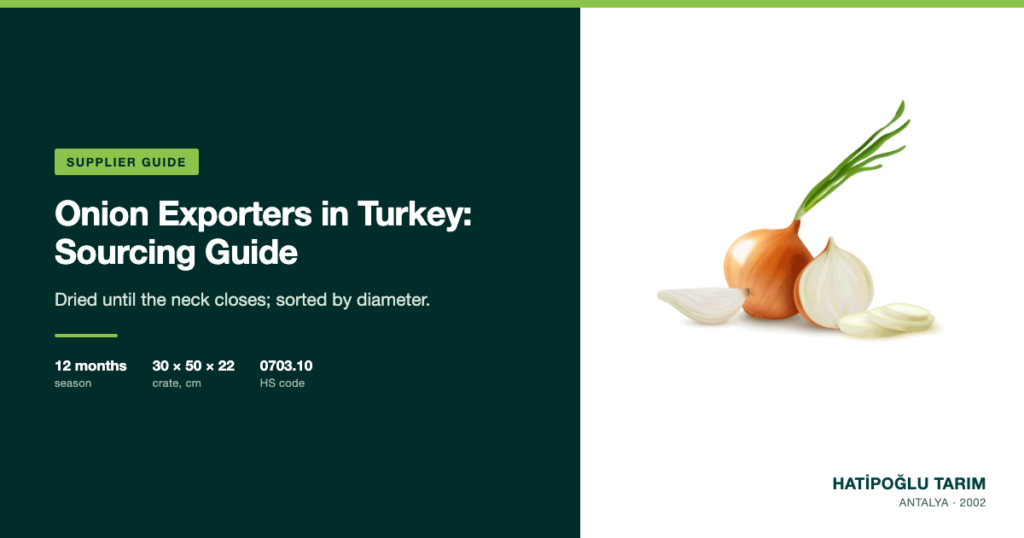
Among onion exporters the real difference lies in the stage after lifting, when the bulb is dried and its neck closes. Hatipoğlu Tarım is a fresh fruit and vegetable exporter and supplier based in Antalya, in business since 2002, and it offers onions in every month of the year from store. Importers, wholesalers and retail buyers can use this guide to check five things: how the bulbs are cured, how they are sorted, what research says about storing them, why onions need their own transport conditions and what an enquiry should contain.
Onions from Turkey: dry skin, firm bulb
The onion is a staple valued for its dry skin, its firm structure and its fitness for storage. For a buyer this means a line that can be ordered on a steady rhythm. It pairs naturally in an order with potatoes, the other long-keeping staple in the range.
Year-round supply from store
Every month is marked on the product calendar. The company’s explanation is short: supply from store is what makes the onion available all year. A buyer who wants to import onions from Turkey therefore plans by week and volume, not by harvest date.
Curing: the step that decides durability
After harvest the onions are dried until their necks have dried out and the outer skins have formed. The company describes this stage as important for how well the product stands up to transport and storage.
Research describes the same stage with numbers. In the data UC Davis publishes for dry onions, curing takes place in the field at a minimum of 24 °C, or with forced air at 30–45 °C for 12 hours, and a relative humidity of 75–80% during curing favours skin colour. An onion counts as field-dry when the neck is completely dry to the touch. These are published values; the company’s own statement is limited to the sentence above.
What an onion supplier in Turkey sorts for
As an onion supplier in Turkey, Hatipoğlu Tarım selects on:
- Diameter: bulbs are separated by diameter, so give the band you sell.
- Skin integrity: a complete dry skin.
- General quality: the overall condition of the bulb.
On the receiving side, the UC Davis quality description is a practical list: a mature neck and skin, firmness, the right diameter, and no decay, greening, sprouting or bruising.
Storage figures from research
UC Davis gives 0 °C and a relative humidity of 65–70%, with adequate air circulation, as the storage conditions for dry onions. Mild onions keep for 0.5–1 month, while pungent onions keep for up to 6–9 months depending on the variety. Temperatures between 5 and 25 °C encourage sprouting and are not advised for long periods. Ethylene may encourage sprouting and the growth of decay fungi. None of this is a statement about the company’s warehouse; it is what the published sheet says.
Why onions travel apart from other vegetables
Two properties matter for a mixed order. Dry onions need low humidity, so they are not carried under the same conditions as vegetables that need high humidity, such as carrots, cabbage and broccoli. Onions also give off odour, which affects apples, celery and pears according to the same data, and they take up odour themselves. A third product with a similar odour question is fresh garlic. Reefer stowage in general is the subject of loading a reefer container.
Nets, sacks and crates for dry onion wholesale
According to the product description, sorted onions go into nets or large sacks. The packaging table on the same page also lists a 30 × 50 × 22 cm plastic crate. For dry onion wholesale, say which of these suits your handling. Palletised goods stand on the 80 × 120 cm euro pallet.
The customs heading for onions is HS 0703.10 at six digits. The complete tariff line is something to confirm with your customs broker ahead of shipment.
Certificates and residues
The onion line is covered by the company’s certificates, namely ISO 9001, ISO 22000, ISO 10002, GLOBALG.A.P. IFA and GRASP, and each lot destined for Europe is analysed for residues. Background on the limits themselves: EU pesticide MRLs.
Six steps between the field and your depot
For onions the six steps are harvest, drying until the necks are dry and the outer skins have formed, sorting by diameter, packing, storage and dispatch, all handled in house. Loads are planned per truck. The standard temperature-controlled truck is 13.60 m long and has room for 33 euro pallets. How to assess a supplier more broadly is covered in the Turkish fruit and vegetable suppliers guide.
Requesting a price
Six facts are enough for a quotation: type, diameter band, packaging, weekly quantity, delivery week and destination country. Our telephone number is +90 242 339 55 25 and our WhatsApp number is +90 534 260 07 25; the e-mail address is info@hatipoglutarim.com.
Hatipoğlu Tarım has exported fresh fruit and vegetables from Antalya since 2002. Under the FİNİKE brand it ships 128 product lines to 42 countries, with harvest, grading, cold storage and dispatch handled in house across five facilities in Serik, Kepez, Mavikent, Yenişehir and Alaşehir.
Get in touch with the diameter band, the pack and the weekly volume you have in mind, and let us prepare the season plan and the price quotation.
