


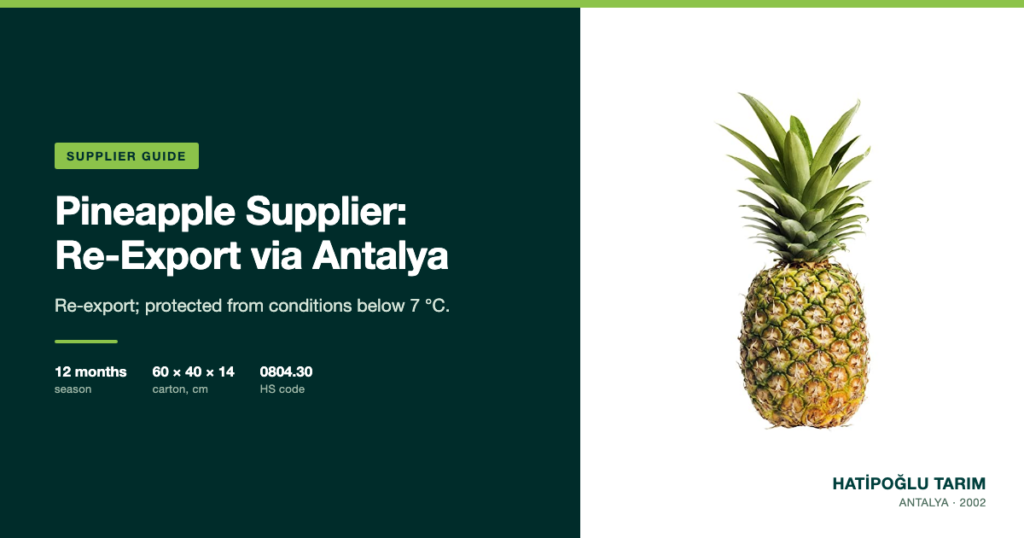
A pineapple supplier in Antalya owes the buyer one plain statement first: pineapples are not grown in Turkey. Hatipoğlu Tarım, which has exported fresh fruit and vegetables from Antalya since 2002, obtains the fruit through selected supply channels, checks it, keeps it in temperature-monitored rooms and prepares it for re-export. This guide is for importers, wholesalers and retail buyers who want to source pineapples through the supplier of their Turkish lines and to understand how the product is handled on the way.
What pineapple re-export from Turkey means
The company’s product text describes the pineapple as a fruit with a full shape, a vivid skin colour and a tropical aroma that is in demand all year. It also says, without qualification, that the fruit is not grown in Turkey and is sourced through selected supply channels before being prepared for re-export. The role of the company is that of a pineapple trader in Turkey who receives, inspects, stores, packs and ships.
Availability through the year
Pineapples are offered all year; the weeks and quantities for your programme are a matter for the enquiry. The Turkish-grown lines that can stand beside pineapples in a given month are shown in the season calendar.
The inspection on arrival
The fruit arrives already sized. It is then checked on four criteria:
- Size: the fruit arrives sized, and its size is checked.
- Crown: the structure of the crown leaves.
- Skin integrity: a skin without damage.
- Ripeness: the stage of ripeness of the fruit.
This inspection carries particular weight with pineapples, and the research says why. According to data published by UC Davis, the pineapple is not a climacteric fruit: it does not ripen after harvest and must be harvested ready to eat. The same source gives at least 12% soluble solids and at most 1% acidity as the minimum for flavour acceptance, and describes good crown leaves as green, of medium length and straight. These are research benchmarks, not values promised for a lot.
The 7 °C line
Here the company’s statement and the research meet. Hatipoğlu Tarım keeps pineapples in temperature-monitored rooms until dispatch and protects them from conditions below 7 °C in order to prevent chilling damage. UC Davis names the same threshold: below 7 °C chilling injury occurs, seen as failure to ripen, water-soaked flesh, darkening of the core and wilting of the crown leaves. The published ranges are 10–13 °C for partially ripe fruit and 7–10 °C for ripe fruit, at 85–90% relative humidity. Shelf life in the source is two to four weeks at 10 °C in air and four to six weeks in a controlled atmosphere of 3–5% O2 with 5–8% CO2.
For pineapple wholesale the conclusion is simple: this fruit never joins a 0 °C load of berries or kiwifruit. Bananas and dragon fruit are chilling-sensitive as well, each with its own published temperature.
The carton
Pineapples are prepared in cartons of 60 × 40 × 14 cm and packed according to the shipment plan. For the way this footprint relates to the euro pallet, see packaging and case sizes in export.
Customs code and origin documents
At six digits pineapples are classified under HS 0804.30, and the full tariff line should be confirmed with your customs broker before shipment. Because this is a re-exported product, confirm the origin and document requirements with your customs broker as well.
Certificates and residues
The company’s certificates are ISO 9001, ISO 22000, ISO 10002, GLOBALG.A.P. IFA and GRASP. Each lot sent to Europe is subject to residue analysis. Our overview of which certificates European buyers require lists what importers commonly request.
How pineapple supply via Turkey runs
There is no harvest step in this chain, because the company does not grow the fruit. The sequence is receiving inspection, storage in temperature-monitored rooms above 7 °C, packing into cartons and dispatch in a temperature-controlled truck. Loads are planned by the vehicle. A standard truck of 13.60 m holds 33 euro pallets of 80 × 120 cm.
Information for a quotation
Send us six details: the type, the size, the packaging, the weekly volume, the delivery week and the destination country. Our numbers are +90 242 339 55 25 for calls and +90 534 260 07 25 for WhatsApp; the e-mail address is info@hatipoglutarim.com.
Hatipoğlu Tarım has exported fresh fruit and vegetables from Antalya since 2002. Under the FİNİKE brand it ships 128 product lines to 42 countries, with harvest, grading, cold storage and dispatch handled in house across five facilities in Serik, Kepez, Mavikent, Yenişehir and Alaşehir.
Tell us the size, the weekly volume and the destination through our contact page, and we will set out the supply plan and the price quotation for pineapples.
