


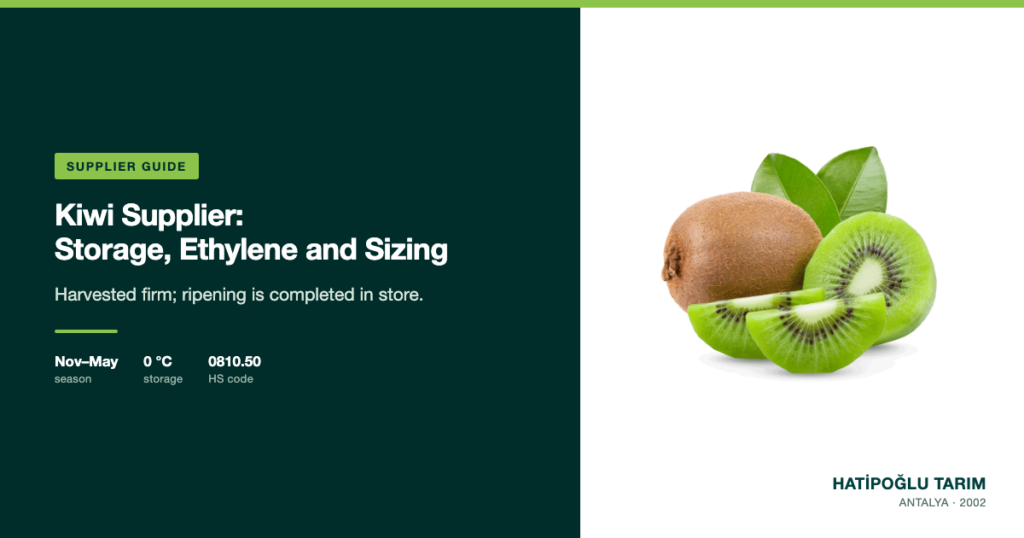
With most fruit you judge a supplier by the harvest; with a kiwi supplier you judge the store. Hatipoğlu Tarım, a fresh fruit and vegetable exporter based in Antalya since 2002, harvests kiwifruit firm between September and December, lets it complete its ripening in storage and, thanks to controlled atmosphere conditions, can continue supply until May. This guide explains what that means for an importer, a wholesaler or a retail buyer: the calendar, the criteria, the research on ethylene, the carton and the enquiry.
A fruit whose season is made in the store
The company describes the kiwi as a fruit with a brown skin, green flesh and a balanced sweet-sour aroma, whose storage process is managed with care. That last phrase is the important one. The harvest of Turkish kiwi runs from September to December; the supply season reaches May.
Harvest in autumn, supply until May
The fruit is picked firm from September to December and finishes ripening in the store. Controlled atmosphere makes it possible to keep supplying until May, and the product calendar marks November to May. A kiwi fruit wholesale programme can therefore be discussed for the winter and spring as one line, with the first and last delivery week named at the start. The season calendar shows which other products share those months.
Criteria, including dry matter
Hatipoğlu Tarım selects kiwifruit for export on:
- Size: after a resting period the fruit is sized on a count-per-tray basis.
- Firmness: the fruit is harvested firm.
- Skin integrity: the brown skin is undamaged.
- Dry matter content: named by the company as a selection criterion.
The research benchmark is expressed differently. UC Davis gives a minimum of 6.5% soluble solids at harvest and at least 14% when the fruit is ripe to eat. The same source reports that late-harvested kiwifruit retains its firmness better than early-harvested fruit. These are published research values; we do not offer them as a guarantee for any lot.
Ethylene: the number to remember is parts per billion
According to the data published by UC Davis, kiwifruit is extremely sensitive to ethylene. As little as 5–10 ppb is enough to start softening, so unripe fruit has to be kept away from ethylene during harvest, transport and storage, unless accelerated ripening is actually wanted. The optimum temperature is 0 °C, the highest freezing point is −1.5 °C, and relative humidity should be 90–95%.
On controlled atmosphere the source is equally specific: 1–2% O2 with 3–5% CO2 delays ripening and preserves firmness; CO2 above 7% can cause internal breakdown; the atmosphere should be established within two days of harvest; and ethylene should be held below 20 ppb. All of this is research data. The company’s own statement is shorter: controlled atmosphere conditions are used, and the fruit is kept cold after sizing.
What may share the truck
Anyone planning to import kiwifruit from Turkey in a mixed load should begin with the ethylene question. Kiwifruit travels at around 0 °C, as do strawberries and blueberries. Putting it in the same vehicle as fruit that produces ethylene, such as apples, pears, ripe bananas or ripe avocados, is not recommended. Bananas, pineapples, dragon fruit and unripe avocados are in any case chilling-sensitive and are not loaded at 0 °C. For the berry side of a cold load, see our guide to strawberries.
Carton, pallet and HS code
Kiwifruit is prepared in cartons of 30 × 40 × 12.5 cm and packed according to the shipment plan. How that footprint sits on an 80 × 120 cm euro pallet is covered in packaging and case sizes in export. The customs code at six digits is HS 0810.50. Have your customs broker confirm the full tariff line before shipment.
Certification and residue control
Buyers comparing a kiwi exporter in Turkey with other origins receive fruit from a company certified to ISO 9001, ISO 22000 and ISO 10002, and holding GLOBALG.A.P. IFA and GRASP. Residue analysis is carried out on every lot that goes to Europe. The European limits are discussed in our article on EU pesticide MRLs.
The steps behind a consignment
The company handles the chain in house: harvest of firm fruit, storage under controlled atmosphere, a resting period, sizing by count per tray, cold storage, packing and dispatch. Transport is planned in truckloads, and one standard refrigerated truck of 13.60 m has space for 33 euro pallets.
Your enquiry
To quote, we need the type, the size expressed as count per tray, the packaging, the weekly volume, the delivery week and the destination country. Ring +90 242 339 55 25, use WhatsApp on +90 534 260 07 25, or e-mail info@hatipoglutarim.com.
Hatipoğlu Tarım has exported fresh fruit and vegetables from Antalya since 2002. Under the FİNİKE brand it ships 128 product lines to 42 countries, with harvest, grading, cold storage and dispatch handled in house across five facilities in Serik, Kepez, Mavikent, Yenişehir and Alaşehir.
If kiwifruit is on your list for the winter, get in touch with the count you sell and your weekly volume, and let us work out the season plan and the price quotation together.
