


Most certification advice is written for the supplier who wants to get certified. Very little of it is written for the person sitting on the other side of the table. Yet the fresh produce export certificates required by European buyers exist for one reason: they close a specific gap in the buyer’s own risk. A supplier who can explain what each certificate guarantees — rather than simply listing them — answers the buyer’s real question in the first meeting.
The certificate map: three layers, three kinds of risk
Sorting certificates into layers removes most of the confusion.
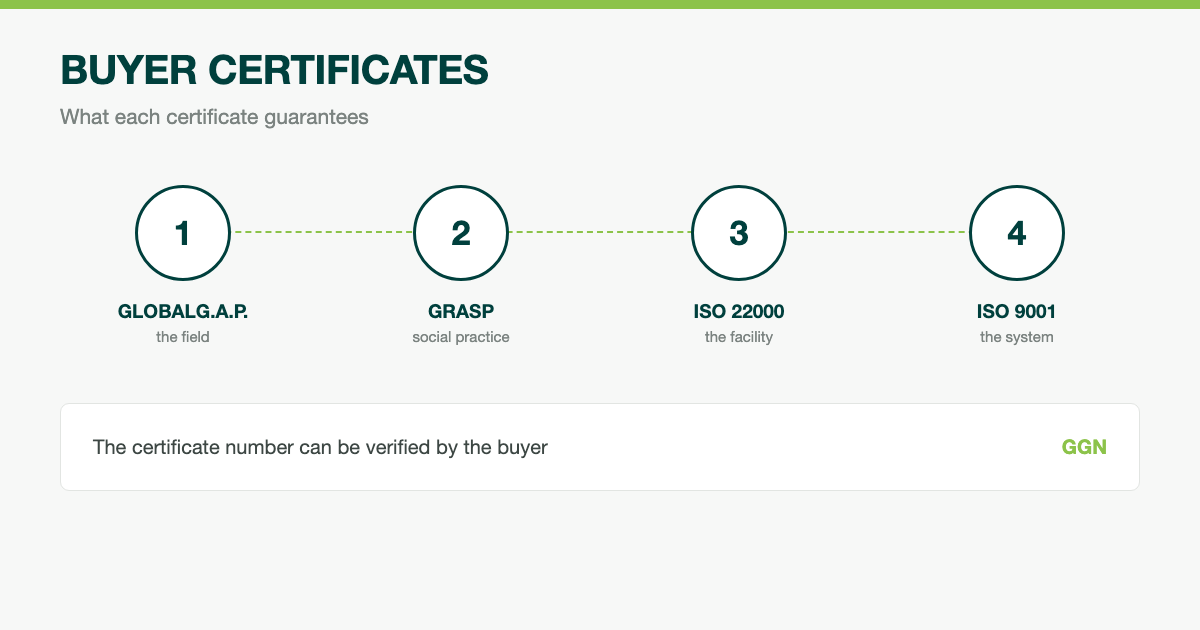
- The field layer covers where the crop grows: plant protection products, irrigation
- water, fertiliser, harvest hygiene, record keeping. GLOBALG.A.P. IFA belongs here.
- The site layer covers where the crop is graded, cooled, packed and dispatched.
- BRCGS and IFS work at this level.
- The system layer covers how the company runs itself: defined processes, document
- control, complaint handling. ISO 9001, ISO 22000 and ISO 10002 sit here.
Which certificate a buyer insists on depends on where the risk originates. Residue problems start in the field. Cross-contamination starts at the site. Lost records start in the system.
GLOBALG.A.P. IFA — everything up to the farm gate
IFA stands for Integrated Farm Assurance and covers production up to the farm gate. For fruit and vegetables the current version is 6, issued in two parallel editions: v6 Smart, the standard offering, and v6 GFS for buyers who need GFSI recognition. v6 Smart became mandatory in 2024.
A buyer asks for it so that one question can be answered quickly: which plot did this pallet come from, which product was applied, on what date, and how many days before harvest? When a residue finding appears, the buyer wants to isolate the problem to a single plot and contain the batch. Without traceability records that is impossible, and the whole programme stops instead of one lot.
GRASP — the labour side of the audit
GRASP is short for GLOBALG.A.P. Risk Assessment on Social Practice. It is not a standalone certificate. It is an add-on to the IFA standard, assessed annually alongside the IFA audit and, under version 2, by the same certification body. Version 2 was published in 2022.
It looks at workers’ health, safety and welfare: workers’ representation, human and labour rights indicators, and the protection of children and young workers. European retail chains write it into contracts because working conditions inside their supply chain are now treated as their own public responsibility. For most European retailers, a GLOBALG.A.P. certificate without GRASP is an incomplete file.
ISO 22000 and ISO 9001 — site and system
ISO 22000 is a food safety management system. It extends HACCP thinking across the whole company: hazard analysis, critical control points, recall procedure, supplier control. ISO 9001 does something different — it does not guarantee food safety, it guarantees repeatability. Will the same specification produce the same result two months from now?
ISO 10002 defines how customer complaints are handled. For a buyer this translates into something concrete: when a shipment goes wrong, they know who responds, within what timeframe, and whether the answer is recorded.
When BRCGS and IFS enter the picture
BRCGS Food Safety and IFS Food are GFSI-recognised standards that audit the production and packing site. The current editions are BRCGS Issue 9 and IFS Food version 8. The difference from GLOBALG.A.P. is one of scope: GLOBALG.A.P. examines the field, BRCGS and IFS examine the site.
They usually become a requirement in two situations. First, when the buyer sells under its own label — a retail chain wants a site audit behind its own name. Second, when the product undergoes processing: slicing, washing, retail-ready packing. For produce that is simply graded and packed as it comes from the field, the buyer’s opening requirement is normally GLOBALG.A.P. IFA plus GRASP.
How a buyer verifies the numbers
This is the step suppliers most often skip. A buyer does not trust a PDF; a buyer checks the number. On the GLOBALG.A.P. side, each producer carries a unique 13-digit GGN, and validity can be checked through GLOBALG.A.P.’s own portal without logging in. A certificate that cannot be found in the system is treated as invalid.
The practical conclusion is simple. Putting a certificate image into an offer file is not enough — put the number in as well. A supplier who volunteers the number is inviting verification, and that reads well.
What the expiry date means in a supply contract
Certificates run on an audit cycle, and in most buyer contracts a valid certificate is a condition of delivery. If it is not valid on the shipping date, the buyer can reject the consignment or hold payment.
So the right question in a first meeting is not “do you hold the certificate?” but “when is your renewal audit?” A renewal that falls in mid-season is something to plan around during negotiation, not to discover on loading day.
About Hatipoğlu Tarım
Hatipoğlu Tarım was founded in Antalya in 2002 and exports fresh fruit and vegetables to 42 countries under the FİNİKE brand. The company runs five facilities — Serik, Kepez, Mavikent, Yenişehir and Alaşehir — and handles 128 product lines. Its certification file includes ISO 9001, ISO 22000, ISO 10002, GLOBALG.A.P. IFA and GRASP.
Send us the products and the delivery period you have in mind and we will share our certification file, numbers included, along with a programme proposal.
