


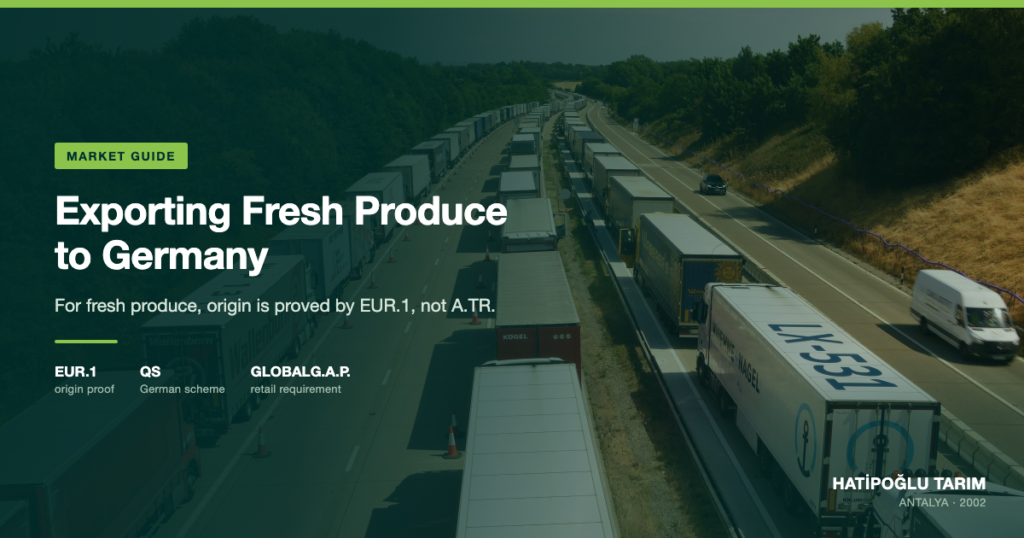
Germany is one of the most orderly markets in Europe and one of the least forgiving. The buyer builds the programme months ahead, keeps the specification in writing, and handles a deviation with a report rather than a phone call. For a fresh fruit and vegetable supplier working from Turkey to Germany, that rhythm is the real subject — this guide follows the path from first sample to standing supply.
What Germany sources from Turkey, and when
German demand begins where German production ends, and Turkey’s strong windows line up with that gap.
- Protected-cultivation vegetables (tomato, pepper, cucumber, courgette): October to
- May along the Antalya coast — the winter backbone of the trade.
- Citrus (grapefruit, lemon, orange, mandarin): November to April.
- Apricot and cherry: a short, intense season from late May into July.
- Pomegranate, fig and grape: autumn lines, roughly August to November.
The buyer’s question is never “do you have it?” but “which weeks can you cover without a break?” The opening and closing weeks of a season matter more than the middle.
What German retail requires on paper
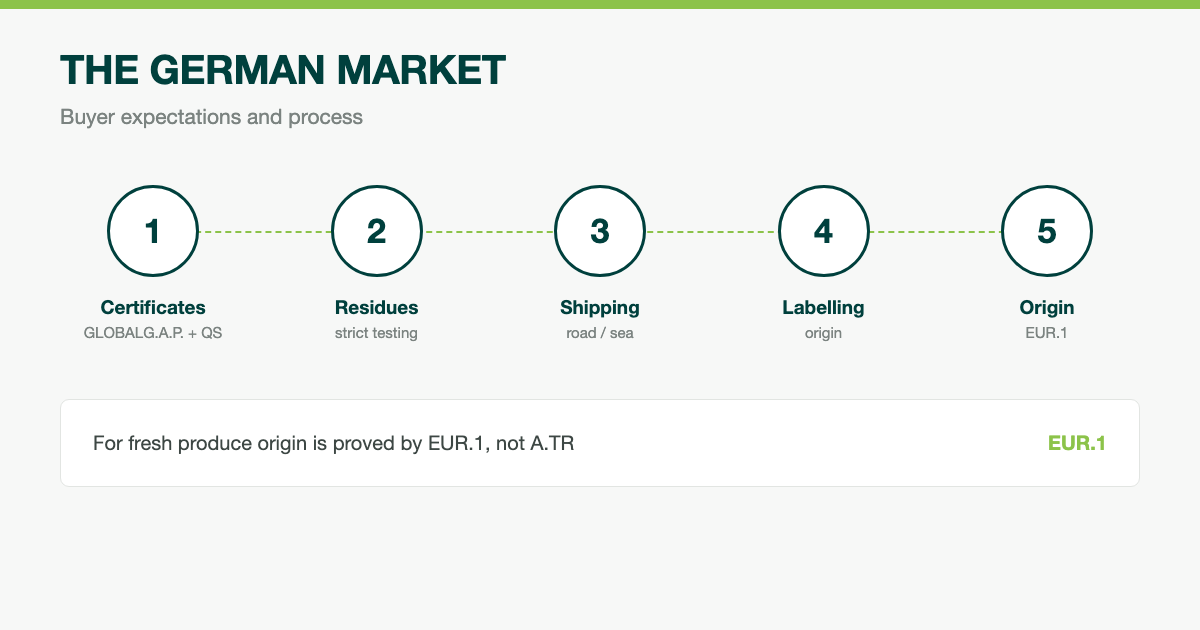
The baseline in German retail is usually GLOBALG.A.P. IFA together with its GRASP add-on. On top sits a layer specific to Germany: the QS Prüfsystem, a German quality assurance system with a dedicated programme for fruit, vegetables and potatoes. Its own farm standard, QS-GAP, is benchmarked and mutually recognised with GLOBALG.A.P. A QS-GAP certified operation can therefore supply into both systems, and a QS-GAP producer must also be registered in the GLOBALG.A.P. database.
Audit frequency is not fixed: QS reviews programme requirements on a risk basis in a cycle of one to three years, and the previous inspection result determines how soon the next one falls.
Residue control: where Germany is strictest
Nothing ends a supplier relationship in Germany faster than a residue finding. QS runs a separate residue monitoring programme, Rückstandsmonitoring, covering maximum residue levels for plant protection products, limits for contaminants and nitrate, and whether the product applied was approved for that crop at all.
That last point is the one exporters most often miss. Staying under the limit is not enough: the substance must be authorised for the crop, and an unapproved one found at a low level can still cost you the consignment.
The work that prevents this happens in the field — plot-level spray records, pre-harvest intervals, an independent laboratory analysis before loading. Sending that report without being asked is one of the highest-return habits on this market.
Shipping: road versus sea
Refrigerated road transport from Antalya to Germany normally takes 5–7 days, varying with route, destination and border traffic; southern points such as Munich run a couple of days shorter than Hamburg. Where remaining shelf life matters, this is the route.
Sea freight lowers cost per unit but lengthens transit noticeably and adds port handling. It suits long-life lines such as citrus and pomegranate, not cherry or leafy vegetables.
Either way, the deciding factor is an unbroken cold chain: fruit at temperature before it leaves the coldstore, a pre-cooled vehicle, and a temperature log covering the whole journey. German buyers ask for that log at unloading.
Packaging and labelling
Cases of 30 × 40 × 14 cm and euro pallets of 80 × 120 cm fit German logistics; pallet pattern and stack height are agreed with the buyer in writing beforehand.
Labelling follows the EU marketing standards for fresh fruit and vegetables, governed since 1 January 2025 by the regulations that replaced Regulation 543/2011. Packaging must show:
- Country of origin, given in full
- Name and address of the packer or dispatcher
- Where the product standard requires it, the class (Extra, Class I, Class II),
- variety and size
The information must be legible on the side of the package. For bulk consignments it travels with the documents or is displayed visibly in the vehicle. Retail-ready packs also carry German text, defined by the chain’s own specification.
Customs and documents
Three documents carry the shipment.
Phytosanitary certificate. Since 14 December 2019 the EU requires this for plants entering the Union, and apart from a short exemption list all fresh fruit and vegetables fall within scope. It attests that the goods are free from quarantine pests.
Proof of origin. A common and expensive mistake here: the A.TR movement certificate does not apply to fresh produce. A.TR covers industrial and processed agricultural goods inside the Turkey–EU Customs Union. Fresh fruit and vegetables sit outside it under a separate preferential regime, and origin is evidenced with the EUR.1 movement certificate. The wrong document costs the tariff preference.
Commercial papers. Invoice, packing list and transport document, plus the laboratory report for that shipment.
From first order to standing supply
The relationship is built in three steps. First the sample: a small quantity, in the real packaging, with the real label. Then the trial load: one truck, complete documents, temperature log. What is measured here is process discipline as much as produce. Third comes the contract — weekly volume, price mechanism, quality tolerance, rejection terms and certificate validity, all written down. A German buyer does not read that as distrust; they simply do not treat anything unwritten as agreed.
About Hatipoğlu Tarım
Hatipoğlu Tarım was founded in Antalya in 2002 and exports fresh fruit and vegetables to 42 countries under the FİNİKE brand, across 128 product lines. Its five facilities — Serik, Kepez, Mavikent, Yenişehir and Alaşehir — sit in different climate zones, which widens the seasonal windows. The certification file includes ISO 9001, ISO 22000, ISO 10002, GLOBALG.A.P. IFA and GRASP.
Send us your product list, weekly volumes and delivery period for the German season, and we will prepare a price and shipping plan.
