


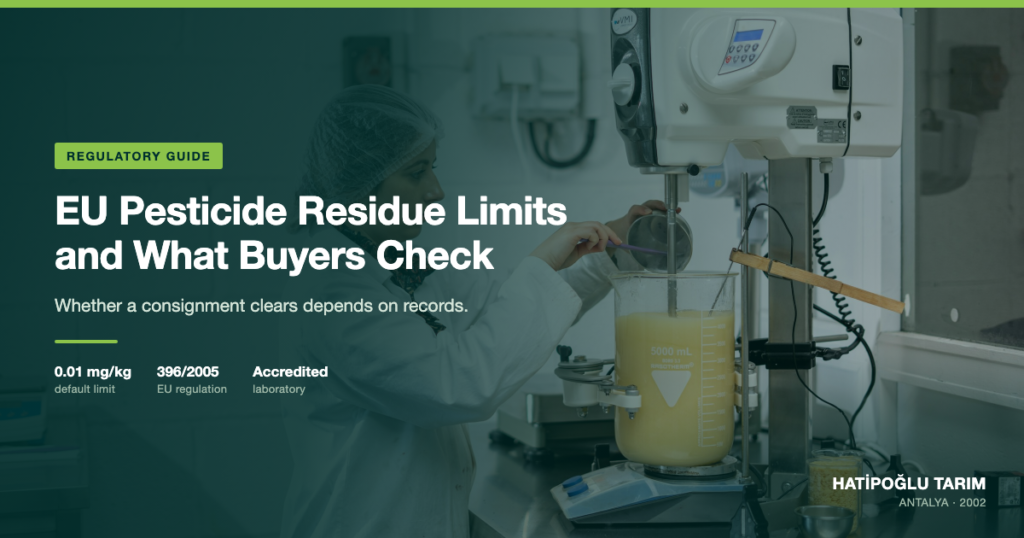
EU pesticide MRLs are the single number that decides whether a consignment of fruit and vegetables clears the border. The fruit can look perfect and the cold chain unbroken; if a residue sits above the limit, the load does not enter. This article publishes no limit values, because they change often and must be read from a current source on the day of shipment. What follows is the mechanism.
What an MRL is and who sets it
A Maximum Residue Level is the highest concentration of a pesticide residue legally permitted in a food, in mg/kg. It is not a toxicity threshold: it describes what remains after label-compliant use, set so that calculated consumer exposure stays well inside the safe range.
In the European Union the framework comes from Regulation (EC) No 396/2005, adopted in 2005 and fully applicable since September 2008. Substance-by-product limits sit in the annexes, are amended in line with EFSA’s opinions, and are read in their current form from the EU Pesticides Database.
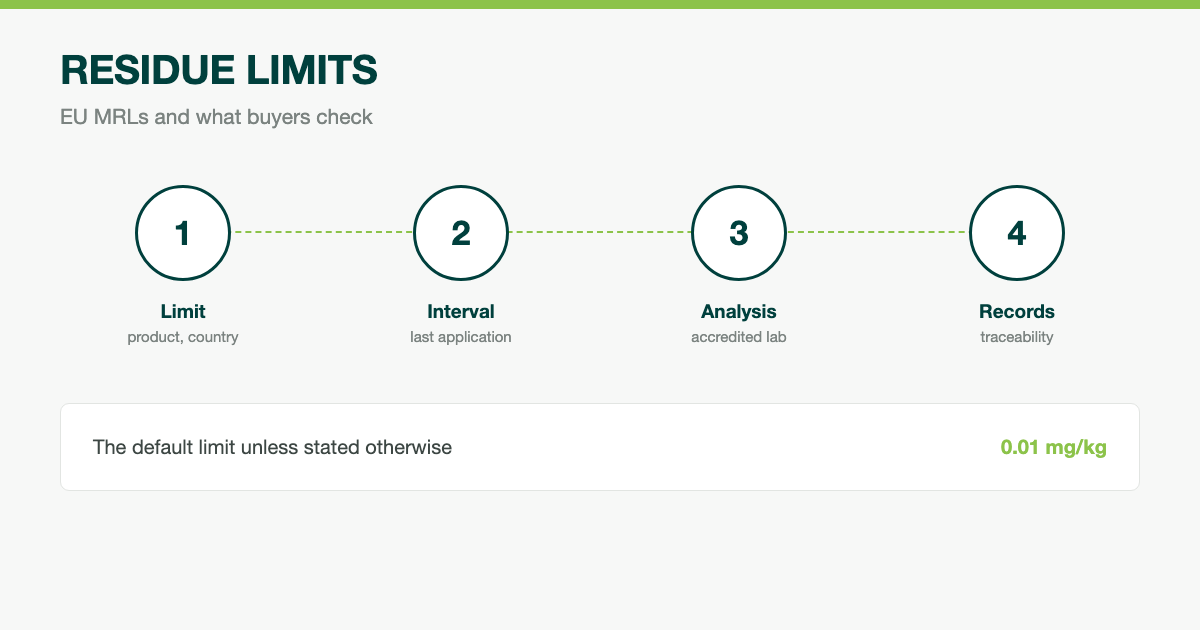
Where no specific limit exists for a substance-product pair, a default of 0.01 mg/kg applies. For most substances that is the limit of determination, which in practice means “must not be detectable”.
Turkey’s counterpart is the Turkish Food Codex Regulation on Maximum Residue Levels of Pesticides, issued by the Ministry of Agriculture and Forestry. It is largely aligned with EU law and applies the same 0.01 mg/kg default.
Same product, different country, different limit
The limit that governs an export is the one in force at the destination. Compliance with Turkish law is not enough; the list applied at the border is the buyer’s.
Three points regularly cause trouble:
- Europe is not one list. The United Kingdom has run its own MRL regime since leaving the EU, and Switzerland maintains a separate one.
- Retailer thresholds. Several large German and British chains accept only a percentage of the legal MRL and cap how many active substances may appear in one lot. This is contractual, stricter than the law, and has to be asked about early.
- Approval status. If an active substance is not approved at the destination, there is no product-specific limit for it and the 0.01 mg/kg default applies.
The right order is: take the order, fix the destination, get its list and any buyer threshold in writing, then build the growing programme around it.
Last spray date and pre-harvest interval
Residues are determined in the orchard, not the laboratory. Every plant protection product carries a pre-harvest interval on its label: the days between last application and picking, calculated so the residue falls below the limit.
Two mistakes recur. The first is pulling harvest forward; when prices rise, the block is picked early and the interval is cut short. The second is spray drift from a neighbouring block, which puts residues on fruit that was never treated.
The defence is record keeping. Keep a spray diary per block: date, product, dose, operator, harvest date. A GLOBALG.A.P. audit asks for it anyway, and the record kept for the audit prevents the export problem.
Laboratory analysis: when, which lot, how many samples
Testing belongs in an accredited laboratory whose scope covers both method and matrix. A report outside that scope can be rejected by the buyer.
Time the test to the harvest, not the shipment. Sample the block before picking and a problem lot is never harvested; sample afterwards and the result arrives while the goods are already moving.
Sampling follows a few rules:
- Draw from several points across the lot and combine them, not from a single spot.
- Define the lot as the report does: one block, one variety, one picking day. Mixing blocks makes it unrepresentative.
- Use a multi-residue screen. A single-substance test will not catch an unexpected finding.
- Match the lot number on the report to the delivery note and the pallet list.
What happens when a limit is exceeded
A consignment over the limit at an EU border is refused entry, then destroyed, returned to origin or redirected outside the EU, with the exporter carrying the cost.
The finding is circulated through RASFF, the Rapid Alert System for Food and Feed, which notifies the competent authorities of all member states at once. The matter never stays between one seller and one buyer.
After repeated notifications, increased border controls can be imposed on that product and origin. Every exporter shipping it from the same country then faces more frequent checks and extra testing on each consignment.
Documents buyers ask for
A professional buyer expects this file before the order is confirmed:
- An accredited laboratory report showing lot number, sampling date, substances screened and limits of determination.
- A traceability record running without a gap from lot number to block to spray diary.
- A GLOBALG.A.P. IFA certificate with the GGN. The number is verified in the database, and the scope must cover that crop and production year.
- A GRASP assessment, covering social practice, increasingly requested by European retail.
- A food safety management certificate, such as ISO 22000.
These documents work together. The report describes one lot; the traceability record shows which orchard it came from. Buyers want both.
About Hatipoğlu Tarım
Hatipoğlu Tarım was founded in Antalya in 2002 and exports fruit and vegetables under the FİNİKE brand, with 128 products shipped to 42 countries. Five facilities — Serik, Kepez, Mavikent (Kumluca), Yenişehir (Bursa) and Alaşehir (Manisa) — cover growing, grading and dispatch. ISO 9001, ISO 22000, ISO 10002, GLOBALG.A.P. IFA and GRASP document the record-keeping behind residue compliance.
Tell us your market and product list, and we will go through the residue requirements with you.
