


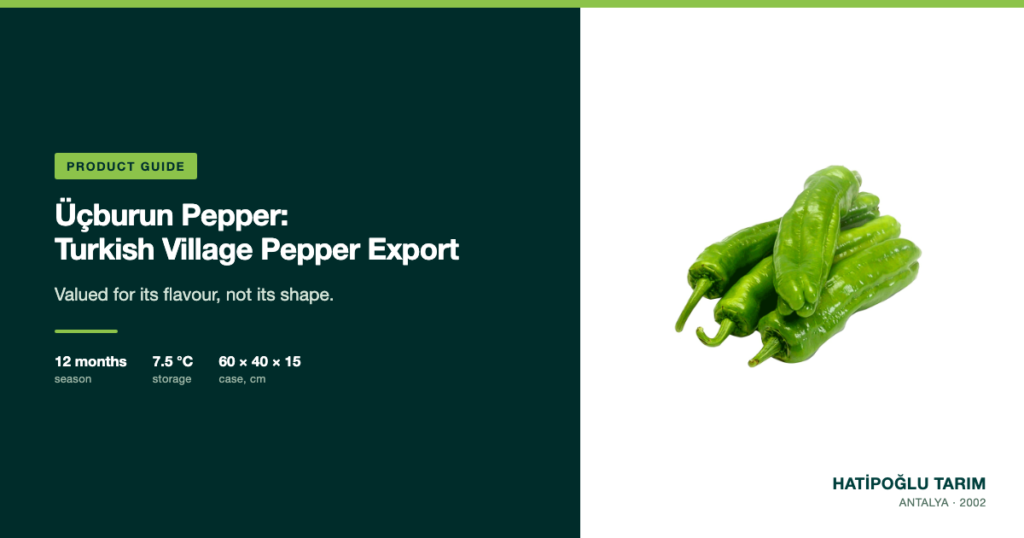
The Üçburun pepper is one of Turkey’s local pepper varieties. Its name, “three noses”, comes from the three-pointed shape of the fruit’s tip. It is a short pepper with thin flesh and a pronounced flavour. In Turkish markets it is usually sold as “village pepper”, a label shoppers associate with traditional, small-scale growing. Unlike greenhouse peppers of standard shape, it owes its value to its taste, not its looks. This guide covers the variety’s characteristics, the way it is grown and the kind of buyer it suits. Hatipoğlu Tarım is a fresh pepper exporter based in Antalya, Turkey, and ships Üçburun pepper all year round; what follows reflects the criteria applied every day in Turkish pepper export.
What distinguishes the Üçburun pepper
- Shape: short, broad-shouldered, with a three-pointed tip. No two fruits are identical; that is the nature of the variety.
- Flesh: thin. Thin flesh cooks quickly and is preferred for frying and stuffing.
- Flavour: pronounced and aromatic. This is why local varieties are sought after.
- Use: frying, stuffing, pickling and eating fresh at breakfast.
Because it is a local variety, differences in shape and size between fruits are greater than in modern hybrids. The buyer needs to see this not as a defect but as the identity of the product.
How it is grown
Hatipoğlu Tarım’s Üçburun pepper is grown on small open-field plots. Because the fruit does not ripen all at once, it is harvested by hand in several passes. This way of growing has two consequences.
First, volume is limited. Üçburun is planned not as a single-product container load but as part of a mixed load. It does not suit a buyer who expects large volumes.
Second, volume varies from week to week. An open-field crop depends on the weather. Working with flexible quantities during the season, rather than a fixed weekly programme, is the realistic approach.
Which buyers it suits
The Üçburun pepper is aimed at markets that look for local flavour and character more than standard shape:
- Grocery shops and greengrocers selling to consumers who know Turkish cooking
- Speciality food shops that stock local and traditional products
- Wholesalers supplying restaurants with Turkish and Mediterranean dishes on the menu
It is not a product for the programmes of large retail chains, which demand uniform size and shape. For those programmes the right variety is the bell pepper or the Charleston.
Selection criteria
Uniformity of shape is not expected of a local variety, but the freshness criteria are the same as for other peppers: bright colour, taut and glossy skin, a green stem, and fruit free of cracks and bruises. The product is selected for freshness, colour, skin integrity and trueness to type. Trueness to type here means that no other pepper type may be mixed into the lot.
Storage and shipping
A thin-fleshed pepper loses water fast. With Üçburun, rapid cooling after harvest and high humidity therefore matter even more than with thick-fleshed varieties. The target is 7.5 °C and a relative humidity above 95%. Green peppers held below 7 °C for long develop chilling injury: pitting of the skin and water-soaked spots.
Since this is a thin-fleshed variety, the right approach is to shorten the time between harvest and sale rather than to try to stretch shelf life. The markets best suited to this Turkish village pepper are those that can be reached by road within a few days. The temperature chain is described in detail in our pepper storage guide.
Packing
Üçburun peppers are packed in 60 × 40 × 15 cm cartons. The fill height inside the carton is kept limited so that the thin-fleshed fruit is not crushed. They can be loaded on the same pallet as other pepper varieties, because all of them require the same temperature.
Üçburun pepper export: from harvest to loading
Exporting Üçburun pepper from Turkey runs in six steps: harvest, same-day cooling, grading, packing, cold storage and dispatch by refrigerated truck. At Hatipoğlu Tarım all of these are handled in house, in the company’s own facilities. When export-grade peppers are allocated, the buyer’s market, sales channel and transit time are considered together, and every lot bound for Europe is also analysed for residues.
As a Turkish pepper exporter we need six details to quote: variety, size or calibre, packaging, weekly volume, delivery week and destination country. With these in hand, we prepare a loading plan and a quotation.
Hatipoğlu Tarım has exported fresh fruit and vegetables from Antalya since 2002. Under the FİNİKE brand it ships 128 product lines to 42 countries, with harvest, grading, cold storage and dispatch handled in house across five facilities in Serik, Kepez, Mavikent, Yenişehir and Alaşehir.
Ask us about the Üçburun pepper volumes available during the season and the options for mixed loading, and we will send back the current position and a price.
