


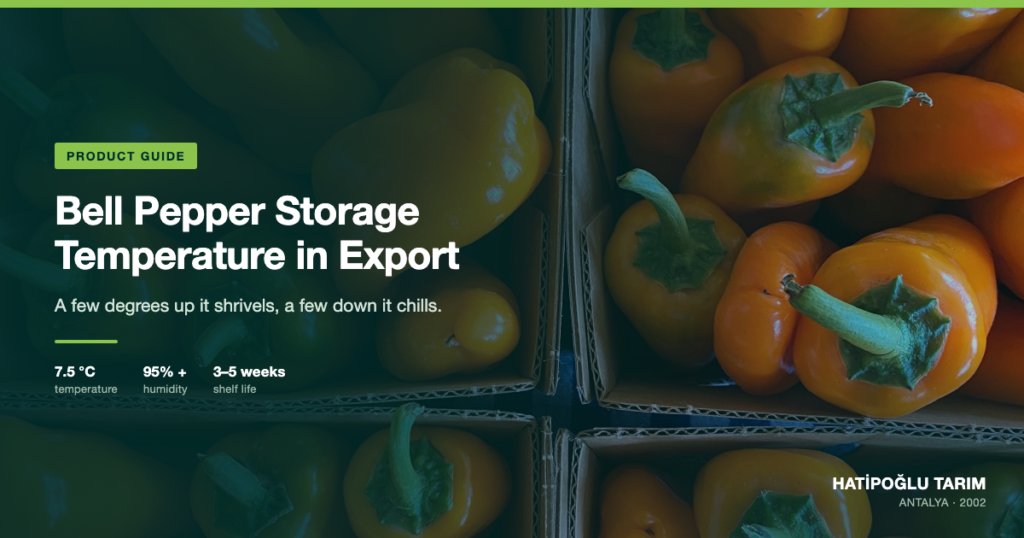
What is the right bell pepper storage temperature? The short answer: the longest shelf life is achieved at 7.5 °C, and the recommended range is 7–8 °C. The best setting can vary with variety, maturity and transit time. The long answer is that peppers are sensitive to both heat and cold, and their safe range is narrow. A few degrees higher and they shrivel; a few degrees lower and they are chilled. Most of the mistakes made in a wholesaler’s store or an importer’s vehicle come from not knowing how narrow that range is. This guide sets out the right conditions, chilling injury and the most common mistakes. Hatipoğlu Tarım is a fresh pepper exporter based in Antalya, Turkey, and ships peppers all year round; what follows reflects the criteria applied every day in Turkish pepper export.
What is the right pepper storage temperature?
- Temperature: the longest shelf life is achieved at 7.5 °C.
- Relative humidity: must be above 95%.
- Shelf life: 3–5 weeks under these conditions.
Peppers should be cooled as quickly as possible after harvest. Every hour spent in the sun, in the field or on the loading dock, means water loss, and the firmness of a pepper depends directly on water loss. A soft pepper is not a rotten pepper but a dehydrated one; it still cannot be sold.
Why do peppers shrivel? When the temperature rises
Peppers held above 7.5 °C lose water faster and shrivel. In thin-fleshed varieties such as Sivri, Kıl Sivri, Charleston and Üçburun, the process is much quicker. In hot peppers, high temperature also speeds up colour change and decay.
Why do peppers break down in the cold? Chilling injury
Peppers can be held at 5 °C for about two weeks; this temperature reduces water loss. Over a longer period, however, chilling injury sets in. The symptoms are:
- pitting of the skin and water-soaked spots,
- darkening of the seed cavity and the seeds,
- softening without water loss,
- black Alternaria rot, particularly at the stem end.
The insidious side of pepper chilling injury is that the symptoms appear not in the cold but when the pepper warms up to shelf temperature. A lot that leaves the store sound breaks down in the shop two days later. A buyer who sees black rot at the stem end should conclude that the product was held too cold in transit or in store.
Do green and red peppers need the same temperature?
Fully ripe, coloured peppers tolerate chilling better than green peppers. Hot peppers are also slightly more tolerant than bell peppers. The most sensitive group is green bell peppers and pale, thin-fleshed peppers. On a mixed pepper pallet the temperature must be set for the most sensitive variety.
Transport temperature in pepper export and mixed loads
Peppers respond very little to ethylene, so sharing a vehicle with tomatoes or bananas does not ripen them. The real problem is temperature. Peppers placed in the same vehicle as products carried at 0 °C, such as apples, grapes or cherries, are chilled. The right travelling companions for peppers are products that need a similar temperature: aubergines, cucumbers, courgettes, green beans and tomatoes.
Does controlled atmosphere help?
Peppers do not respond well to controlled atmosphere. Low oxygen has little effect on quality, while carbon dioxide above 5% causes pitting of the skin, discolouration and softening, particularly below 10 °C. What extends bell pepper shelf life is not a gas mixture but the right temperature and high humidity.
Completing the colour
If peppers picked partly coloured are to complete their colour, the method is not cooling but the opposite: 20–25 °C and humidity above 95% speed up the colour change. For this the fruit must be at least 50% coloured. Applying ethylene brings no clear benefit in peppers.
The five most common mistakes in the store
- Putting peppers in a fruit room at 0–2 °C.
- Delaying cooling after harvest.
- Keeping humidity low; in dry air peppers turn dull within a few days.
- Overfilling the cartons; the fruit at the bottom is bruised and decay starts at the bruise.
- Neglecting water hygiene where peppers are washed; dirty water spreads bacterial soft rot.
Pepper export and cold chain at Hatipoğlu Tarım
At Hatipoğlu Tarım, peppers are harvested with a short stem and cooled the same day; for thin-fleshed Charleston, that means within the first two hours after cutting. The whole chain is described in our cold chain article, and pallet and container patterns in our article on loading a reefer container.
The temperature, humidity and shelf-life figures in this article are based on the bell pepper and chile pepper fact sheets of the UC Davis Postharvest Research and Extension Center.
Fresh pepper export: from harvest to loading
Exporting peppers from Turkey runs in six steps: harvest, same-day cooling, grading, packing, cold storage and dispatch by refrigerated truck. At Hatipoğlu Tarım all of these are handled in house, in the company’s own facilities. When export-grade peppers are allocated, the buyer’s market, sales channel and transit time are considered together, and every lot bound for Europe is also analysed for residues.
As a Turkish pepper exporter we need six details to quote: variety, size or calibre, packaging, weekly volume, delivery week and destination country. With these in hand, we prepare a loading plan and a quotation.
Hatipoğlu Tarım has exported fresh fruit and vegetables from Antalya since 2002. Under the FİNİKE brand it ships 128 product lines to 42 countries, with harvest, grading, cold storage and dispatch handled in house across five facilities in Serik, Kepez, Mavikent, Yenişehir and Alaşehir.
Write to us about the temperature and mixed-load plan for your pepper shipment, and together we will work out the right setting for your product list.
