


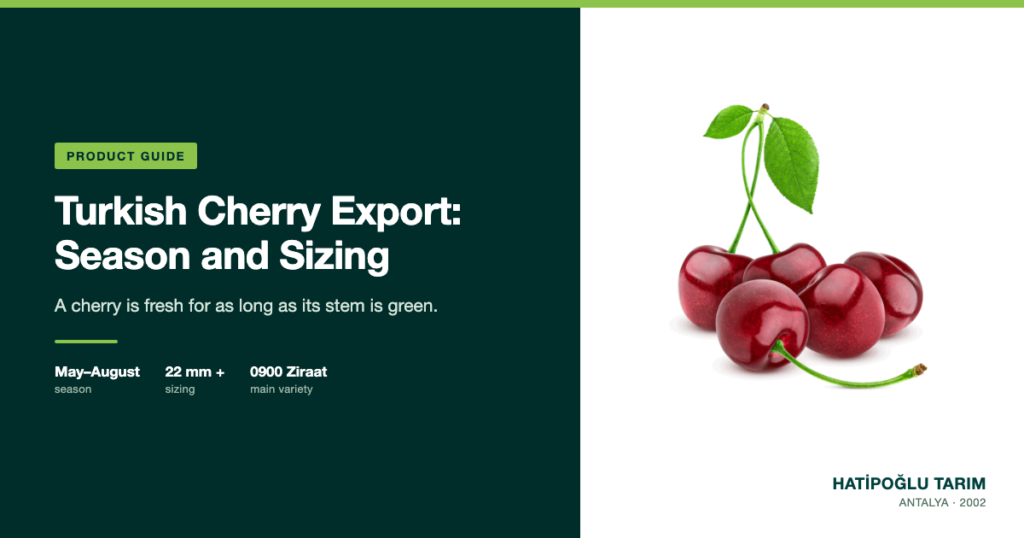
Cherry export is a business limited by how long the stem stays green. Turkey is the world’s largest cherry producer, yet the first thing a buyer looks at on opening a box is not a production figure but the colour of the stem and the firmness of the fruit. Both are decided in the first hours after picking. This guide takes importers through variety, season, sizing, cooling and packaging.
The export variety: 0900 Ziraat
Turkey’s export cherry is 0900 Ziraat, known in European markets simply as the “Turkish cherry”. The fruit is large and heart-shaped, with firm flesh and a glossy dark red colour. That firmness is what allows it to pass over a sizing line and still withstand a long journey. Most export programmes are built on this variety.
In Hatipoğlu Tarım’s cherry programme, fruit is selected for size, colour, firmness, stem freshness and surface integrity.
Turkish cherry season: May to August
Any single orchard is picked for only a few weeks. What extends the season is altitude. Early orchards in low, warm districts open in May. June is the main harvest month. In July and early August picking moves up to the high plateau orchards. Sourcing across altitudes keeps the same variety loading without a break for about three months.
For a buyer, June offers the widest choice of sizes. Late in the season there is less competing fruit on the market, which gives high-altitude cherries a value of their own.
Sizing: from 22 mm upwards
Cherries are sized by diameter. Grading starts at 22 mm and continues through 24, 26 and 28 mm and above. Retail chains generally ask for 26 mm and larger; size drives both the price and the look on the shelf. Sizing follows the calibre ordered, and the spread within a box is kept tight.
Harvest and hydrocooling on the same day
Cherries are picked in the cool of the morning, with the stem attached. Skin colour and soluble solids are the measures of harvest maturity. The fruit reaches the packhouse the same day and is hydrocooled. Cold water brings the pulp temperature down far faster than air can. This step keeps the stem green and slows decay from the outset.
Sorting, sizing and packing follow cooling. The two most common defects in cherries are pitting and bruising, and both are caused by impact: when a cherry hits a surface, the cells beneath the skin collapse and the mark appears days later. Drop heights along the line are therefore kept low.
Storage: 0 °C at 90–95% humidity
The optimum storage temperature for cherries is −0.5 °C (± 0.5 °C) at 90–95% relative humidity. High humidity matters most for the stem, which turns brown within days in dry air.
For distant markets, modified atmosphere bags are used inside the box. Successful atmospheres fall within 3–10% oxygen and 10–15% carbon dioxide; elevated carbon dioxide suppresses decay. Rhizopus rot develops at 5 °C and above, so correct temperature alone stops it. Grey mould, by contrast, keeps growing slowly even at 0 °C, which is why injured fruit must never go into the box. The full temperature chain is described in our article on the cold chain in fresh produce export.
Packaging
Cherries are packed in 40 × 60 × 10 cm cartons. The shallow box prevents the fruit from being crushed under its own weight. Loose fill or consumer packs inside the carton are prepared to the buyer’s specification.
A buyer’s checklist on arrival
Check the following on arrival: are the stems green and turgid, is the fruit firm, is the colour uniform within the box, are there cracks or bird pecks, is any pitting visible? On flavour, the deciding factor is the balance between sugar and acidity.
Every lot bound for Europe is analysed for residues; our article on EU pesticide MRLs explains how the limits work.
Cherry export: from harvest to loading
Exporting cherries from Turkey runs in six steps: harvest, cooling, grading, packing, cold storage and dispatch under cold chain. As a Turkish cherry exporter and supplier, Hatipoğlu Tarım handles all of them in house, in its own facilities. When export-grade fruit is allocated, the buyer’s market, sales channel and transit time are considered together, and every lot bound for Europe is also analysed for residues.
To quote for a cherry export programme we need six details: variety, calibre, packaging, weekly volume, delivery week and destination country. With these in hand, we prepare a loading plan and a quotation.
Hatipoğlu Tarım has exported fresh fruit and vegetables from Antalya since 2002. Under the FİNİKE brand it ships 128 product lines to 42 countries, with harvest, grading, cold storage and dispatch handled in house across five facilities in Serik, Kepez, Mavikent, Yenişehir and Alaşehir.
Tell us the calibre, packaging and delivery week you need, and we will send back a season plan and a price.
