


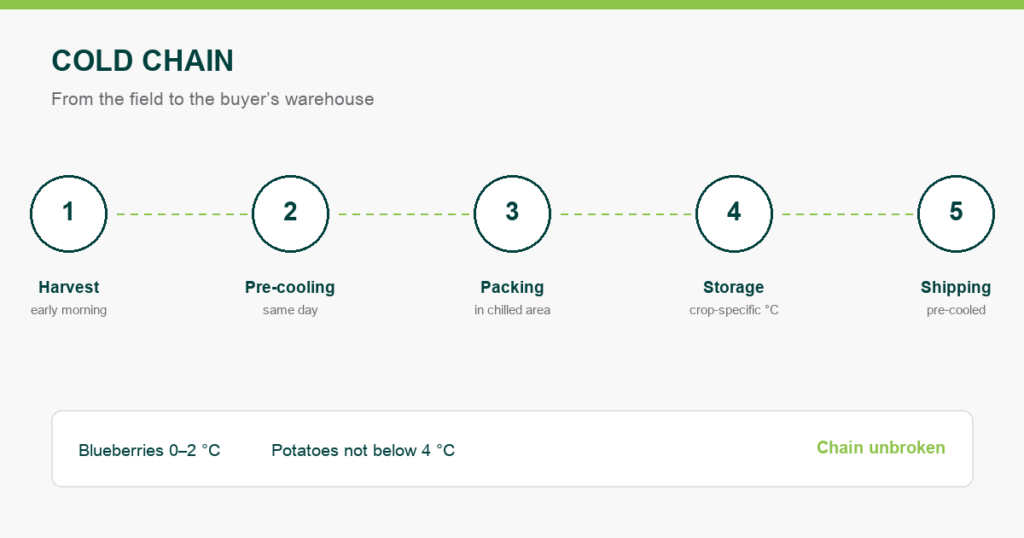
In Antalya’s fresh produce exports, quality is not decided in the field alone. What happens to the temperature between picking and the buyer’s warehouse determines how many days the produce will hold on the shelf. The cold chain is the discipline that covers that whole stretch.
The cold chain begins in the field
Once picked, produce keeps respiring. That respiration generates heat, and as the heat builds the produce loses water, softens and loses shelf life. Cooling therefore has to start while the crop is still in the field, not when it reaches the store.
In practice this means cooling on the day of harvest. Picking starts early, the crop is moved into shade before the midday heat and goes straight into pre-cooling. With delicate produce such as blueberries, that window narrows to about an hour.
Every crop has its own temperature
Colder is not automatically better. Each crop holds its texture within a particular range, and dropping below that range does as much harm as rising above it.
Blueberries are held at 0–2 °C. Potatoes work the other way round: the temperature must not fall below 4 °C, because colder storage turns starch into sugar and the crop darkens when fried. Bananas, avocados and aubergines are sensitive to chilling injury — stored too cold, the skin pits and the colour fades.
Where the chain breaks
The cold chain rarely fails in the store room. It fails in the transitions, and three points account for most of it:
- The loading dock. Without an enclosed dock, produce leaving cold storage meets the outside air. In summer that gap can reach 25 °C.
- Palletising time. The longer cases sit while a pallet is built, the more they warm. Preparing inside the chilled area removes the risk.
- Container pre-cooling. If the container is not cooled before loading, the produce itself has to cool it during the first hours of the journey.
Airflow and stacking
Cold air can only reach the produce if the ventilation channels stay clear. Stack the cases flush against one another and the air from the unit simply travels around the pallet, leaving the cases in the middle above target temperature.
Packaging is therefore part of the cold chain. In carton cases the vent holes do this work; in plastic crates the open sides do it.
The cold chain at Hatipoğlu Tarım
Our five packing and cold storage facilities sit in different growing regions of Türkiye, which lets us cool produce in the region where it was picked. Serik, Kepez and Mavikent cover Antalya production; Yenişehir and Alaşehir serve the Bursa and Manisa regions.
Produce is cooled on the day it is picked, and the right conditions are held through packing, storage and shipment. You can browse our product list or get in touch to discuss shipping conditions.
