


In Antalya’s fresh produce export, packaging is not simply a box that carries the produce. The dimensions of the case decide how many units fit on a pallet, the vent holes decide whether cold air ever reaches the fruit, and the material decides whether the load arrives crushed or intact. More often than not, the packaging is also the first thing the buyer sees.
What determines case sizes
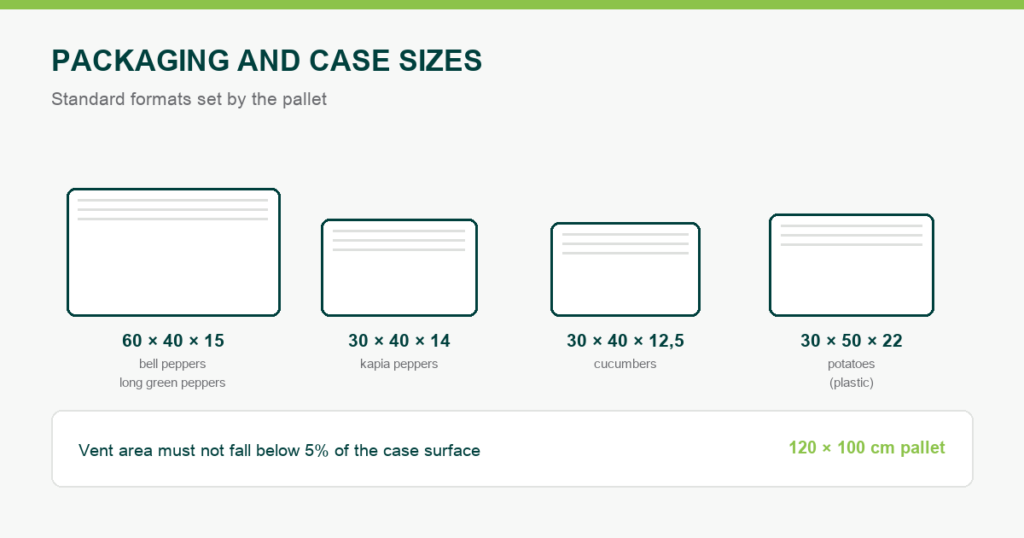
Case sizes in fresh produce export are not arbitrary. They follow the pallet footprints common across Europe — 120 × 100 cm and 120 × 80 cm. A case that does not sit squarely on the pallet leaves gaps, and a pallet with gaps shifts in transit, which is where damage begins.
These are the sizes we use most:
- 60 × 40 × 15 cm — for bulkier vegetables such as bell peppers, long green peppers and aubergines.
- 30 × 40 × 14 cm — for more delicate produce laid in a single layer, such as kapia peppers.
- 30 × 40 × 12.5 cm — for thin-skinned crops with a short shelf life, such as cucumbers and pickling cucumbers.
- 30 × 50 × 22 cm — for heavy, robust produce such as potatoes, usually in plastic crates.
Carton or plastic
Cartons are light, single-use and take print well, which gives the brand visibility on the shelf. What they do not tolerate is prolonged humidity, so they are avoided where produce will sit for long periods in a damp environment.
Plastic crates carry weight, survive repeated use and are indifferent to moisture. In return they cost something to send back empty and they take up storage space. Potatoes travel in plastic for exactly these reasons: the weight of the crop and the need to stack crates several high.
Vent holes
The holes in a case are not decoration. Air from the cooling unit passes through them to reach the produce. Once their combined area drops below five per cent of the case surface, the cases in the middle of the pallet never come down to target temperature.
They also have to line up. When cases are stacked so that their vents sit directly above one another, air can travel vertically through the whole pallet instead of circling around it.
How the case is filled
How many units go into a case depends on the buyer’s sales channel. Retail chains generally specify a count and a size grade, and expect the produce laid in a single layer facing the same way. Wholesale markets work by weight and tolerate a wider size range.
That difference is planned at the packing stage. When the same crop ships to two buyers on the same day, each pallet is packed to its own specification.
Packaging and cold chain work together
The right case supports the cold chain; the wrong one will defeat even the best cooling system. This is why a packaging decision cannot be made without knowing the destination market, the season and the length of the journey.
We publish the case format for every crop on its product page. Have a look at our range, or get in touch about packaging suited to your market.
