


What separates one Turkish pomegranate exporter from another is not the fruit but the discipline after harvest. A pomegranate does not ripen once it leaves the tree: whatever quality it has on picking day is the quality that arrives. This guide covers varieties, season, storage, grading, packing and documentation for importers buying pomegranates from Turkey.
Hicaznar and the other varieties
Hicaznar is registered by the Western Mediterranean Agricultural Research Institute in Antalya and is the variety that carries Turkish pomegranate exports. The fruit is large, the skin red, the arils deep red. The taste sits on the sweet-tart side, with a sugar-acid balance that works for both table consumption and juicing. A firm rind makes it suitable for long-haul freight and cold storage, and Hicaznar export volume rests largely on those two properties.
Wonderful is known for intense red colour and sweetness, and is bought for fresh sale as well as for juice.
Katırbaşı is smaller and rounder and goes mostly into fresh consumption.
Silifke Aşısı is a regional variety on the tart side of the scale.
Fellahyemez is among the other registered varieties grown in Turkey.
Buyers usually decide on three criteria: depth of aril colour, acidity and rind strength.
The harvest calendar
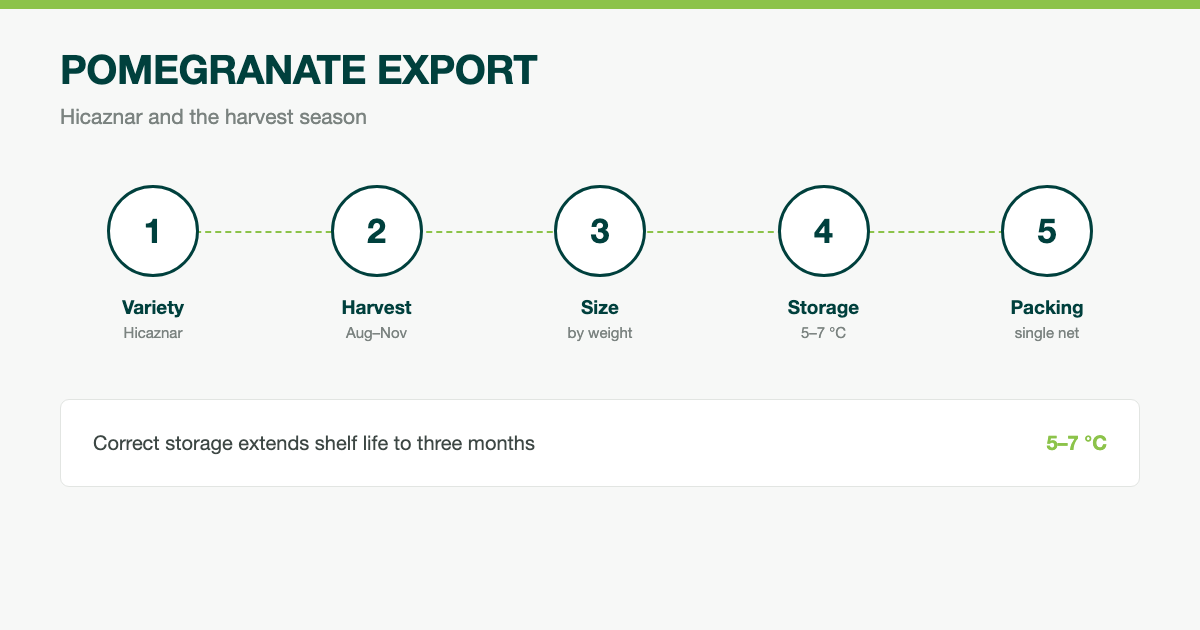
The Turkish pomegranate harvest opens with early varieties at the end of August. Hicaznar, the main export variety, is picked from October to mid-December in two or three passes through the same orchard, and shipments from cold storage continue until the end of March:
- Late August to September — early varieties. Fruit is smaller than later in the season and colour is lighter.
- October — the main Hicaznar harvest begins. Calibre and colour arrive together, and this is where the export programme is built.
- November to mid-December — the final passes. Fruit reaches its largest calibres, and these lots go mainly into storage and winter shipments.
- January to March — shipments continue from cold storage.
Fruit does not grow after picking, so the calibre plan is fixed on harvest day. A buyer who needs large sizes is scheduled into the later passes.
Storage: temperature, humidity and shelf life
Pomegranates hold best at 5–7 °C with 90–95% relative humidity. Under those conditions the fruit keeps safely for two to three months. Controlled atmosphere at 7 °C (5% O₂ + 15% CO₂) extends that to about five months.
Humidity is easy to underestimate. Below 90% the rind loses water and shrivels, so polyethylene liners go into the cartons.
Pushing the temperature lower causes chilling injury rather than longer life. Damage develops when fruit is held between its freezing point and 5 °C for more than a month, or at 5 °C for more than two months. Symptoms are pitting and browning of the skin, pale arils and dark membranes. None of it shows in the cold room; it shows on the buyer’s shelf.
Cracking and sunburn: what grading removes
Two defects are graded out of every export lot.
Rind cracking happens when internal pressure exceeds the elasticity of the skin, most often after irregular irrigation or a delayed harvest. A crack is an open door for decay, so cracked fruit never enters an export lot.
Sunburn leaves a pale, hardened patch on the sun-facing side. Even where the arils underneath are sound, it counts as a visual defect and comes out of table-grade fruit.
Grading runs in two stages: a rough sort in the orchard, then piece-by-piece inspection on a lit belt in the packhouse.
Packing: crate sizes, foam nets, calibre classes
The standard carton measures 30 × 40 × 12.5 cm. Pallets are 80 × 120 cm euro pallets, and the 30 × 40 cm footprint fits exactly — 8 cartons per layer, no wasted surface. The second option is a 30 × 50 × 22 cm plastic crate.
Each fruit is sleeved in a foam net, which keeps fruit from touching in transit and prevents rub marks on the skin. Crates are packed in one or two layers, with a card divider between them.
Calibre is classified by fruit weight and expressed as the count per crate. The line is set to whatever count the buyer specifies, and weight spread within a single crate is kept narrow.
Target markets and how demand differs
Russia and the CIS markets lead with large calibres and deep aril colour, and work on volume.
Germany and Western European retail put uniform calibre, tidy packing and a complete document file first. MRL compliance is enforced most strictly here.
Gulf markets are sensitive to appearance and skin gloss, with more demand for gift and single-presentation packaging than elsewhere.
Fruit from one orchard reaches these markets under three different specifications, so calibres are allocated before harvest, not after.
Documentation and traceability
GLOBALG.A.P. IFA and the GRASP social assessment apply in the field. In the packhouse, ISO 22000, ISO 9001 and ISO 10002 govern food safety, quality and complaint handling.
Every lot is analysed for pesticide residues and checked against the destination market’s MRL list. A phytosanitary certificate is issued for the border crossing, with certificate of origin, invoice and packing list completing the file.
Traceability runs on the lot number: the crate label carries the harvest parcel and both harvest and packing dates, so any claim traces back to the orchard.
Pomegranate export: from harvest to loading
Exporting pomegranates from Turkey runs in six steps: harvest, cooling, grading, packing, cold storage and dispatch under cold chain. As a Turkish pomegranate exporter and supplier, Hatipoğlu Tarım handles all of them in house, in its own facilities. When export-grade fruit is allocated, the buyer’s market, sales channel and transit time are considered together, and every lot bound for Europe is also analysed for residues.
To quote for a pomegranate export programme we need six details: variety, calibre, packaging, weekly volume, delivery week and destination country. With these in hand, we prepare a loading plan and a quotation.
Hatipoğlu Tarım has exported fresh fruit and vegetables from Antalya since 2002. Under the FİNİKE brand it ships 128 product lines to 42 countries, with harvest, grading, cold storage and dispatch handled in house across five facilities in Serik, Kepez, Mavikent, Yenişehir and Alaşehir.
Tell us the variety, calibre and delivery month you need, and we will send back a season plan and a price.
