


What makes a Turkish tomato exporter worth a buyer’s time is not the climate but the continuity that protected cultivation makes possible. Once a programme is agreed, the buyer expects the same calibre and the same grade in November as in March. This guide sets out varieties, harvest maturity, packing, temperature and ordering for importers and retail supply managers sourcing tomatoes from Antalya.
Varieties and the markets that ask for them
Vine (truss) tomatoes are harvested on the stem, usually five to six fruit per truss. A green, unwilted stem signals freshness on the shelf, which is why European retailers buy heavily into this type. In vine tomato export the decisive quality measure is even fruit size along the whole truss.
Cherry tomatoes run 15–25 g and ship loose or on the vine. They go straight to the shelf in 250 g and 500 g punnets. Skin firmness and sugar content decide whether a cherry tomato supply programme holds up.
Beef tomatoes are large, fleshy and low in seed. They hold their shape when sliced, so catering and sandwich production take most of the volume.
Pink tomatoes have thin skin and pronounced aroma. That thin skin is also the risk: they suit shorter routes and careful packing.
Round field tomatoes are firm, uniform in calibre and the standard type on wholesale markets.
Why protected cultivation means year-round supply
Greenhouse production in Antalya covers exactly the months when open-field volume disappears. Planting on the Serik and Kumluca lines is scheduled so that harvest spreads evenly across the season instead of peaking in a few weeks. For a greenhouse tomato supplier in Turkey working year round, that translates into something practical: the buyer runs a fixed weekly truck and is shielded from both price spikes and supply gaps.
Control is the second argument. Temperature, irrigation and feeding are measured under glass and plastic, which makes calibre distribution and residue management predictable rather than hopeful.
Harvest maturity and shipping distance
Tomatoes continue to ripen after picking, so maturity is chosen against the length of the journey:
- Mature green for the longest routes. Fruit has reached full size, colour has not started to turn.
- Turning to pink for medium-distance road freight.
- Red ripe for short routes and fast shelf rotation.
A wrong maturity call cannot be corrected downstream. Fruit picked green on a short route arrives dull; fruit picked red on a long route arrives soft.
Packing: crate size, weights and pallet layout
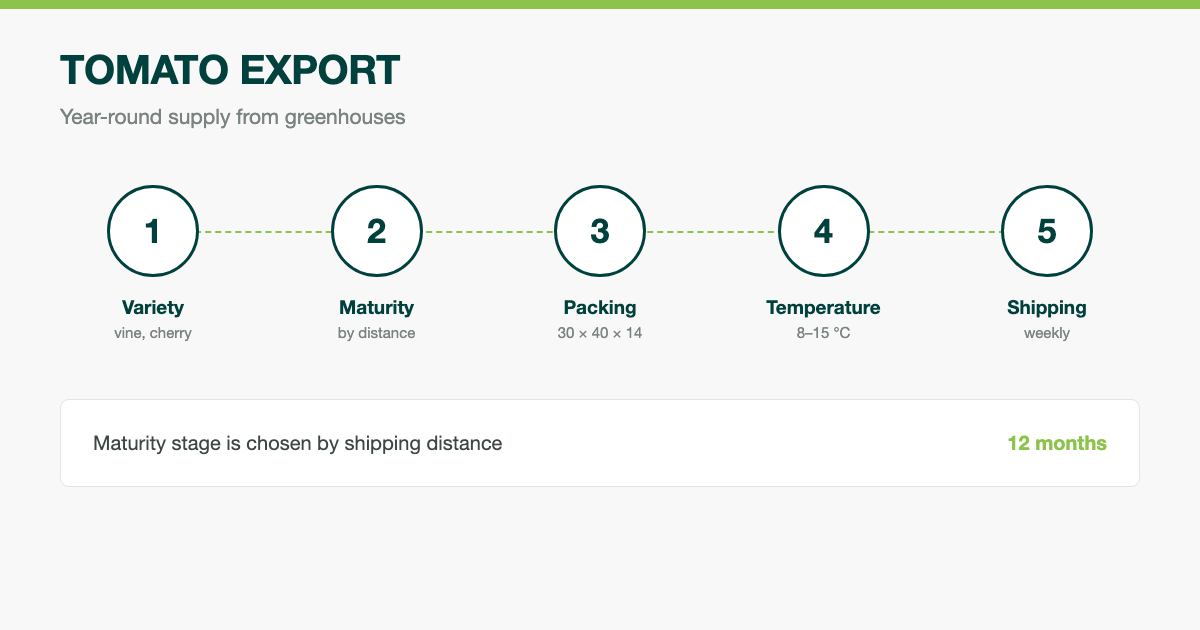
The standard crate measures 30 × 40 × 14 cm and is commonly filled to 5–6 kg net for fresh produce; the exact net weight follows the buyer’s shelf format.
Pallets are 80 × 120 cm euro pallets. A 30 × 40 cm footprint fits the pallet surface exactly: 8 crates per layer with no wasted space. Layer count depends on trailer height and how much load the fruit tolerates; ten layers give 140 cm of crate height.
Cherry and vine tomatoes usually travel in carton, round and beef types in returnable plastic crates. Vine tomatoes are packed in a single layer per crate as a rule.
Shipping temperature and shelf life
Tomatoes are chilling sensitive. They are not carried at 0–2 °C: that range causes chilling injury and the fruit never colours properly afterwards.
The correct range follows maturity:
- Mature green: 12–15 °C
- Turning to pink: 10–12 °C
- Red ripe: 8–10 °C
Relative humidity is held near 90%. Loads kept below 10 °C for extended periods show surface pitting, blotchy colour, premature softening and higher decay. Above 27 °C, red colour loses intensity.
Shelf life runs 1–2 weeks for mature green and turning fruit and about one week for red ripe. Tomatoes produce ethylene, so they are not stored in the same chamber as ethylene-sensitive produce.
Certification: GLOBALG.A.P., residue testing, phytosanitary certificate
On the growing side, GLOBALG.A.P. IFA and the GRASP social assessment apply. In the packhouse, ISO 22000 governs food safety management, ISO 9001 quality management and ISO 10002 complaint handling.
Every lot is tested for pesticide residues and assessed against the MRL list of the destination market. A phytosanitary certificate is issued for the border crossing, with certificate of origin, invoice and packing list completing the shipping file.
Traceability runs on the lot number: the crate label identifies the harvested parcel and the packing date.
Ordering: samples, pricing, minimum load
1. Enquiry — variety, calibre, packing type, net weight, weekly volume and delivery terms. 2. Samples and photographs — product images, and samples where required, before the first load. 3. Pricing — quoted FOB, CFR or DAP, valid on a weekly basis. 4. Programme — a fixed weekly loading calendar. 5. Minimum load — planned by full truck. A 13.60 m reefer trailer takes 33 euro pallets. 6. Loading check — pulp temperature is measured after pre-cooling and recorded.
Tomato export: from harvest to loading
Exporting tomatoes from Turkey runs in six steps: harvest, cooling, grading, packing, cold storage and dispatch under cold chain. As a Turkish tomato exporter and supplier, Hatipoğlu Tarım handles all of them in house, in its own facilities. When export-grade produce is allocated, the buyer’s market, sales channel and transit time are considered together, and every lot bound for Europe is also analysed for residues.
To quote for a tomato export programme we need six details: variety, calibre, packaging, weekly volume, delivery week and destination country. With these in hand, we prepare a loading plan and a quotation.
Hatipoğlu Tarım has exported fresh fruit and vegetables from Antalya since 2002. Under the FİNİKE brand it ships 128 product lines to 42 countries, running harvest, grading and cold chain in house across five facilities in Serik, Kepez, Mavikent, Yenişehir and Alaşehir.
Send us the variety, calibre and weekly volume you need, and we will come back with a price and a loading calendar.
