


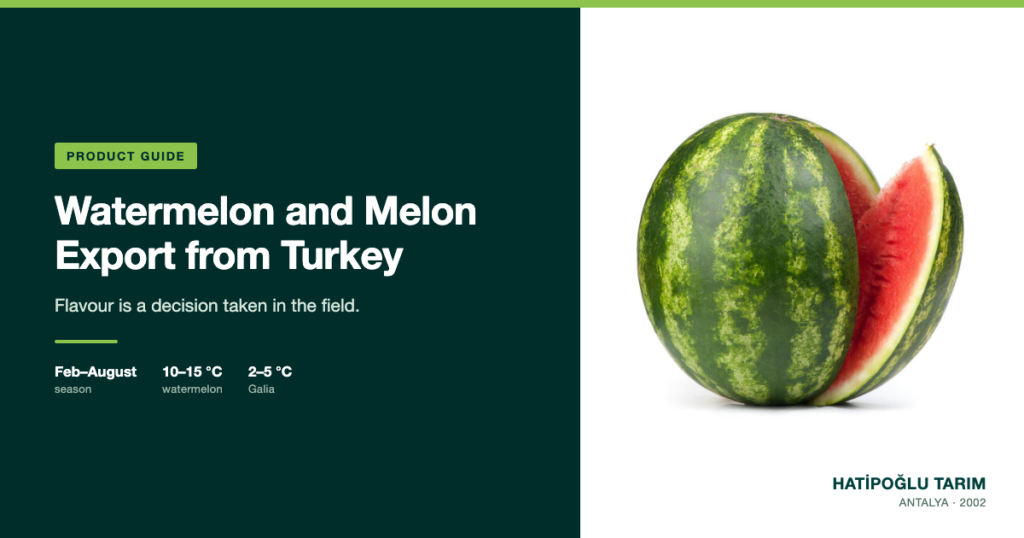
In watermelon and melon export, quality is fixed the moment the fruit is cut from the vine. A watermelon gains neither sugar nor colour after harvest; a melon softens but does not get sweeter. The flavour on the buyer’s shelf is a decision taken in the field on harvest day. This guide takes importers through season, maturity, varieties, transit temperature and loading.
Season: February to August
Hatipoğlu Tarım sources watermelon from the Antalya plain and from growing districts in Diyarbakır. The season opens in February with protected cultivation and runs until August on open-field harvests. Melons follow the same calendar: greenhouse fruit opens the season and open-field fruit carries the summer.
The early window is when little competing fruit is on the European market, and Antalya’s protected cultivation gives buyers an advantage then. Volumes grow in summer, and having two separate growing regions helps keep supply steady.
How watermelon maturity is judged
Watermelons are harvested fully mature. Three signs are checked in the field. The ground spot, where the fruit rests on the soil, turns from pale white to creamy yellow. The tendril next to the stem begins to wilt. Samples from each lot are then cut open: soluble solids near the centre should be at least 10%, and the flesh should be firm, crisp and well coloured.
On the outside, the fruit should be symmetrical, with a bright, waxy rind free of scars, sunburn and transit abrasion. A good watermelon feels heavy for its size.
Galia and Kırkağaç: two melons, two temperatures
Galia is a netted melon with an intense aroma. Raised, well-defined netting is one of the signs of maturity. It is the type European retail knows best.
Kırkağaç is the traditional Turkish melon, yellow-skinned with dark green flecks. Its rind is tough and it travels better than Galia. It is in particular demand in European markets with large Turkish communities.
Both melons are cut close to the stem and packed in a single layer in 30 × 50 × 22 cm wooden crates. Single-layer packing protects the fruit underneath from bruising.
Transit temperature and chilling injury
These three products need different temperatures, and the most common loading mistake is to set one temperature for all of them.
- Watermelon: the optimum is 10–15 °C at 85–90% relative humidity. Storage life is around 14 days at 15 °C and up to 21 days at 7–10 °C. Held below 7 °C for several days, watermelon suffers chilling injury: pitting of the rind, fading flesh colour and loss of flavour. The symptoms do not show in the cold but after the fruit returns to shelf temperature.
- Galia melon: 2.2–5 °C at 90–95% relative humidity, which typically gives 12–15 days of shelf life. Temperatures below 2 °C cause chilling injury.
- Kırkağaç melon: a winter-melon type that travels warmer; the range recommended for this type is 7–10 °C.
Watermelon is sensitive to ethylene. Exposure to as little as 5 ppm for a week causes an unacceptable loss of firmness and eating quality. Watermelons are therefore never loaded together with ethylene producers such as tomatoes, bananas or ripe melons.
Loading: the real losses come from impact
Most postharvest loss in watermelon comes not from disease but from bruising and cracking. Internal bruising cannot be seen from outside; the flesh breaks down early and turns mealy. The fruit is therefore passed from hand to hand rather than thrown, and stacking height is limited. Pallet and container layout is covered in our article on loading a reefer container and pallet patterns.
Watermelon calibre is expressed as a weight class. The weight range the buyer wants is agreed when the programme is set up.
Watermelon and melon export: from harvest to loading
Exporting watermelons and melons from Turkey runs in six steps: harvest, cooling, grading, packing, cold storage and dispatch under cold chain. As a Turkish watermelon and melon exporter and supplier, Hatipoğlu Tarım handles all of them in house, in its own facilities. When export-grade fruit is allocated, the buyer’s market, sales channel and transit time are considered together, and every lot bound for Europe is also analysed for residues.
To quote for a watermelon and melon export programme we need six details: variety, calibre, packaging, weekly volume, delivery week and destination country. With these in hand, we prepare a loading plan and a quotation.
Hatipoğlu Tarım has exported fresh fruit and vegetables from Antalya since 2002. Under the FİNİKE brand it ships 128 product lines to 42 countries, with harvest, grading, cold storage and dispatch handled in house across five facilities in Serik, Kepez, Mavikent, Yenişehir and Alaşehir.
Tell us the weight class, packaging and delivery week you need, and we will send back a season plan and a price.
