


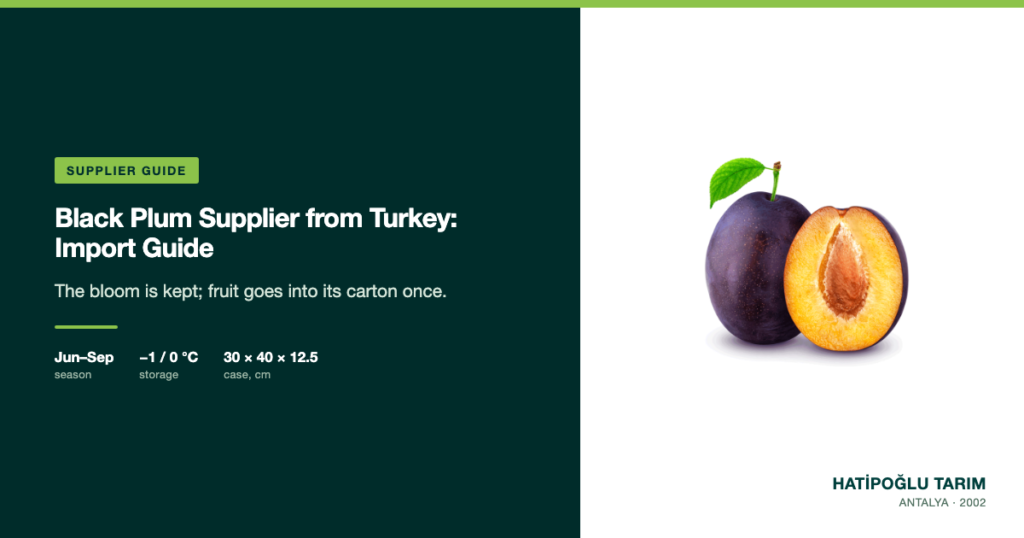
A black plum supplier is judged on two things the buyer sees the moment the carton is opened: whether the natural bloom is still on the skin, and whether the fruit is still firm. Both are decided early, in how the fruit is picked, cooled and packed. Hatipoğlu Tarım is a fresh produce exporter based in Antalya, in business since 2002, and it prepares black plums for export through the summer. This guide is for importers, wholesalers and retail buyers who want to import black plums from Turkey: season, quality criteria, storage temperature, packaging, HS code, documents and quotation.
What the Turkish black plum is and why buyers ask for it
The black plum is a summer stone fruit with dark skin, firm flesh and a natural waxy bloom, the pale film that sits on the surface of an untouched plum. An intact bloom suggests that the fruit has been handled little; a plum that reaches the shelf polished and shiny has been rubbed somewhere along the way. The Turkish black plum fits both a retail stone-fruit range and black plum wholesale trade. Postharvest research from UC Davis notes that plums are less susceptible to bruising than most peach and nectarine varieties of similar firmness.
Plum season in Turkey: the supply calendar
Black plums are harvested from June to September. That is the same window as peaches and nectarines. See our fresh produce season calendar for other Turkish crops. For a programme covering the whole summer, give us your weekly volume before the season opens.
Quality criteria a black plum supplier works to
Export fruit is selected against five criteria:
- Size: fruit in one carton is uniform; the size range is fixed in the order.
- Colour: dark, even skin colour. Skin colour is also the maturity index for plums.
- Firmness: in dark varieties, where colour says less, flesh firmness is measured with a penetrometer fitted with an 8 mm tip.
- Surface: skin free of cuts, cracks and pressure marks.
- Bloom: the natural bloom is kept on the fruit from orchard to carton.
Fruit at 2–3 pounds-force of flesh firmness is considered ready to eat. Export fruit is harvested firmer than that.
Harvest, cooling and the temperature that shortens shelf life
The plums are picked firm and cooled the same day. To limit rubbing, each plum is placed once, directly into the carton it will travel in; every extra transfer from crate to crate takes bloom off the skin.
The optimum storage temperature for plums is −1 to 0 °C at 90–95% relative humidity. The longest market life is reached at about 0 °C and ranges from 1 to 8 weeks depending on the variety. The main limit on market life is internal breakdown, a form of chilling injury: translucent or browning flesh, a mealy texture, fruit that fails to ripen and loss of flavour. Market life is shortest when fruit is held at 5 °C: a cold room or vehicle that is only moderately cool is the worst option for plums. Controlled atmosphere (6% O₂ + 17% CO₂) is recommended to reduce internal breakdown during shipment, although the benefit depends on the variety. See our guide to the cold chain in fresh produce export.
Packaging, mixed loads and the HS code
Black plums are packed in 30 × 40 × 12.5 cm cartons and palletised on 80 × 120 cm euro pallets. Carton footprints and pallet patterns are explained in packaging and case sizes in export.
Shipments are planned by the truck: a standard 13.60 m refrigerated truck takes 33 euro pallets. Because black plums travel at −1 to 0 °C, they can share a truck with peaches and nectarines, and with other 0 °C products such as cherries, apricots and grapes.
Fresh plums are classified under HS code 0809.40. Please confirm the full tariff line with your customs broker before shipment.
Documents and residue analysis
Hatipoğlu Tarım holds ISO 9001, ISO 22000, ISO 10002, GLOBALG.A.P. IFA and GRASP certification. Every lot is analysed for pesticide residues and the results are checked against European Union limits. See our articles on EU pesticide MRLs and on which certificates European buyers require.
Import process: from the orchard to your warehouse
As a black plum exporter we run the process in six steps: harvest of firm fruit, same-day cooling, grading, packing into the travel carton, cold storage and dispatch by refrigerated truck. All six steps are carried out in house, with no handover between companies from orchard to truck. Our guide to Turkish fruit and vegetable suppliers lists the questions worth asking any supplier.
How to get a quote
We need six details to quote: variety, size, packaging, weekly volume, delivery week and destination country. You can reach us by phone on +90 242 339 55 25, by WhatsApp on +90 534 260 07 25 or by email at info@hatipoglutarim.com.
Hatipoğlu Tarım has exported fresh fruit and vegetables from Antalya since 2002. Under the FİNİKE brand it ships 128 product lines to 42 countries, with harvest, grading, cold storage and dispatch handled in house across five facilities in Serik, Kepez, Mavikent, Yenişehir and Alaşehir.
Send us the size, weekly volume and delivery week for your black plum programme, and we will reply with a loading plan and a quotation.
