


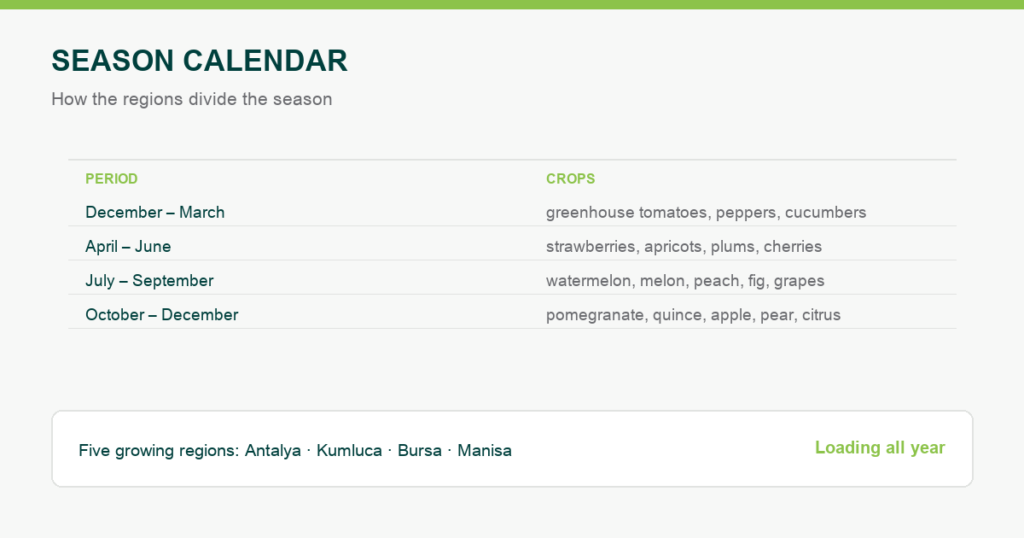
Türkiye’s biggest advantage in fresh produce export is not the range of crops — it is the calendar. The same crop ripens in different months in different regions, so the season never depends on one growing area alone. As the harvest ends in one region, it begins in the next.
How the regions divide the season
Antalya and its surroundings are the centre of protected cultivation. The greenhouses along the Kumluca–Demre–Serik line supply tomatoes, peppers, cucumbers and courgettes across all twelve months. Much of the vegetable volume that reaches Europe in winter comes from here.
Bursa and its region come into their own in late spring and early summer. For cherries, peaches and figs the calendar there runs about a month behind Antalya, and that lag is what stretches the season.
Manisa and the inland Aegean are grape country. Around Alaşehir, sultana and crimson varieties are picked from mid-August through to early November.
The season by crop group
In broad terms the calendar works like this:
- Winter vegetables (December–March): greenhouse tomatoes, peppers, cucumbers, courgettes and aubergines. This is when European demand peaks.
- Spring (April–June): strawberries, apricots, plums, green plums and fresh pulses, followed by cherries.
- Summer (July–September): watermelons, melons, peaches, figs, grapes and green beans.
- Autumn (October–December): pomegranates, quinces, apples, pears, citrus — and greenhouse vegetables again.
Why the start and end of a season matter
Quality does not stay level across a season. In the opening weeks the fruit tends to run small and the price sits high. The middle stretch is the most balanced, both for size grade and for price. Towards the end the fruit grows larger but the flesh softens and shelf life shortens.
Long-haul shipments are therefore planned for the middle of the season. End-of-season fruit is better suited to short routes or to processing.
What the calendar changes in planning
For a buyer, a season calendar answers more than “what is available when”. Checking it before ordering means knowing in advance which region the crop will come from and which size grades are likely to be available.
Having facilities in five separate growing regions is what lets us follow this calendar without gaps. One region’s season closes as the next one opens, which is why we can load in all twelve months.
To see what is loading this month, visit In Season Now, or get in touch to plan your season.
