


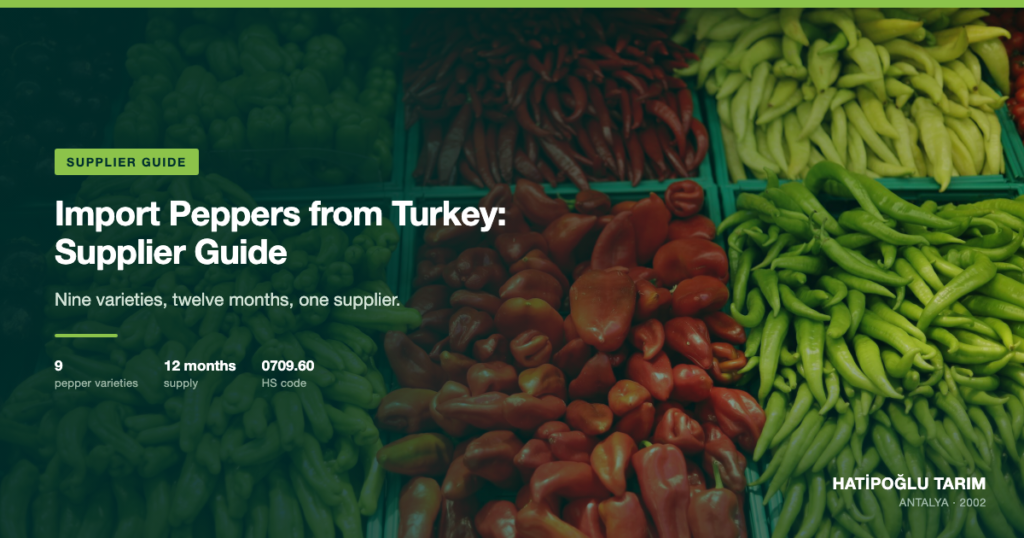
Buyers who import peppers from Turkey can plan the whole year with a single supplier. Antalya’s protected cultivation delivers in winter, and the open fields of the Marmara and Aegean regions deliver in summer, so loading continues through all twelve months. Hatipoğlu Tarım is a Turkish pepper supplier that has exported fresh fruit and vegetables from Antalya since 2002, and it prepares and loads nine pepper varieties in its own facilities. This page is for wholesalers, retail chains and processors. It brings together the varieties, the calendar, packaging, minimum load, the HS code, the documents and the details we need to quote.
Wholesale peppers from Turkey: the nine varieties we supply
Each variety has its own detailed guide:
- Kapya (kapia) pepper: thick-fleshed, deep red and sweet. In demand for roasting and for pepper paste. → Kapia pepper guide
- Bell pepper: green, red and yellow; blocky shape. → Bell pepper guide
- Charleston (Çarliston) pepper: pale yellow-green, thin-fleshed and sweet. → Charleston pepper guide
- Sivri and Kıl Sivri pepper: the long green pepper of Turkish cooking. → Turkish long green peppers
- Green chili pepper: long, with noticeable heat. → Green chili pepper supplier guide
- Red chili pepper: for the fresh channel and for processing. → Red chili pepper supplier guide
- Cin biberi (small hot chili): small-fruited and very hot; for pickling and fresh sale. → Cin biberi guide
- Üçburun pepper: a local village pepper; limited quantities. → Üçburun pepper guide
- Black California pepper: a purple-black bell pepper. → Black bell pepper guide
For a comparison of the hot varieties, see our article on Turkish hot peppers and the Scoville scale.
When can you import peppers from Turkey?
All nine varieties can be ordered in all twelve months. In winter the product comes only from greenhouses; quantities are limited, and product is reserved for buyers who give their weekly requirement in advance. In summer the open fields come in and volumes reach their peak. For Kapya peppers bought for paste and roasting, the best months are August and September. The month-by-month detail is in our pepper season and export calendar.
What export quality means
Whatever the variety, export-grade peppers are judged on the same points: shape and colour true to the variety, uniform size, glossy and taut skin, a green and crisp stem, and fruit free of cracks and bruises. Hot and sweet varieties are kept separate in the growing area, because heat cannot be judged from the outside. The peppers are harvested with a short stem and cooled the same day; for thin-fleshed Charleston, that means within the first two hours after cutting.
Packaging and carton sizes
- 60 × 40 × 15 cm carton: bell pepper, Charleston, Kıl Sivri, Üçburun, cin biberi, black California pepper
- 30 × 40 × 14 cm carton: Kapya pepper
- 30 × 40 × 12.5 cm and 60 × 40 × 15 cm cartons: green and red chili pepper
The cartons fit the 80 × 120 cm euro pallet. The pallet patterns for these sizes are explained in our article on packaging and case sizes.
Minimum load and mixed truckloads
Shipments are planned by the truck: a standard 13.60 m refrigerated truck takes 33 euro pallets. Because all pepper varieties travel at the same temperature, they can be loaded together. A buyer can take several pepper varieties on one truck, and even other vegetables that need the same temperature. Peppers reach their longest shelf life at 7.5 °C and a relative humidity above 95%; the details are in our guide to pepper storage temperature.
HS code for fresh peppers
Fresh peppers fall under HS code 0709.60. The 12-digit Turkish tariff lines for sweet peppers are:
- 0709.60.10.00.11 — Sivri (long green) pepper
- 0709.60.10.00.12 — bell pepper
- 0709.60.10.00.13 — Charleston pepper
- 0709.60.10.00.14 — red pepper (paprika)
- 0709.60.10.00.19 — other
The line to be declared depends on the product. We recommend confirming the classification with your customs broker before shipment.
Documents a Turkish pepper supplier should provide
Residue controls on peppers entering the European Union are strict. Every lot is analysed, and the result is compared with the limits of the destination market. GLOBALG.A.P. IFA and GRASP apply in production; ISO 22000, ISO 9001 and ISO 10002 apply in the facility. The certificate numbers and validity dates are on our certificates page. A phytosanitary certificate is issued for the border crossing. For more detail, see which certificates European buyers require and our guide to EU pesticide MRLs.
Six questions to ask a pepper exporter in Turkey
The same questions apply whether you are comparing bell pepper suppliers or sourcing hot varieties:
- Is the product prepared in the supplier’s own facility, or collected from others and sent on?
- Can the supplier guarantee your weekly volume in the winter months?
- Are hot and sweet varieties kept separate in the growing area?
- How many hours pass between harvest and cooling?
- Is every lot analysed for residues, and can the certificate numbers be verified?
- Can the supplier load mixed trucks?
What we need to quote
Six details are enough for a quotation: variety, size or calibre, packaging, weekly volume, delivery week and destination country. With these we prepare a loading plan and a price offer. If you plan to import peppers from Turkey this season, you can reach us by phone on +90 242 339 55 25, on WhatsApp on +90 534 260 07 25 or at info@hatipoglutarim.com.
Hatipoğlu Tarım has exported fresh fruit and vegetables from Antalya since 2002. Under the FİNİKE brand it ships 128 product lines to 42 countries, with harvest, grading, cold storage and dispatch handled in house across five facilities in Serik, Kepez, Mavikent, Yenişehir and Alaşehir.
Tell us the varieties, volume and delivery week for your pepper programme, and we will prepare a loading plan and a quotation.
