


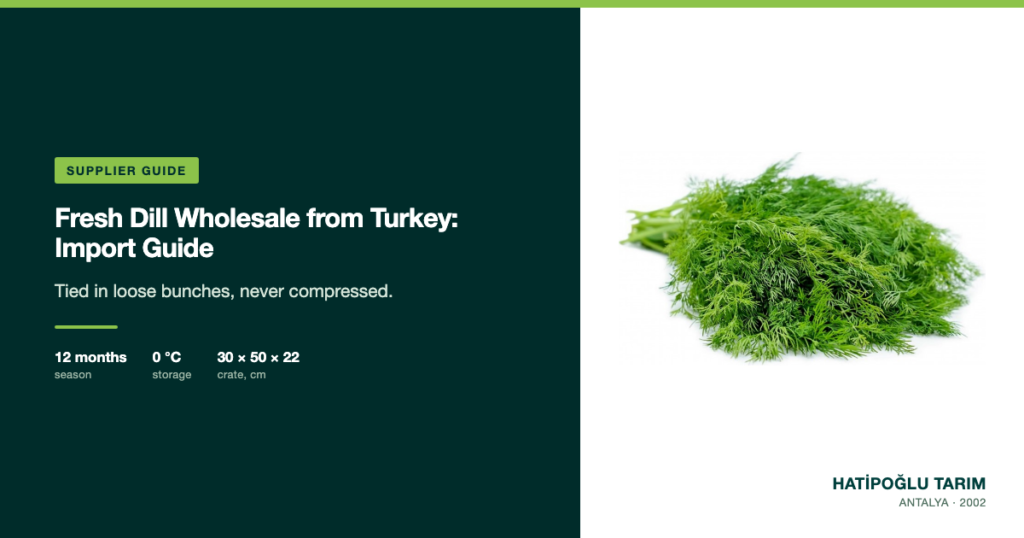
Fresh dill wholesale is a question of how the bunch is tied: dill leaves are so fine that the bunch is tied loosely instead of being compressed. Hatipoğlu Tarım is an Antalya-based exporter of fresh fruit and vegetables, established in 2002, and it supplies dill through all twelve months.
Fresh dill from Turkey: a delicate herb
Dill is a delicate green with fine leaves, a bright green colour and a marked aroma. Fresh dill from Turkey is selected by the company on freshness, colour and leaf integrity, and prepared to the export order. For other herbs in the range, see the guides to fresh parsley and fresh coriander.
Why a dill supplier in Turkey ties loose bunches
Because of its fine structure, dill is tied into loose bunches without being compressed. The bunches are then placed in ventilated crates and cooled without delay, which helps them stay fresh. For a buyer assessing a dill supplier in Turkey, the loose bunch is the detail to ask about, and the first thing to look at when the crates are opened.
Available all year
Dill can be supplied throughout the year. Buyers who import dill from Turkey are therefore not tied to a season; the product calendar marks every month. Our season calendar shows which products run alongside it.
Quality criteria
- Freshness: fine leaves that are not limp.
- Colour: bright green throughout the bunch.
- Leaf integrity: leaves not crushed or broken.
- Bunch: loose, not compressed.
The research view is similar. UC Davis states for fresh culinary herbs that quality is mainly judged by eye, on freshness, on uniformity of size, form and colour, and on the absence of yellowing, damage, decay and wilting. The characteristic aroma is essential and decreases during storage.
Storage data: temperature and water loss
As published by UC Davis, most herbs keep best at 0 °C with relative humidity above 95%; the expected shelf life is three weeks at 0 °C and two weeks at 5 °C. The fact sheet also makes a point that matters for a fine-leaved herb: since herbs are marketed in small quantities, water loss is a serious cause of quality loss. Among the cooling methods it lists are hydrocooling before packing and room cooling after packing. These are research data, not a company specification.
Dill can be combined on one truck with lettuces, other fresh herbs and spring onions, all carried at around 0 °C. Products carried at around 10 °C, such as greenhouse tomatoes, peppers, aubergines and cucumbers, need a separate vehicle. Spring onions deserve a note in a mixed load, because their odour can pass to other products. More in the cold chain in fresh produce export.
The crate, and mixing dill with other herbs
Dill is prepared in ventilated plastic crates of 30 × 50 × 22 cm. For fresh herbs wholesale orders that combine dill with parsley, mint or coriander, note that those herbs use a smaller case of 30 × 40 × 14 cm. The buyer specifies the bunch weight or the number of bunches. All cases go on 80 × 120 cm euro pallets. Our article on loading patterns shows how pallets are arranged.
Paperwork and tariff position
You will need the tariff position confirmed on your side: the classification of fresh herbs can differ with the intended use and with the country, which is why this guide names no HS code. Ask your customs broker before shipment. On the supplier’s side, the certificates are ISO 9001, ISO 22000, ISO 10002, GLOBALG.A.P. IFA and GRASP, and a residue analysis is done for every lot that goes to Europe. See which certificates European buyers require.
Import process in six steps
Dill goes from harvest to cooling without delay, then to grading, packing in ventilated crates, cold storage and dispatch. Shipments are organised as truckloads, and one 13.60 m refrigerated truck of the standard type takes 33 euro pallets.
Details for a quotation
We need to know the product, the bunch weight or count, the packaging, the weekly volume, the delivery week and the destination country. Reach us on +90 242 339 55 25 by phone, +90 534 260 07 25 on WhatsApp, or info@hatipoglutarim.com by e-mail.
Hatipoğlu Tarım has exported fresh fruit and vegetables from Antalya since 2002. Under the FİNİKE brand it ships 128 product lines to 42 countries, with harvest, grading, cold storage and dispatch handled in house across five facilities in Serik, Kepez, Mavikent, Yenişehir and Alaşehir.
Share your bunch specification and weekly dill volume with us, and we will send a quotation.
