


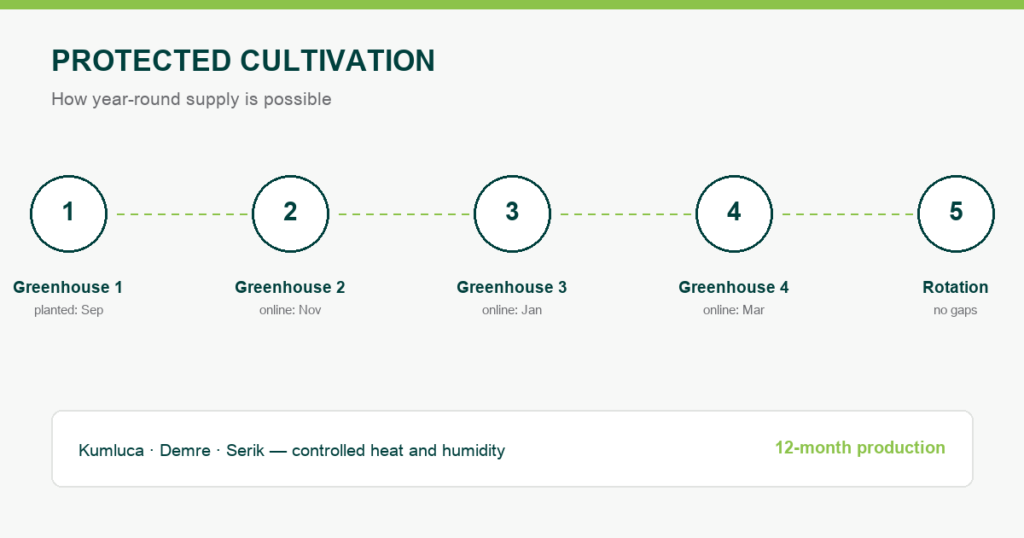
Climate alone doesn’t explain how Turkey ships vegetables to Europe all winter. The greenhouses along the Kumluca-Demre-Serik line near Antalya provide something open fields can’t: a controlled growing environment. That’s what keeps tomatoes, peppers and cucumbers in production twelve months a year.
Why a greenhouse differs from open field
In the open field, the crop depends on outdoor conditions — frost, heavy rain or a temperature swing hits the harvest directly. A greenhouse removes most of that variability. Temperature, humidity and, in some modern facilities, CO2 levels are controlled, which lets the plant grow at a steady rate all year.
Glass versus plastic cover
Most greenhouses in the region use plastic covers — cheap to build and, in the Mediterranean climate, letting through enough light. Glass houses cost more to build but offer better light transmission and insulation; they’re chosen for high-value crops and winter production.
Soil or soilless growing
In traditional greenhouses the crop grows in soil. In soilless systems (hydroponics) the root zone is fed a controlled nutrient solution. Soilless growing gives higher yields and lower disease risk, but costs more to set up. Both methods are used in the region; the choice depends on the crop and the age of the facility.
How year-round loading is possible
No single greenhouse produces the same crop for twelve months straight — plants have cycles and maintenance periods. Continuity comes from staggering plots with different planting dates. As one plot’s yield tapers off, a newly planted one comes into production; this rotation is planned well ahead.
Regional spread helps too: Antalya covers winter, Bursa spring, Manisa autumn, so a gap in one region is filled by another.
The limits of protected cultivation
A greenhouse isn’t right for every crop. Root vegetables (potatoes, carrots) and crops needing open space (watermelon, melon) are grown in the field. Greenhouses make economic sense for vertically growing, frequently harvested crops — tomatoes, peppers, cucumbers, aubergines.
Protected cultivation at Hatipoğlu Tarım
Our supply network across Serik, Kepez and Mavikent keeps greenhouse tomatoes, peppers and cucumbers flowing without gaps. See what’s fresh this month, or get in touch to plan year-round supply.
