


The hardest thing about running an import programme is keeping a line on the list once its season has closed. Hot pepper is one of the few products that removes the problem altogether: under protected cultivation, red and green hot peppers load twelve months a year.
What year-round production actually changes
The greenhouse structure around Antalya largely dissolves the idea of a pepper season. For a buyer this has three concrete consequences.
The first is programme continuity. A buyer who can draw the same line all year need not rearrange the shelf every quarter. The second is steadier pricing; where supply never stops, prices do not lurch the way they do on open-field crops. The third is a shorter supplier list — buying twelve months from one source carries less risk than finding a new supplier each season.
Year-round supply does not mean the product is identical every month. As greenhouse temperatures fall in winter, fruit grows more slowly, the skin thickens and heat levels tend to rise. In summer the opposite happens. Talking through this natural swing at the programme stage prevents claims later.
Red and green: one plant, two products
Red and green hot peppers are usually the same plant at different stages of maturity, yet commercially they are two distinct products.
Green hot pepper is harvested before maturity. The skin is thinner, the fruit firmer, and the shelf life shorter than the red. Red hot pepper is left on the plant to full maturity; sugar content and pigment increase, but the fruit softens and becomes more vulnerable to mechanical damage.
That difference carries straight into transport. With a red consignment, the way fruit is arranged in the case and how tightly the pallet is built matters more than it does with green.
Sizing and heat
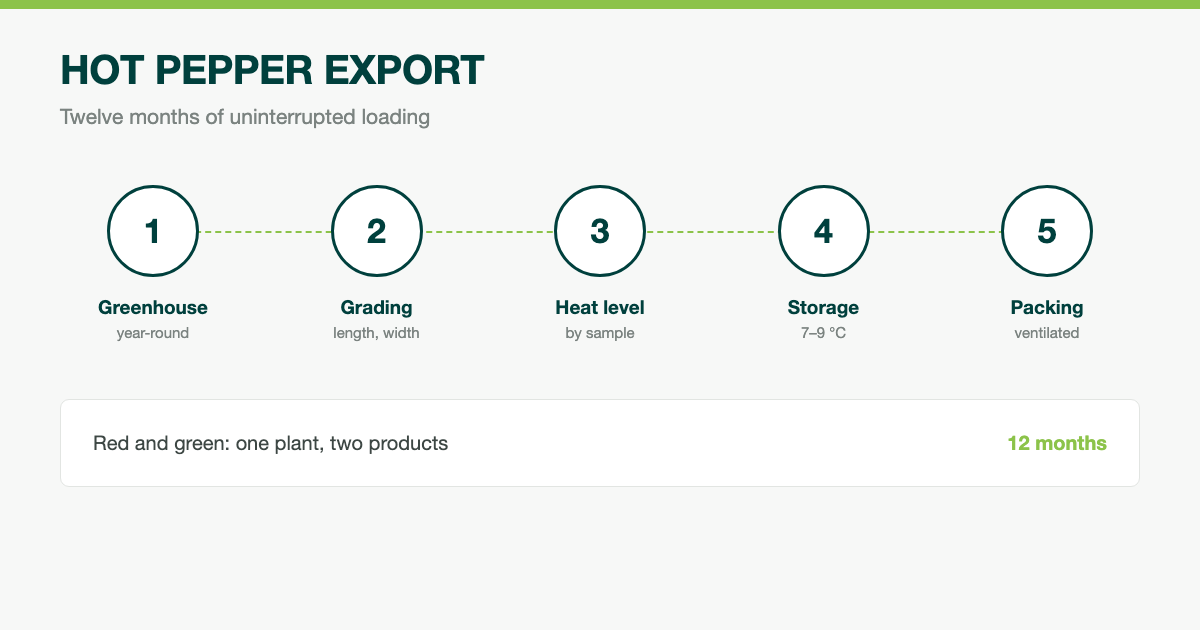
Hot peppers are graded on length and diameter. Ordering “hot pepper” is not a specification on its own: the length range, the diameter and the required heat level all belong in the same sentence.
Heat is the most misunderstood attribute of this product. Even within one variety it shifts with the water and temperature the plant received. Serious programmes therefore fix heat against a sample rather than a description: the approved sample is retained, and later consignments are judged against it.
Storage: peppers suffer from cold
Pepper is a chilling-sensitive product. The correct storage range is 7–9 °C. Below it the skin pits and turns watery, and the damage usually appears not in the shipper’s store but in the buyer’s.
For this reason peppers should not travel at a single set point alongside stone fruit or leafy produce. In a mixed load set to the coldest line on the container, the pepper is the one that pays.
Humidity is equally critical. In dry air peppers lose water quickly; the fruit shrivels and weight is lost with it.
Packing
The common format for hot peppers is a case measuring 30 × 40 × 14 cm. Fill depth is kept limited so that fruit at the bottom is not crushed.
Ventilation deserves particular attention here, because peppers continue to generate heat through respiration after harvest. In a closed case that heat accumulates and the fruit breaks down from within.
Documentation and residues
Peppers sit among the most closely monitored groups for residues entering Europe, a consequence of how frequently the plant is treated. The interval between the final pre-harvest application and loading must be documented if a consignment is not to be held at the border. GLOBALG.A.P. certification covers the growing stage, ISO 22000 the packing process.
Choosing a supplier
For a product bought all year, the supplier quality that matters most is the capacity to sustain supply. Holding a programme together when winter greenhouse output falls requires access to more than one growing region.
Hot pepper export: from harvest to loading
Exporting hot peppers from Turkey runs in six steps: harvest, cooling, grading, packing, cold storage and dispatch under cold chain. As a Turkish hot pepper exporter and supplier, Hatipoğlu Tarım handles all of them in house, in its own facilities. When export-grade produce is allocated, the buyer’s market, sales channel and transit time are considered together, and every lot bound for Europe is also analysed for residues.
To quote for a hot pepper export programme we need six details: variety, calibre, packaging, weekly volume, delivery week and destination country. With these in hand, we prepare a loading plan and a quotation.
Hatipoğlu Tarım has exported fresh fruit and vegetables from Antalya since 2002. Five facilities — in Serik, Kepez, Mavikent, Yenişehir and Alaşehir — are spread across different growing regions, so weather in any one area does not halt the programme. A range of 128 products and shipments to 42 countries make a twelve-month pepper programme workable.
We welcome your enquiry for pricing and a programme on red and green hot peppers.
