



Of all the citrus fruits, grapefruit leaves the exporter the widest margin for error. The skin is thick, the shelf life is long, and the fruit travels well by sea to distant markets. That comfort breeds a misconception: because grapefruit is robust, it is assumed to tolerate rough handling. In reality, quality is rarely lost here to decay — it is lost to rind blemish and moisture loss.
The season opens in October and closes in April
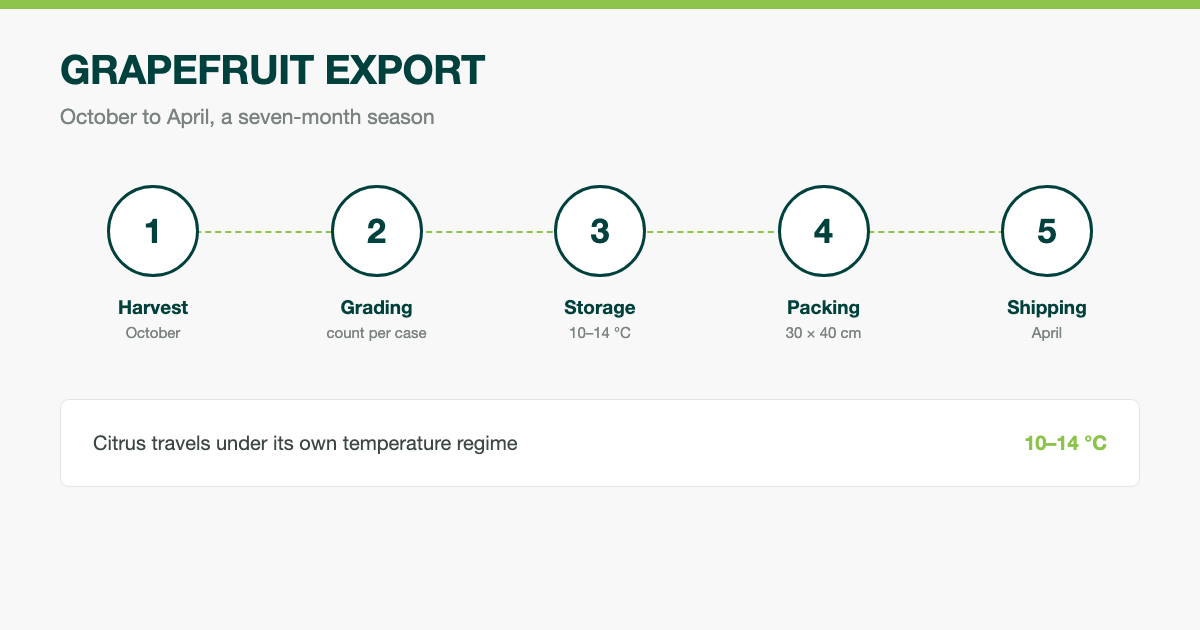
Along the Mediterranean coast around Antalya, the grapefruit harvest begins in October and continues to the end of April. Set against a fruit as short-lived as the apricot, this seven-month window gives an exporter real freedom to plan.
The two ends of the season behave differently. In October and November the fruit has not yet settled into full colour, and the sugar-acid balance reaches the level buyers expect from December onwards. January and February are the strongest months of the season for both internal quality and rind appearance. By March and April the fruit is coming out of store, and this is where the quality of storage management becomes plainly visible.
Red and white: two separate markets
Variety preference in grapefruit divides sharply by destination. Red-fleshed varieties — Star Ruby and Rio Red foremost among them — dominate demand in European retail and in Russia, where the depth of internal colour feeds straight into the price. White-fleshed varieties find their buyers principally in the Middle East and the Far East.
With red varieties, one point deserves attention: internal colour shifts across the season. Putting a Star Ruby picked in October in the same box as one picked in February is the single thing buyers complain about most. Colour intensity has to stay consistent from consignment to consignment.
Sizing and rind
Grapefruit is graded by diameter and expressed as a count per case. European retail favours the middle grades, while Middle Eastern markets pay a premium for large fruit.
The rind is the most visible measure of quality in this product. Surface scratches made during harvest turn brown in storage, and a consignment drops a grade while the fruit itself remains perfectly sound. Attention in grapefruit therefore concentrates on the points of mechanical contact — from the harvesters’ gloves to the height from which fruit is tipped into a case.
Storage: citrus cold is not the same cold
Unlike stone fruit, grapefruit is damaged by low temperature. The correct storage range is 10–14 °C. Below it the fruit suffers chilling injury: the rind pits and stains, and the damage tends to appear not in the store but on the buyer’s shelf.
This is the most common error in grapefruit shipping. In a mixed container set to suit stone fruit, the grapefruit will be harmed. Citrus has to travel under its own temperature regime.
Humidity matters no less than temperature. In dry air the fruit loses water, the rind shrivels, and weight goes with it.
Packing and pallets
The common format is a carton with a 30 × 40 cm footprint, the depth varying with fruit size and the way it is arranged. A single-layer arrangement protects the rind on large grades; loose fill raises pallet efficiency.
The ventilation holes in the cases must line up vertically through the pallet. Where they are offset, the air column is broken and the centre of the pallet never cools.
Documentation
Residue limits are followed particularly closely on citrus consignments entering Europe; the interval between the final pre-harvest application and the loading date has to be on record. GLOBALG.A.P. certification secures that record on the growing side, ISO 22000 on the packhouse side.
Choosing a supplier
The long grapefruit season makes a supplier’s storage capacity decisive. Taking fruit in October and carrying it to March with its quality intact means holding it at the right temperature and the right humidity throughout. The second factor is consistency of variety and colour: a supplier who can deliver the same specification across the whole season protects the buyer’s programme.
Grapefruit export: from harvest to loading
Exporting grapefruit from Turkey runs in six steps: harvest, cooling, grading, packing, cold storage and dispatch under cold chain. As a Turkish grapefruit exporter and supplier, Hatipoğlu Tarım handles all of them in house, in its own facilities. When export-grade fruit is allocated, the buyer’s market, sales channel and transit time are considered together, and every lot bound for Europe is also analysed for residues.
To quote for a grapefruit export programme we need six details: variety, calibre, packaging, weekly volume, delivery week and destination country. With these in hand, we prepare a loading plan and a quotation.
Hatipoğlu Tarım has exported fresh fruit and vegetables from Antalya since 2002. Five facilities — in Serik, Kepez, Mavikent, Yenişehir and Alaşehir — allow citrus to be held under its own temperature regime. A range of 128 products and shipments to 42 countries support an uninterrupted programme through the citrus season.
We welcome your enquiry for pricing and a shipping programme for the grapefruit season.
