


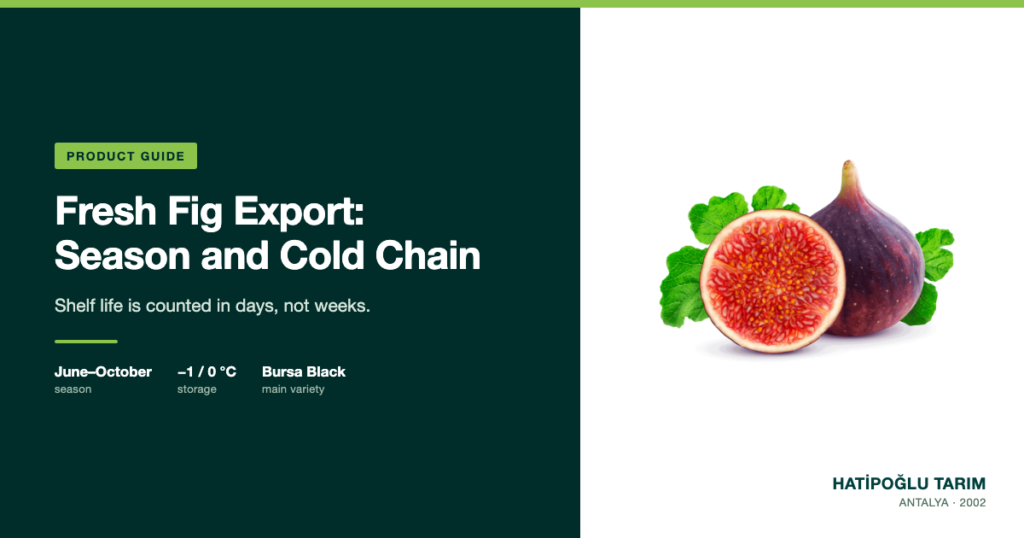
Fresh figs are the most time-critical line in fruit export. A fig does not ripen after picking, and its shelf life is counted in days rather than weeks. What separates one fig exporter from another is therefore not the orchard but the hours between harvest and the cold room. This guide takes importers through variety, season, harvest, storage, packaging and quality.
Bursa Black: the variety behind Turkish fresh fig exports
Turkey is the world’s largest fig exporter. The dried trade is built on the yellow varieties of the Aegean; the fresh trade is led by Bursa Black (Bursa Siyahı). The fruit is large, with deep purple skin and red flesh. Its skin is firmer than that of most other varieties, so it travels well and gives European retailers the appearance they want on the shelf.
Hatipoğlu Tarım’s fig programme is built on fruit selected for size, skin integrity, ripeness and surface quality. One of the company’s five facilities is in Yenişehir, in the province of Bursa.
Turkish fig season: June to October
The season opens in June in the early districts and runs into October. Volumes peak in August and September, which is also when Bursa Black is in full harvest. Towards the end of the season nights turn cooler, and dew and rain become more frequent. Wet fruit is prone to decay, so grading gets stricter in the final weeks and shipped volumes fall.
For a buyer this means weekly programmes are easy to plan for August and September. June and October loadings are smaller and should be agreed in advance.
Harvest: twice a day, by hand, straight into the tray
Figs for the fresh market are picked almost fully ripe. Fruit picked too early never develops flavour; fruit picked too late softens in transit. Skin colour and flesh firmness are the two indicators: the fig must have reached its colour and should give slightly under the finger without bruising.
Picking takes place twice a day, in the morning and in the late afternoon. Each fig is picked by hand with its stem and placed in a single-layer tray as soon as it leaves the orchard. That tray is the pack the customer receives. The fruit is not handled a second time, because every touch leaves a mark on the skin. Figs that have fallen to the ground never go into a fresh pack.
Cooling and storage: 0 °C at 90–95% humidity
The optimum storage temperature for figs is −1 to 0 °C at 90–95% relative humidity, and rapid forced-air cooling to 0 °C straight after harvest is recommended. Under these conditions fresh figs keep for one to two weeks in normal air, depending on variety and ripeness at harvest.
That window decides the logistics. Markets within a few days’ drive are served by refrigerated truck; more distant markets receive fresh figs by air. Above 5 °C softening and decay speed up, so the cold chain must hold on the loading dock as well. Our article on the cold chain in fresh produce export covers the whole route.
Packaging options
Figs are packed in a single layer. Three formats are used:
- 30 × 40 × 14 cm carton
- 40 × 60 × 10 cm carton
- 30 × 50 × 22 cm plastic crate
Each fig sits in its own cell and does not touch its neighbour. The count per box depends on the calibre; sizing follows the count the buyer asks for.
Defects a buyer should check
The defects to look for in a fig shipment are skin cracks, sunburn, bird pecks, wilted stems and a sour smell. Souring is caused by yeasts and bacteria that vinegar flies carry into the fruit, and it shows up as an alcoholic or vinegary odour. Cracked skin is an open door for mould. Affected fruit is removed in two stages, first in the orchard and again on the packing line.
For the paperwork side, see which certificates European buyers actually require.
Fresh fig export: from harvest to loading
Exporting fresh figs from Turkey runs in six steps: harvest, cooling, grading, packing, cold storage and dispatch under cold chain. As a Turkish fresh fig exporter and supplier, Hatipoğlu Tarım handles all of them in house, in its own facilities. When export-grade fruit is allocated, the buyer’s market, sales channel and transit time are considered together, and every lot bound for Europe is also analysed for residues.
To quote for a fresh fig export programme we need six details: variety, calibre, packaging, weekly volume, delivery week and destination country. With these in hand, we prepare a loading plan and a quotation.
Hatipoğlu Tarım has exported fresh fruit and vegetables from Antalya since 2002. Under the FİNİKE brand it ships 128 product lines to 42 countries, with harvest, grading, cold storage and dispatch handled in house across five facilities in Serik, Kepez, Mavikent, Yenişehir and Alaşehir.
Tell us the calibre, packaging and delivery week you need, and we will send back a season plan and a price.
