


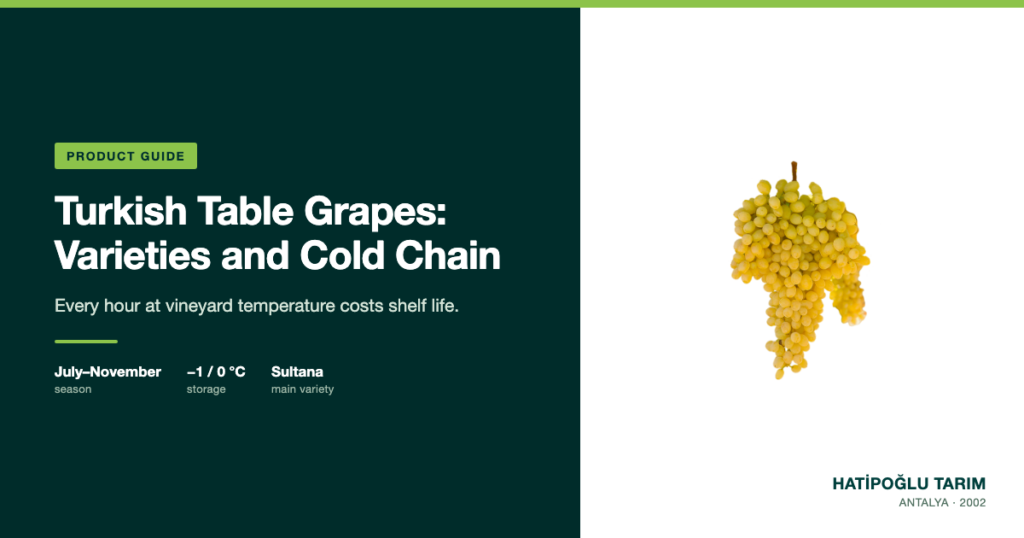
Table grape export is about preserving the bunch exactly as it was when cut in the vineyard. Grapes do not sweeten after harvest; the sugar level on picking day is the sugar level on the buyer’s shelf. From then on, all anyone can do is stop the losses: stem browning, berry shatter and mould. This guide takes importers through varieties, season, harvest, storage and packaging.
Three varieties, three markets
Sultana seedless is the backbone of Turkey’s fresh grape exports. The berries are seedless, thin-skinned and amber-green, with a high sugar content. It answers European retail demand for white seedless grapes. Production is centred on Manisa; one of Hatipoğlu Tarım’s five facilities is in that region, in Alaşehir.
Crimson Seedless is a bright red, late-ripening seedless variety. It gives a supply advantage in the final months of the season and completes the programme for chains that want red seedless fruit.
Red Globe is a seeded variety with large, dark red berries. Its firm texture stands up to long journeys, and it is preferred in markets where big berries and an impressive bunch matter most.
Season: July to November
The grape harvest begins in July and runs into November. August and September are the strongest months for Sultana volumes. October and November belong to the late varieties and to fruit held in cold storage. Spread over five months, this calendar lets a buyer run a programme from one source from midsummer to early winter.
Harvest: from the vine straight into the box
The decision to pick rests on soluble solids. For table grapes the maturity threshold lies between 14 and 17.5%, depending on variety and growing area; red varieties must also meet a minimum colour requirement.
Bunches are cut in the vineyard and placed directly in the box. No intermediate container is used, because every transfer shakes off berries and rubs away the natural bloom. Loose, crushed and rotten berries are trimmed out with scissors during picking, and the bunch is held by the stem, never by the berries.
Precooling: the first two hours
In grapes it is the stem that shows water loss first: it dries, turns brown and makes the bunch look stale. The way to prevent this is to precool the fruit within the first two hours after harvest. Every hour spent at vineyard temperature is a day taken off shelf life.
Storage: −1 to 0 °C at 90–95% humidity
The optimum storage temperature for table grapes is −1 to 0 °C at 90–95% relative humidity. Thanks to their high sugar content the berries do not freeze at this temperature; the stem freezes at around −2 °C, which is why the temperature is taken no lower.
The main enemy in storage is grey mould (Botrytis cinerea). The fungus develops even at −0.5 °C and spreads from berry to berry. The industry’s answer is a sulphur dioxide pad placed inside the box; controlled atmosphere brings little benefit for grapes and is not widely used. At Hatipoğlu Tarım, boxes are fitted with a moisture pad once the fruit comes out of precooling.
The second problem is shatter, the loss of berries from the stem. It increases the longer the bunch stays on the vine and is more common in seedless varieties. Not overfilling the box, bagging the bunches and gentle handling all reduce it.
Packaging options
Grapes are packed in wooden or carton boxes:
- 30 × 40 × 12.5 cm wooden box
- 30 × 20 × 12.5 cm wooden box
- 30 × 40 × 12.5 cm carton
- 60 × 40 × 15 cm carton
The small wooden box suits gift and traditional markets, while cartons dominate supermarket programmes. How these formats fit the pallet is explained in our article on packaging and case sizes in export.
A buyer’s checklist on arrival
On arrival, check whether the stems are green and flexible, whether the berries are firm, whether there are loose berries at the bottom of the box, whether any cracking or sunburn is visible, and whether there are mouldy berries inside the bunch. On flavour, the deciding factor is the ratio of sugar to acid.
Table grape export: from harvest to loading
Exporting table grapes from Turkey runs in six steps: harvest, cooling, grading, packing, cold storage and dispatch under cold chain. As a Turkish table grape exporter and supplier, Hatipoğlu Tarım handles all of them in house, in its own facilities. When export-grade fruit is allocated, the buyer’s market, sales channel and transit time are considered together, and every lot bound for Europe is also analysed for residues.
To quote for a table grape export programme we need six details: variety, calibre, packaging, weekly volume, delivery week and destination country. With these in hand, we prepare a loading plan and a quotation.
Hatipoğlu Tarım has exported fresh fruit and vegetables from Antalya since 2002. Under the FİNİKE brand it ships 128 product lines to 42 countries, with harvest, grading, cold storage and dispatch handled in house across five facilities in Serik, Kepez, Mavikent, Yenişehir and Alaşehir.
Tell us the variety, packaging and delivery week you need, and we will send back a season plan and a price.
