


Pomegranate season in Turkey is about to open. Early varieties reach the market at the end of summer; the harvest of Hicaznar, the variety that carries most of the export volume, begins in October. For a pomegranate exporter, September is the month when programmes are built: which calibre goes to which market, and in which week, is settled before picking starts. This article sets out how the season unfolds month by month and what a buyer needs to decide now.
When the Turkish pomegranate season starts and ends
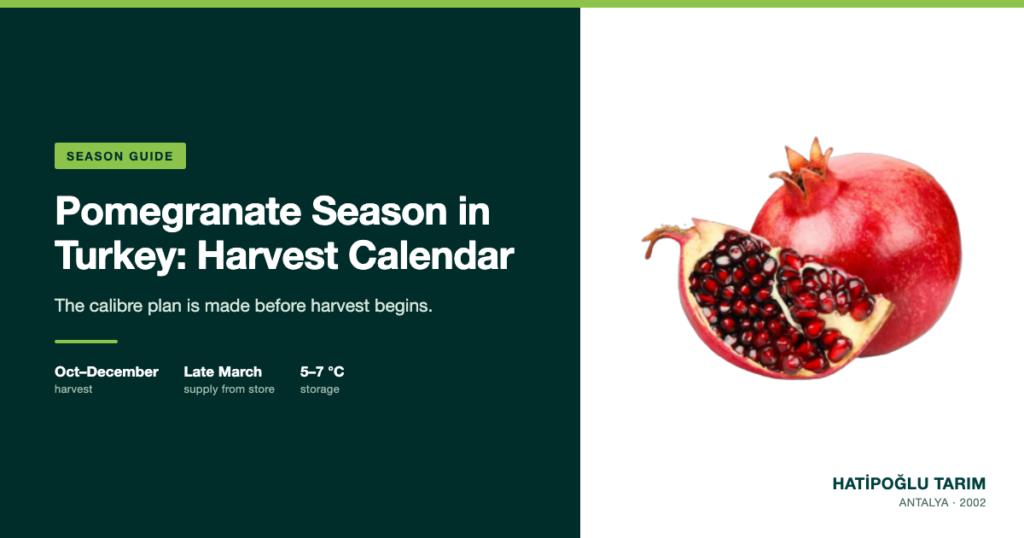
In Hatipoğlu Tarım’s pomegranate programme, harvest begins in October and continues until mid-December. Under proper cold storage the fruit keeps its quality until the end of March. The field calendar is two and a half months long; the supply calendar is six.
Month by month, the season runs as follows:
- September: early varieties are on the market. The fruit is smaller than later in the season and the arils are paler. On the export side this is the month for samples and programme planning.
- October: Hicaznar harvest opens. Colour and calibre come together, and the first regular loadings begin.
- November: the strongest month of the harvest. The fruit reaches its largest calibres. Lots for direct shipment and lots for storage are both picked now.
- Mid-December: the last picks come in and the field season closes.
- January to March: loading continues from cold storage. Winter and spring programmes run on fruit put into store in November and December.
Why buyers should decide now
A pomegranate neither ripens nor grows once it leaves the tree. Whatever calibre, colour and flavour it has on harvest day is what it has on the buyer’s shelf. Two things follow from this.
First, the calibre plan is made before harvest. A buyer who wants large fruit is booked into the late picks, because the fruit gains size the longer it stays on the tree. Asking to move up a calibre in mid-season is usually not possible: that fruit has either been allocated or already picked.
Second, the storage programme is fixed in November. The volume a buyer wants between January and March has to be known while the fruit is going into store. Fruit that was not stored in November cannot be found in February.
September and early October are therefore the time to agree variety, calibre, packaging and weekly volume.
What is checked at harvest
Harvest maturity is judged by rind colour, aril colour and taste. The fruit is clipped with a short stem; a long stem would wound the neighbouring fruit in the box.
Two defects never go into an export lot: rind cracking and sunburn. A crack is an open door for micro-organisms, and sunburn counts as a visual defect even when the arils are sound. Autumn rain raises the risk of cracking, so sorting becomes stricter in the days after rainfall. Sorting is done first in the orchard and again on the packing line.
The fruit is cooled on the day of harvest and shipped under cold chain.
Storage: the conditions that carry the season to March
The correct holding temperature for pomegranates is 5–7 °C at 90–95% relative humidity. If humidity falls below that, the rind loses water, hardens and shrivels, and the fruit loses its shelf value even when the arils are sound. Taking the temperature lower causes chilling injury: pitting and browning of the rind and fading of the aril colour. These symptoms do not appear in the store but on the buyer’s shelf.
Varieties, storage and market differences are covered in detail in our guide to Turkish pomegranate export.
Packaging
Pomegranates are packed in two formats:
- 30 × 40 × 12.5 cm carton
- 30 × 50 × 22 cm plastic crate
Calibre is expressed as the number of fruit per box. The weight spread within a box is kept tight; in retail programmes that uniformity matters as much as the calibre itself.
Documents for shipments to Europe
Every lot bound for the European Union is analysed for residues, and the result is compared with the limits of the destination market. How the limits work is explained in our article on EU pesticide MRLs, and the paperwork buyers ask for in which certificates European buyers require.
Pomegranate export: from harvest to loading
Exporting pomegranates from Turkey runs in six steps: harvest, cooling, grading, packing, cold storage and dispatch under cold chain. As a Turkish pomegranate exporter and supplier, Hatipoğlu Tarım handles all of them in house, in its own facilities. When export-grade fruit is allocated, the buyer’s market, sales channel and transit time are considered together, and every lot bound for Europe is also analysed for residues.
To quote for a pomegranate export programme we need six details: variety, calibre, packaging, weekly volume, delivery week and destination country. With these in hand, we prepare a loading plan and a quotation.
Hatipoğlu Tarım has exported fresh fruit and vegetables from Antalya since 2002. Under the FİNİKE brand it ships 128 product lines to 42 countries, with harvest, grading, cold storage and dispatch handled in house across five facilities in Serik, Kepez, Mavikent, Yenişehir and Alaşehir.
Tell us the calibre, packaging and delivery weeks you need for the pomegranate season, and we will send back a plan and a price before harvest begins.
