


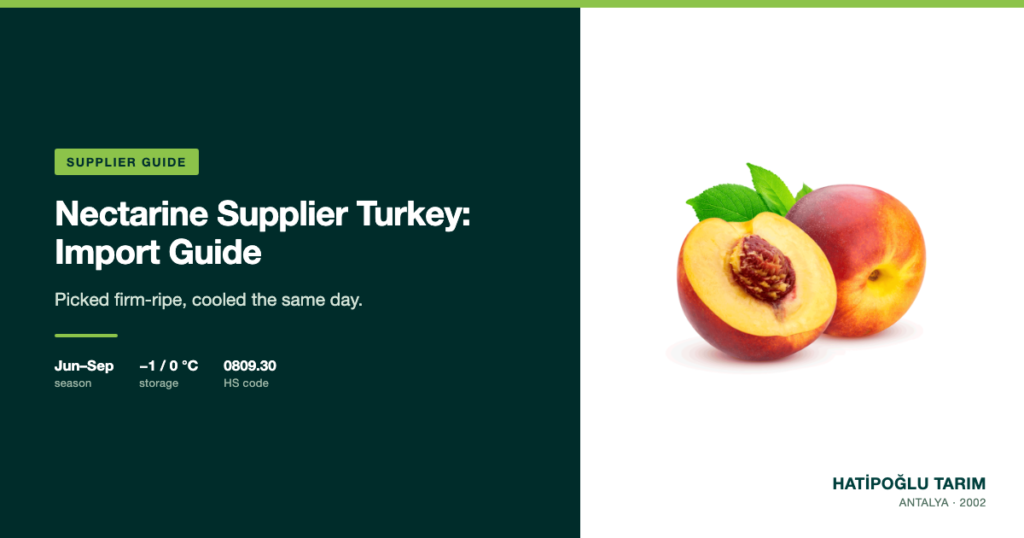
Any nectarine supplier Turkey has to offer is judged first on the skin of the fruit. The nectarine has no fuzz to hide anything: every rub, pressure mark and scar shows on its smooth skin. Hatipoğlu Tarım is a fresh produce exporter based in Antalya, in business since 2002, and it ships nectarines through the summer. This guide is for importers, wholesalers and retail buyers who want to import nectarines from Turkey: season, grading criteria, cooling and storage, tray and crate options, HS code, documents and quotation.
Turkish nectarines: a fruit sold on its skin
The nectarine is a summer fruit with smooth skin, lively colour and a texture that is crisp and juicy at the same time. Because the skin is smooth, surface quality counts for a great deal, and this is why nectarines are among the most carefully classified products of the season. At Hatipoğlu Tarım the fruit is selected one by one. For a buyer supplying retail, this single-fruit selection is what keeps marked fruit off the shelf.
Nectarine season in Turkey: June to September
Nectarines are harvested from June to September, in the same window as peaches and black plums. See our season calendar for Turkish fresh produce for other Turkish crops. For a programme covering the full season, send your weekly volumes before June.
Grading criteria for export nectarines
Each fruit is checked against four criteria:
- Size: uniform in the tray or crate; the size range is fixed in the order.
- Colour: lively and even. Maturity is read from the change of ground colour from green to yellow; where red colour covers the ground, flesh firmness is measured instead.
- Firmness: fruit is picked at the firm-ripe stage, mature enough to develop flavour and firm enough to travel.
- Surface: smooth skin free of rub marks, cuts and pressure points.
Consumer acceptance is determined by soluble solids content (SSC), acidity and the SSC-to-acid ratio, so eating quality is worth raising with any nectarine exporter alongside size and colour.
Same-day hydrocooling and storage at −1 to 0 °C
Nectarines are cooled with water on the day of harvest. The optimum storage temperature is −1 to 0 °C at 90–95% relative humidity. According to postharvest research from UC Davis, the longest market life is obtained at about 0 °C and ranges from 1 to 7 weeks for nectarines, depending on the variety.
The disorder that ends market life is internal breakdown, a chilling injury seen as mealy or browning flesh, failure to ripen and loss of flavour. Market life is shortest when fruit is held at 5 °C. For the importer this is a point to check at every link, including your own cold store and the last-mile vehicle. Controlled atmosphere (6% O₂ + 17% CO₂) is recommended to reduce internal breakdown during shipment. The research also notes that small fruit from the outer part of the tree keeps longer than large fruit from inside the canopy. See our guide to the cold chain in fresh produce export.
Packaging: single-layer trays, cartons and plastic crates
For sales channels where appearance matters, nectarines are placed in single-layer trays that reduce pressure on the skin. Two materials are available, cartons and plastic crates, each in two sizes: 30 × 40 × 12.5 cm and 30 × 50 × 12.5 cm. The choice is yours, whether you buy for retail or for nectarine wholesale, and it is fixed in the order. Footprints and pallet patterns are covered in packaging and case sizes in export.
Shipments are planned by the truck: a standard 13.60 m refrigerated truck takes 33 euro pallets of 80 × 120 cm. Nectarines can be loaded together with peaches and black plums, which travel at the same temperature, and with other 0 °C products such as cherries, apricots and grapes. See also pallet patterns and reefer loading.
HS code for nectarines
Nectarines are classified together with peaches under HS code 0809.30. Please confirm the full tariff line with your customs broker before shipment.
Documents and residue analysis
Hatipoğlu Tarım holds ISO 9001, ISO 22000, ISO 10002, GLOBALG.A.P. IFA and GRASP certification. Every lot is analysed for pesticide residues and the results are compared with European Union limits. See our articles on EU pesticide MRLs and on which certificates European buyers require.
Import process in six steps
The process has six steps: harvest at the firm-ripe stage, hydrocooling the same day, grading fruit by fruit, packing into single-layer trays, cartons or crates, cold storage and dispatch by refrigerated truck. All six are carried out in house, so grading and loading stay with one team.
How to get a quote
We need six details to quote: variety, size, packaging, weekly volume, delivery week and destination country. You can reach us by phone on +90 242 339 55 25, by WhatsApp on +90 534 260 07 25 or by email at info@hatipoglutarim.com.
Hatipoğlu Tarım has exported fresh fruit and vegetables from Antalya since 2002. Under the FİNİKE brand it ships 128 product lines to 42 countries, with harvest, grading, cold storage and dispatch handled in house across five facilities in Serik, Kepez, Mavikent, Yenişehir and Alaşehir.
Tell us whether you need cartons or plastic crates, your size and your weekly volume for nectarines, and we will prepare a quotation.
