


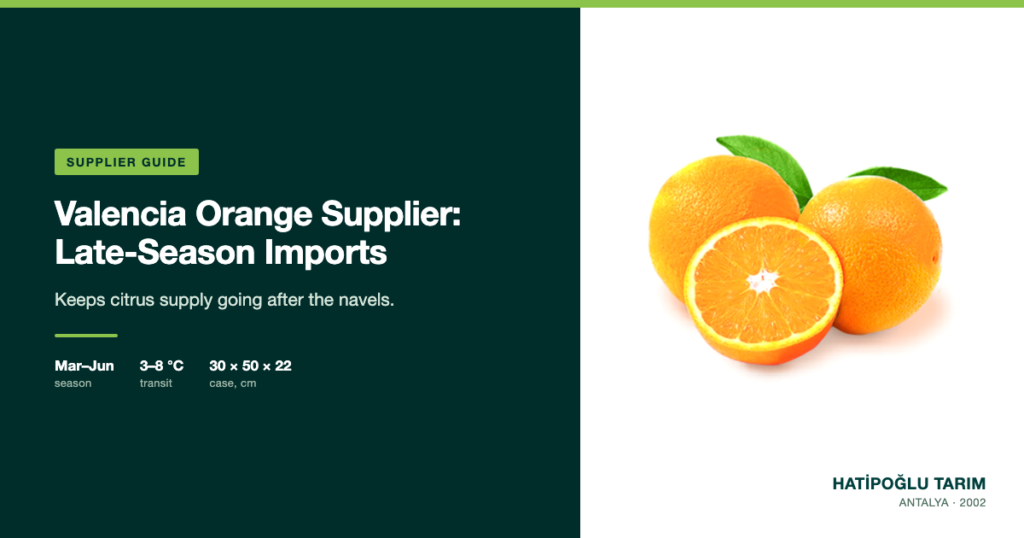
A Valencia orange supplier answers one need above all: the navel season is ending and the buyer still needs oranges. Valencia is the variety that answers that need, and it is also the orange preferred in the juice market. Hatipoğlu Tarım is a fresh produce exporter based in Antalya, in business since 2002, and it ships Valencia from March to June. This guide is for importers, wholesalers and retail buyers who want to import Valencia oranges from Turkey.
What the Valencia orange is and who buys it
The Valencia orange is a late-season variety with a thin rind and a high juice content. Its aroma keeps its sweetness after the fruit has been squeezed, which is why it is the preferred variety in the juice market. It is also the orange a buyer needs on the shelf in spring, when the table navels have finished. Turkish Valencia oranges serve both uses, in retail programmes and in the Valencia orange wholesale trade.
Late-season oranges from Turkey: how Valencia extends supply
Valencia is harvested from March to June. The Washington navel is picked from November to February and Valencia from March, so orange supply continues after the navel season ends. For a buyer who runs oranges as a permanent line, the orange season does not close in winter but runs on into June. Our guide for buyers choosing an orange supplier from Turkey describes the whole orange programme, and the Washington navel guide covers the early table variety that comes before Valencia. The calendar for all citrus lines is in citrus export and harvest seasons.
Picked by hand in spring, with next year’s blossom on the tree
The fruit is picked in spring, and in spring the tree is already carrying the blossom of the following crop. The oranges are therefore picked by hand and with care, so that next year’s flowers are not damaged. Careful hand picking also helps to keep the thin rind free of cuts and pressure marks, and postharvest research is clear that minimising physical damage at harvest and in handling is the main protection against storage decay. ## Quality criteria
Fruit is selected for export against four criteria:
- Size: uniform within the pack; the size range is fixed in the order.
- Colour: even skin colour within the lot.
- Rind integrity: fruit with cuts, punctures or pressure marks on the thin rind is taken out.
- Maturity: the UC Davis maturity index for oranges is a soluble solids to acid ratio of at least 8 with yellow-orange colour on at least 25% of the fruit surface, or a ratio of at least 10 with green-yellow colour on 25% of the surface.
A buyer receiving a lot can add firmness, shape, smoothness of the rind and freedom from decay to that list.
Storage and transport: 3–8 °C
The optimum temperature for oranges is 3–8 °C at 90–95% relative humidity, and depending on variety, maturity at harvest and growing area, storage life can extend to three months. Held too cold, oranges develop chilling injury: pitting of the rind, brown staining and an increase in decay. The lowest safe temperature varies with variety, growing area and maturity. Symptoms are milder where water loss has been reduced, which is what waxing does.
The storage diseases to look for at arrival are green mould and blue mould, stem-end rots, brown rot and sour rot. How the temperature is held between packhouse and destination is explained in our article on the cold chain in fresh produce export.
Packaging, loading and HS code
Valencia is packed in plastic crates or cartons, both 30 × 50 × 22 cm, and arranged according to the shipment plan. Pallets are 80 × 120 cm euro pallets, and a standard 13.60 m refrigerated truck takes 33 of them. Pallet patterns are covered in our article on loading and pallet patterns. Oranges can be loaded together with mandarins, which travel in a similar temperature range. They should not travel with fruit carried at 0 °C, and if lemons are on the same truck the temperature is set for the lemons, at 12–14 °C.
Fresh oranges fall under HS code 0805.10. Please confirm the full tariff line with your customs broker before shipment.
Documents and residue analysis
Hatipoğlu Tarım is certified to ISO 9001, ISO 22000, ISO 10002, GLOBALG.A.P. IFA and GRASP. Every lot shipped to Europe is analysed for residues; our article on EU pesticide MRLs explains what importers should check.
Import process: from the tree to the truck
A Valencia order passes through six steps: hand harvest, cooling, grading, packing in crates or cartons, cold storage and dispatch by refrigerated truck. All six are carried out in house. ## How to get a quote
To quote we need six details: variety, size, packaging (plastic crate or carton), weekly volume, delivery week and destination country. Call +90 242 339 55 25, write on WhatsApp to +90 534 260 07 25 or email info@hatipoglutarim.com.
Hatipoğlu Tarım has exported fresh fruit and vegetables from Antalya since 2002. Under the FİNİKE brand it ships 128 product lines to 42 countries, with harvest, grading, cold storage and dispatch handled in house across five facilities in Serik, Kepez, Mavikent, Yenişehir and Alaşehir.
If Valencia is on your spring and early-summer list, get in touch with the size, pack and weekly volume you need.
