


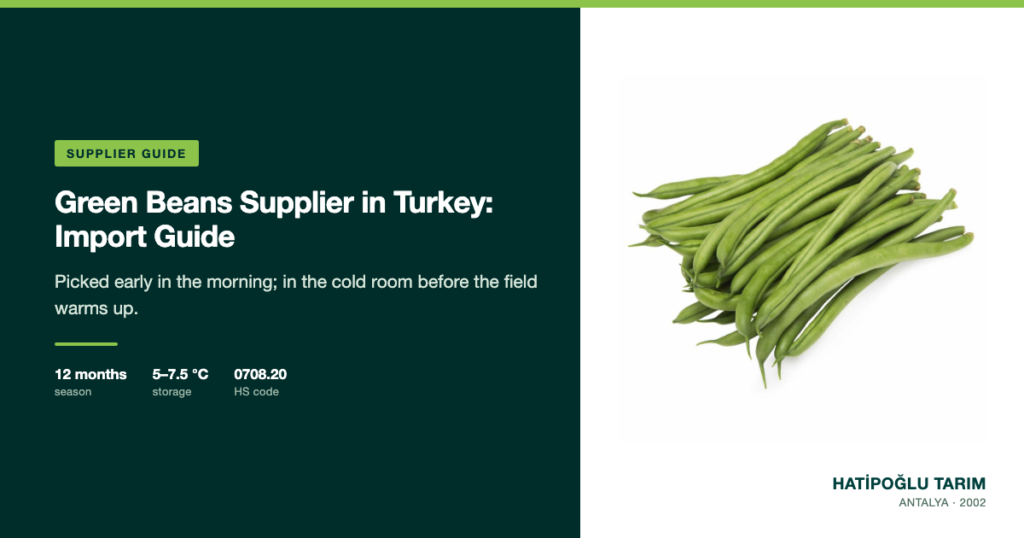
A green beans supplier’s work can be checked at the receiving dock with one movement: bend a pod, and it should snap instead of folding. Hatipoğlu Tarım, an Antalya-based exporter of fresh fruit and vegetables founded in 2002, describes that clean break as the sign that a bean has kept its crispness. This guide is written for importers, wholesalers and retail buyers. It follows the questions a buyer asks: when the product is available, how quality is defined, what the research says about temperature and water loss, how the beans are packed and how to obtain a quotation.
What the buyer is paying for
Green beans are valued for three things: a bright green colour, a regular pod and a crisp texture. Hatipoğlu Tarım selects the product for export on colour, length, pod integrity and freshness. A pod that bends without breaking has lost part of that crispness.
Season: green beans from Turkey through the year
The crop is grown under cover, and according to the company this makes supply possible throughout the year. The busiest periods are spring and autumn. If your programme runs outside those two peaks, mention the weekly volume early in the enquiry. The months of the other products are listed in our season calendar.
Quality criteria and the snap test
The company’s own selection criteria are short:
- Colour: bright green.
- Length: the pod length is stated in the order.
- Pod integrity: whole pods, not broken ones.
- Freshness: the pod snaps easily when it is bent.
The data published by the UC Davis Postharvest Center describe good beans in similar terms: well formed and straight, bright in colour, fresh in appearance, tender but firm. Leaves, stems, broken beans, blossom remains and insect damage should be absent. The same source places harvest at about 8–10 days after flowering, while the pod is fleshy and the seeds are still small and green. Later, seed development lowers quality: the pod turns pithy and tough and loses its green.
Water loss: a key figure in green beans wholesale
UC Davis names water loss as a common problem in this product. Shrivelling and limpness become visible at a weight loss of about 5%, and after a loss of 10–12% the beans can no longer be marketed. The recommended relative humidity is 95–100%. For green beans wholesale, humidity therefore belongs in the receiving specification next to temperature.
Harvest, cooling and the temperature data
According to the company, the beans are harvested in the early hours of the morning and taken into the cold room before field heat rises.
The research figures are these. UC Davis gives 5–7.5 °C as the optimum, with a shelf life of 8–12 days in that range. Below 5 °C very good quality is kept for a few days, but chilling injury begins; even at the recommended 5 °C some chilling can appear after 7–8 days. Ethylene above 0.1 ppm shortens shelf life at 5 °C by 30–50%, through loss of green colour and browning. In controlled atmosphere, 2–5% oxygen reduces respiration and 3–10% carbon dioxide helps to retain colour. These are published research values; they are not a description of Hatipoğlu Tarım’s procedures. For the general picture, see the cold chain in fresh produce export.
Mixed loads when you import green beans from Turkey
Green beans are sensitive to chilling and do not go into a load carried at 0 °C. With products that travel at similar temperatures, such as cucumbers, aubergines and peppers in the 7–12.5 °C range, a mixed load can be planned together with the buyer. Okra is chilling-sensitive in the same way. Because beans react to ethylene, sharing a vehicle with ethylene-producing fruit is not recommended.
Cartons, pallets and the HS code
The beans are prepared in 60 × 40 × 15 cm cartons and packed according to the shipment plan. Cartons stand on 80 × 120 cm euro pallets; more on case sizes is in our article on packaging and case sizes in export. At six digits, fresh beans fall under HS 0708.20. Ask your customs broker to confirm the full tariff line before shipment.
Certificates and residue analysis
As a green bean exporter in Turkey, Hatipoğlu Tarım works with ISO 9001, ISO 22000, ISO 10002, GLOBALG.A.P. IFA and GRASP. Each lot that leaves for Europe passes a residue analysis first. Limits are explained in our article on EU pesticide MRLs.
Import process: from the morning pick to the truck
The sequence has six steps: harvest early in the morning, cooling, grading by colour, length and pod integrity, packing, cold storage and dispatch. All six are handled in house. Shipments are planned by the truck, and a standard 13.60 m refrigerated truck takes 33 euro pallets.
What to send for a quotation
A quotation starts from six details: the type of bean, the pod length, the packaging, the weekly volume, the delivery week and the destination country. You can reach us by phone on +90 242 339 55 25, on WhatsApp at +90 534 260 07 25 or by e-mail at info@hatipoglutarim.com. If legumes are a wider part of your range, the guide to fresh peas covers a product that is cooled within the first hour after picking.
Hatipoğlu Tarım has exported fresh fruit and vegetables from Antalya since 2002. Under the FİNİKE brand it ships 128 product lines to 42 countries, with harvest, grading, cold storage and dispatch handled in house across five facilities in Serik, Kepez, Mavikent, Yenişehir and Alaşehir.
Send us the pod length, packaging and weekly volume for your green bean programme, and we will prepare the season plan and the price quotation.
