


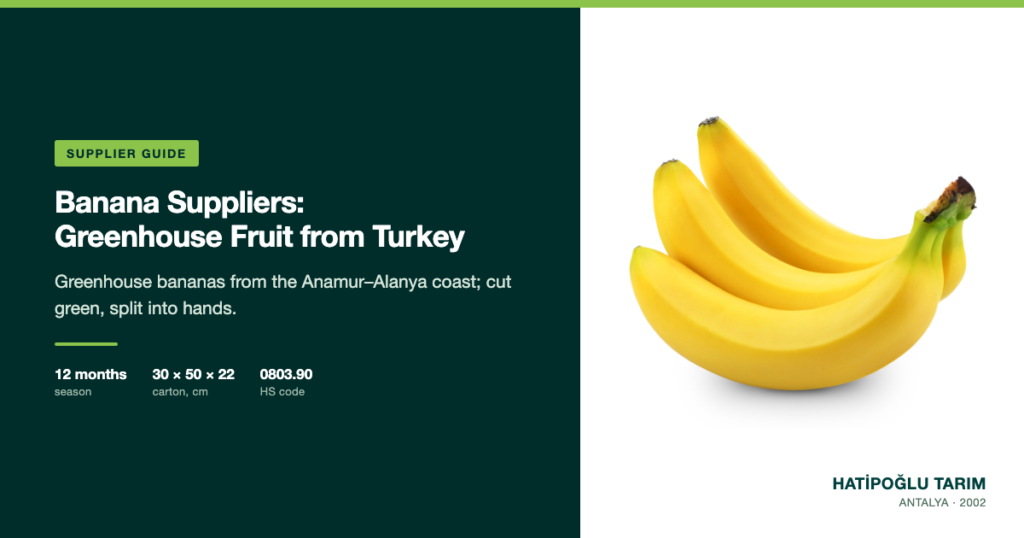
Banana suppliers differ first of all in where and how the fruit grows; the fruit described here grows under glass on the Mediterranean coast. Hatipoğlu Tarım, a fresh fruit and vegetable exporter established in Antalya in 2002, supplies bananas from glasshouse production along the Anamur–Alanya line throughout the year. They are cut green, separated into hands at the facility and either shipped green or taken into the ripening room, according to the buyer’s ripening programme. This guide covers the product, the criteria, the research on temperature and ripening, the carton, the documents and the enquiry.
Short, dense fruit from the Anamur–Alanya line
The company’s text describes Turkish bananas as a short and dense product, grown in glasshouses on the stretch of coast between Anamur and Alanya. The product page for the banana gives the same origin.
Supply through the year
The product text speaks of supply all year round, and the calendar marks all twelve months. Supply through the year is possible; which weeks and which volumes can be covered is a question for the enquiry, not something to read off a calendar. For the seasonal lines that can accompany bananas from Turkey, see the season calendar.
How the bunches are selected
The bunches are selected for export on four criteria:
- Size: the fruit is short by nature; state the size you need.
- Skin integrity: a skin free of damage.
- Colour: the bananas are cut while still green.
- Firmness: checked at selection.
Green or from the ripening room
The central sentence of the product text is this: according to the buyer’s ripening programme, the bananas are shipped green or taken into the ripening room. Your ripening programme is therefore the first thing to describe when you contact us.
Research describes what happens in such a room. The UC Davis figures below were published for Cavendish-type bananas, so they are a reference and not a recipe for the short Turkish fruit. Ripening is carried out with 100–150 ppm ethylene for 24–48 hours at 15–20 °C and 90–95% relative humidity, with CO2 kept below 1%. The source states that bananas are harvested mature-green and ripened on arrival.
Cold shock: the limit is well above zero
The company notes that the fruit is sensitive to cold shock and that the temperature process is therefore controlled carefully. The data published for Cavendish-type bananas put storage and transport at 13–14 °C and relative humidity at 90–95%. Mature-green fruit lasts two to four weeks at 14 °C in air, and four to six weeks in a controlled atmosphere of 2–5% O2 with 2–5% CO2. Chilling injury shows as a dull or smoky skin colour, dark brown streaks under the skin and a failure to ripen.
Two loading rules follow. Bananas do not go into a load that runs at 0 °C. And ripe bananas give off ethylene, so they are not recommended in the same vehicle as kiwifruit. Pineapples and dragon fruit are chilling-sensitive too, but each has its own published temperature, so please do not assume that one setting suits all three.
A deep carton and HS 0803.90
The product table gives one carton for bananas: 30 × 50 × 22 cm. For the six-digit customs code the reference is HS 0803.90. Ask your customs broker to confirm the full tariff line before the goods move.
Certificates and residue testing
As a banana exporter in Turkey, Hatipoğlu Tarım works under ISO 9001, ISO 22000 and ISO 10002, together with GLOBALG.A.P. IFA and GRASP. Residue analysis is a fixed step for every lot that travels to Europe. For the legal background, see our article on EU pesticide MRLs.
From the cut to the truck
If you want to import bananas from Turkey, it helps to know the order of events, because it differs from a chilled product. The bunches are cut green. At the facility they are separated into hands and selected. The hands are packed into cartons. Depending on the buyer’s ripening programme they are then shipped green or taken into the ripening room. Throughout, the fruit is protected from cold shock, and dispatch is by temperature-controlled truck. The planning unit is the full vehicle: a standard 13.60 m truck carries 33 euro pallets of 80 × 120 cm. Pallet layouts are explained in our piece on pallet patterns for fresh produce export.
What we need to quote
Six points: the type, the size, the packaging, the weekly volume, the delivery week and the destination country. We answer on +90 242 339 55 25, on WhatsApp at +90 534 260 07 25 and at info@hatipoglutarim.com.
Hatipoğlu Tarım has exported fresh fruit and vegetables from Antalya since 2002. Under the FİNİKE brand it ships 128 product lines to 42 countries, with harvest, grading, cold storage and dispatch handled in house across five facilities in Serik, Kepez, Mavikent, Yenişehir and Alaşehir.
Write to us about your ripening programme, your weekly volume and your delivery weeks, and we will come back with a season plan and a price quotation for bananas.
