


Few fruits leave an exporter as little room for error as the apricot. It continues to ripen after it is picked, and its shelf life is a fraction of what citrus allows. What decides a successful apricot shipment, then, is rarely the fruit itself — it is how the hours between the orchard and the container are handled.
The season opens in March and closes in August
Our fresh apricot programme opens in March and closes at the end of August. The first fruit of the season comes from protected cultivation; the open-field harvest joins in May. Within that six-month window sit three distinct periods, each with a different buyer.
March and April belong to early protected-cultivation fruit: volumes are small, prices are high, and the buyers are usually European retailers filling an early-season shelf. May and June bring the open-field harvest and the peak of available volume, which makes them the natural months for programme shipments. July and August carry the late varieties, when competition thins out.
Separating these three periods matters at the planning stage. April pricing and June volume cannot be had at the same time, and a programme built on that assumption will not hold.
Sizing follows the market, not the packhouse
Apricots are graded by diameter, and the preferred grade shifts from market to market. Russian and Middle Eastern buyers favour larger fruit, while European retail asks above all for consistency of size and an unblemished skin. In practice, mixed sizing within a single consignment generates more complaints than a genuine quality defect does.
Skin colour gives the first reading of maturity, though never the whole picture. The longer the journey, the firmer the fruit must be at harvest: a nearby market can take fruit that has turned fully yellow, while a distant one needs fruit cut as the colour is still breaking.
Cold chain: 0–2 °C, and no waiting
Apricots hold at 0–2 °C, and that range has to be reached as soon after harvest as the operation allows. Removing the field heat — pre-cooling — is not a negotiable step with this fruit. A consignment that skipped it will look sound when the container doors open, but its shelf life was spent on the road.
Proof matters as much as practice. When loading temperature, container set point and in-transit readings can all be handed to the buyer as records, the consignment is accepted without argument.
Packing: protection and pallet efficiency together
The common format for fresh apricots is a single-layer tray measuring 30 × 40 × 14 cm. The single layer keeps the fruit from bruising under its own weight, and the tray height lets air move through the case rather than around it.
Pallet configuration decides as much as the case does. A pallet stacked without air channels will chill its outer rows and leave the core warm — which is precisely why the temperature a buyer measures at the door can differ from the true temperature inside the load.
Documentation and traceability
Every consignment of fresh produce bound for Europe must stand up to scrutiny on residue limits and traceability. GLOBALG.A.P. certification records the growing stage; ISO 22000 covers food safety management inside the packhouse. When something goes wrong, the first question a buyer asks is which orchard the fruit came from. An answer that takes days rather than hours costs more than the claim itself.
What to look for in a supplier
With a fruit this perishable, three supplier qualities carry the most weight. The first is cold storage close to the growing area, since a shorter run from field to facility buys shelf life at the far end. The second is the ability to hold a programme across the whole season rather than a few peak weeks. The third is record discipline.
Apricot export: from harvest to loading
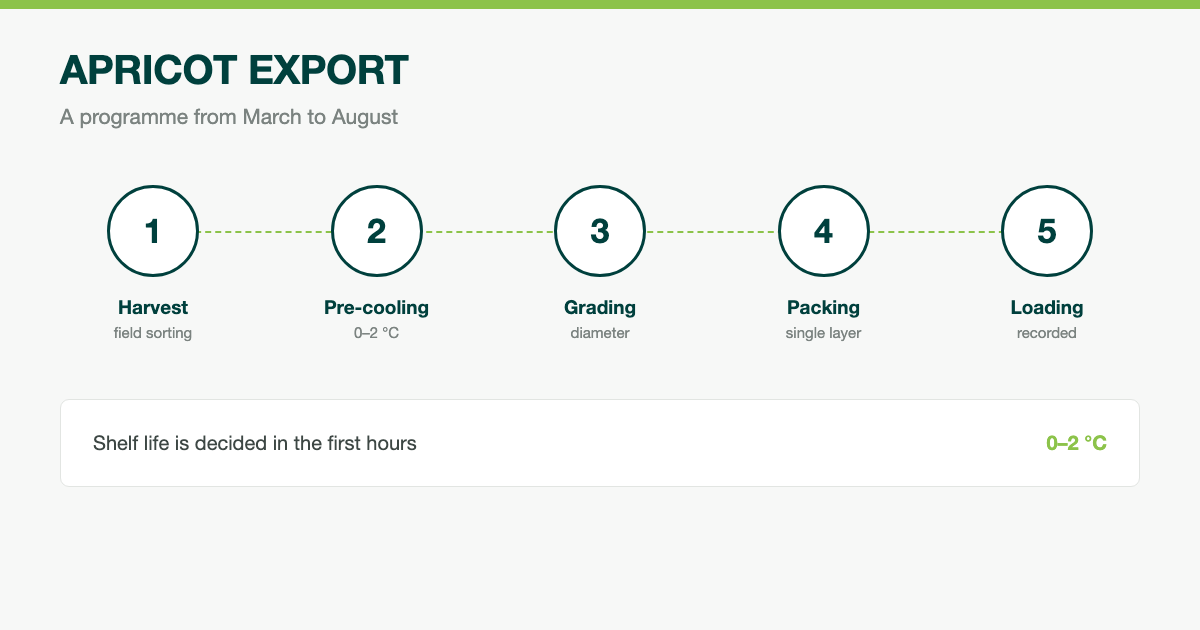
Exporting apricots from Turkey runs in six steps: harvest, cooling, grading, packing, cold storage and dispatch under cold chain. As a Turkish apricot exporter and supplier, Hatipoğlu Tarım handles all of them in house, in its own facilities. When export-grade fruit is allocated, the buyer’s market, sales channel and transit time are considered together, and every lot bound for Europe is also analysed for residues.
To quote for a apricot export programme we need six details: variety, calibre, packaging, weekly volume, delivery week and destination country. With these in hand, we prepare a loading plan and a quotation.
Hatipoğlu Tarım has exported fresh fruit and vegetables from Antalya since 2002. Five facilities — in Serik, Kepez, Mavikent, Yenişehir and Alaşehir — sit close to the growing regions, which shortens the time before produce enters the cold chain. A range of 128 products and shipments to 42 countries make season-long programme continuity possible.
We welcome your enquiry for pricing and a shipping programme for the coming apricot season.
