


A case of tomatoes leaving Antalya takes several days to reach a shelf in Europe. How long that journey takes, which route it follows and how it travels are decided in advance, based on the destination market and how well the crop holds up.
Road: the backbone for most of Europe
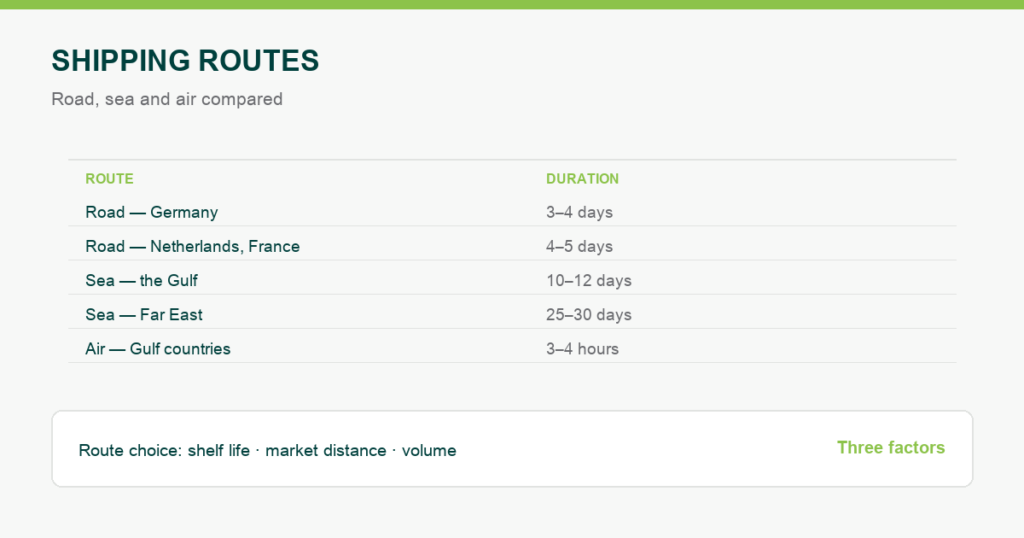
Most of the volume leaving Antalya and its surroundings travels by refrigerated truck. The route runs through Istanbul into Bulgaria and on into Central Europe. Germany takes about 3-4 days; the Netherlands and France take 4-5.
The advantage of road transport is flexibility: the truck goes straight to the buyer’s warehouse, with no transfer point. Temperature stays constant the whole way, and the driver checks it at every border crossing.
Sea: for distant markets and large volumes
For distant markets — the Gulf, the Far East, North Africa — sea freight in containers is the usual choice. It takes longer than road: 10-12 days to the Gulf, 25-30 to the Far East, but the cost per unit is lower and large volumes travel in a single shipment.
The critical point at sea is pre-cooling the container. If it is not brought down to target temperature before loading, the crop has to cool the container itself during the first days of the voyage, and that time comes straight out of shelf life.
Air: for produce that can’t wait
For delicate, high-value crops such as strawberries and cherries, a short shelf life makes air freight the only option. From Antalya to the Gulf takes 3-4 hours — the most expensive method, used only when the margin covers the cost.
Customs and border crossings
Shipments entering the European Union go through phytosanitary inspection at the border. The main documents checked are the GLOBALG.A.P. certificate and the certificate of origin. Without them, the truck is held at the border, and that wait puts the cold chain at risk.
Russia and some Middle Eastern markets require an additional crop-specific import permit. These have to be obtained weeks before shipment; a permit sorted out at the last minute throws the whole shipping schedule off.
Three factors that decide the route
Planning a shipment comes down to three questions: how long does the crop hold, how far is the market, how large is the volume. Short shelf life and a nearby market point to road; long shelf life and large volume point to sea; short shelf life and a distant market point to air.
We plan our shipments around these three methods, matching the route to the buyer’s market and the crop’s characteristics. Browse our range, or get in touch to plan your shipment.
