


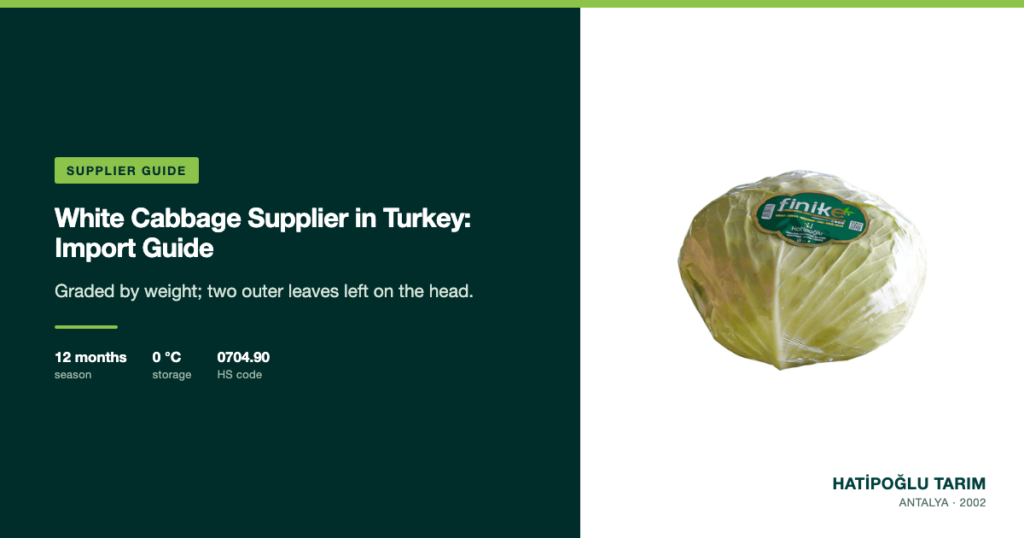
A white cabbage supplier is judged first on how tight the head is when the crate is opened at your depot. Hatipoğlu Tarım is an Antalya-based exporter of fresh fruit and vegetables, established in 2002, and white cabbage appears in every month of its product calendar. This guide is for importers, wholesalers and retail buyers. It explains what the company selects for, when the tightest heads are cut, what published research says about storage, how the crate is built and which details we need before we can quote.
White cabbage from Turkey: a head built for storage
White cabbage is a head vegetable with a tight structure, a pale colour and sturdy leaves that suit storage. The same range includes red cabbage, which shares the wooden crate and the customs heading, so the two can be discussed in one enquiry.
Calendar: twelve months, with autumn as the strong point
All twelve months are marked on the product calendar. The company adds one remark that matters to a buyer planning stock: tight heads cut in autumn in particular can keep their quality for a long time under suitable conditions. If you intend to run a programme through the winter, autumn is the right moment to raise it. Other products of the same months are listed in the Türkiye fresh produce season calendar.
What the heads are selected on
Hatipoğlu Tarım prepares white cabbage for export against four criteria:
- Head weight: the basis of grading; heads are classed by weight, so state the class you want.
- Firmness: a tight, dense head.
- Leaf integrity: whole leaves without tears or decay.
- General quality: the head assessed as a whole.
Data published by UC Davis describe maturity in a way any receiving inspector can use. A compact head yields only slightly to moderate hand pressure, and a very loose head is immature. After the wrapper leaves are removed, a good head shows the colour typical of its type, is firm and heavy for its size, has crisp leaves and is free of insects, decay and seed stalk development.
Trimming: two outer leaves stay on
After grading by weight, each head is cleaned, and two outer leaves are left on to protect it. Their job is protection: they sit between the head and the crate on the journey.
Storage data and mixed loads
According to the data UC Davis publishes for cabbage, the storage temperature is 0 °C at a relative humidity above 95%. Early-crop cabbage keeps for 3–6 weeks and late-crop varieties for up to 6 months. A controlled atmosphere of 2.5–5% oxygen and 2.5–6% carbon dioxide at 0–5 °C brings some benefit. In long storage, heads are trimmed again to remove outer leaves that have deteriorated. These are research figures, not a description of the company’s own store.
Cabbage is sensitive to ethylene, which causes leaf drop and yellowing, so adequate ventilation in storage is important. Cabbage, broccoli, cauliflower, radish, carrot and sweet corn all travel at around 0 °C and high humidity and can share a truck. Placing them with ethylene-producing fruit such as apples, pears, melons and tomatoes is not recommended. More background is in our article on the cold chain in fresh produce export.
Crate, pallet and HS code for cabbage wholesale
White cabbage is packed in a 40 × 50 × 22 cm wooden crate, stacked on 80 × 120 cm euro pallets. In a cabbage wholesale order, name the weight class you want in each crate. The six-digit HS code for white cabbage is 0704.90; confirm the full tariff line with your customs broker before shipment.
Certificates and residue analysis
The company holds ISO 9001, ISO 22000, ISO 10002, GLOBALG.A.P. IFA and GRASP. Every lot bound for Europe goes through residue analysis. Two articles explain what these mean on the buyer’s side: EU pesticide MRLs and which certificates European buyers require.
From the field to the truck: six steps
As a cabbage exporter in Turkey, Hatipoğlu Tarım keeps the chain in house: harvest, cooling, grading by weight, packing into wooden crates, cold storage and dispatch. Shipments are planned by the truck. A standard 13.60 m refrigerated truck takes 33 euro pallets.
Six details for a quotation
If you plan to import cabbage from Turkey, send us the type, the size class, the packaging, the weekly quantity, the delivery week and the destination country. You can phone +90 242 339 55 25, use WhatsApp on +90 534 260 07 25 or write to info@hatipoglutarim.com.
Hatipoğlu Tarım has exported fresh fruit and vegetables from Antalya since 2002. Under the FİNİKE brand it ships 128 product lines to 42 countries, with harvest, grading, cold storage and dispatch handled in house across five facilities in Serik, Kepez, Mavikent, Yenişehir and Alaşehir.
Write to us with the weight class, the weekly volume and the delivery weeks you need, and let us prepare the season plan and the price quotation.
