


For a buyer sourcing fresh fruit and vegetables from Turkey, the real difficulty is not finding an exporter — there are thousands. The difficulty is working out which of them will still be delivering to specification at the end of the season. What follows are the questions worth asking before the first order, in the order they matter.
Start with the supplier’s structure
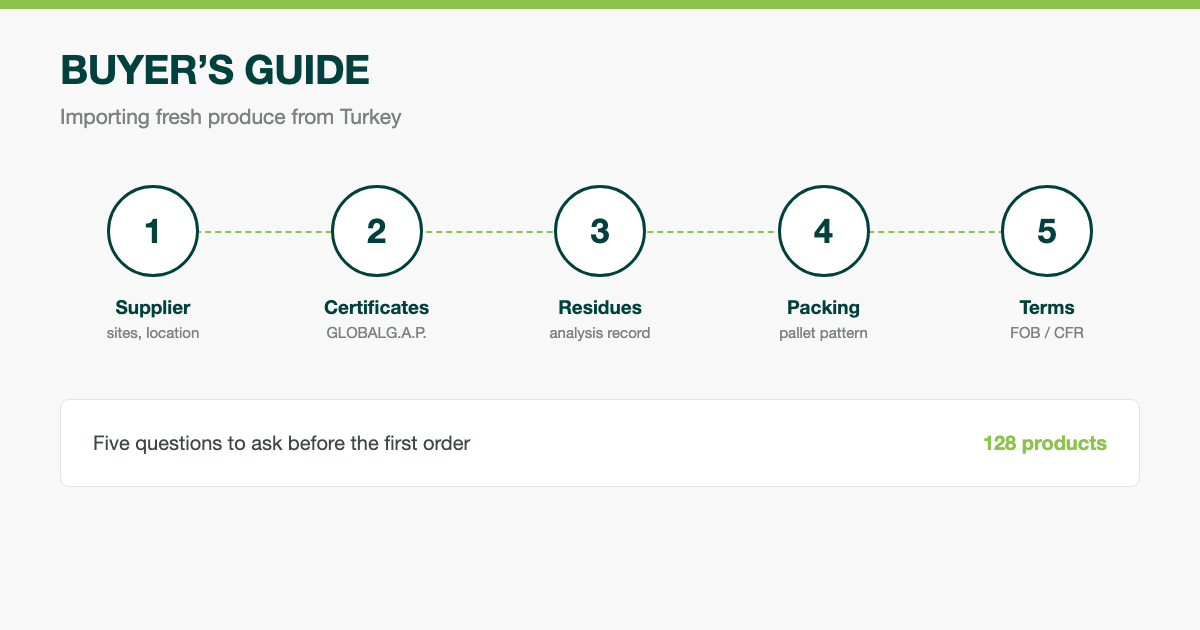
Three concrete things describe an exporter’s capacity: how many facilities they run, where those facilities sit, and how wide the product range is.
Location determines shelf life directly. The shorter the run from field to cold store, the longer the produce lasts on your shelf. An operation concentrated in a single centre stretches that interval for anything grown further away.
The number of facilities tells you how weather-resistant the programme is. With a supplier tied to one region, a frost or a heatwave there stops everything. Production spread across different climate zones distributes that risk.
Range is what lets you shorten your supplier list. Buying thirty lines from one exporter is cheaper and safer than managing documentation and shipping with thirty firms.
Ask for certificates at the first meeting
In fresh produce, certification is not paperwork to be completed later; it decides whether a consignment clears the border.
GLOBALG.A.P. documents the growing stage — which site the produce came from and how it was grown. Most of European retail treats it as a precondition. GRASP works alongside it as the social compliance module.
ISO 22000 covers food safety management inside the packhouse. ISO 9001 covers quality management, and ISO 10002 the handling of customer complaints.
Validity matters as much as possession. Ask for a copy and check the expiry date at the first meeting.
Residue limits: the most common failure
The most frequent hold-up on consignments entering the European Union is a breach of pesticide residue limits. It rarely comes from bad faith — it comes from missing records. All it takes is for the interval between the last pre-harvest application and loading to go untracked.
Put this question to your supplier: for any given consignment, how quickly can you document the growing site and the date of the final application? If the answer is measured in days rather than hours, the relationship carries risk.
Settle packing and pallet configuration when ordering
Packing belongs in the order, not in a later email. The common case size in fresh produce is 30 × 40 × 14 cm, with depth and arrangement varying by product.
Two points decide pallet quality. First, the ventilation holes in the cases must line up vertically through the whole pallet; where they are offset, the air column breaks and the centre never cools. Second, the pallet itself must suit the destination — the 80 × 120 cm euro pallet is the standard for Europe.
Cold chain: every product has its own temperature
The most expensive mistake in fresh produce shipping is running a mixed load at a single set point. Product groups travel under different regimes:
- Stone fruit (apricot, peach, plum): 0–2 °C
- Grapefruit and lemon: 10–14 °C
- Orange and mandarin: 4–8 °C
- Peppers: 7–9 °C
- Aubergine: 10–12 °C
Load grapefruit into a container set for stone fruit and the produce takes chilling injury — and the damage surfaces not in transit but in your own warehouse. Container planning has to follow the product group.
Ask for the records too. When loading temperature, container set point and in-transit readings can all be produced as documents, any dispute is settled quickly.
Incoterms and payment
FOB and CFR are the terms most used in fresh produce. Under FOB, freight and insurance fall to the buyer, which suits those with their own shipping arrangements. Under CFR the freight sits with the seller, which makes price comparison simpler. Under both, risk passes to the buyer once the goods are loaded on board at the port of shipment.
Advance or part-advance payment is normal on early orders, moving to credit terms as the relationship settles. Rather than asking a new supplier for large volume on the first consignment, starting with a small trial load is both established practice and plain good sense.
Programme buying or spot
Spot buying can win on price in a given week, but it gives no continuity across a season. Under a programme, weekly volumes and a price range are agreed in advance, and the supplier plans production accordingly.
For a buyer who has to keep a shelf filled, a programme almost always costs less in the end. Spot prices rise precisely in the week everyone is looking for goods.
About Hatipoğlu Tarım
Hatipoğlu Tarım has exported fresh fruit and vegetables from Antalya since 2002, shipping to 42 countries under the export brand FİNİKE.
Five facilities — in Serik, Kepez, Mavikent, Yenişehir and Alaşehir — are spread across different climate zones. That structure shortens the time before produce enters the cold chain and keeps weather in one region from halting the programme. A range of 128 products allows buyers to work with fewer suppliers.
On quality and food safety the company holds ISO 9001, ISO 22000 and ISO 10002, together with GLOBALG.A.P. IFA and GRASP.
Send us the products, volumes and delivery period you need, and we will prepare a price and programme offer.
