


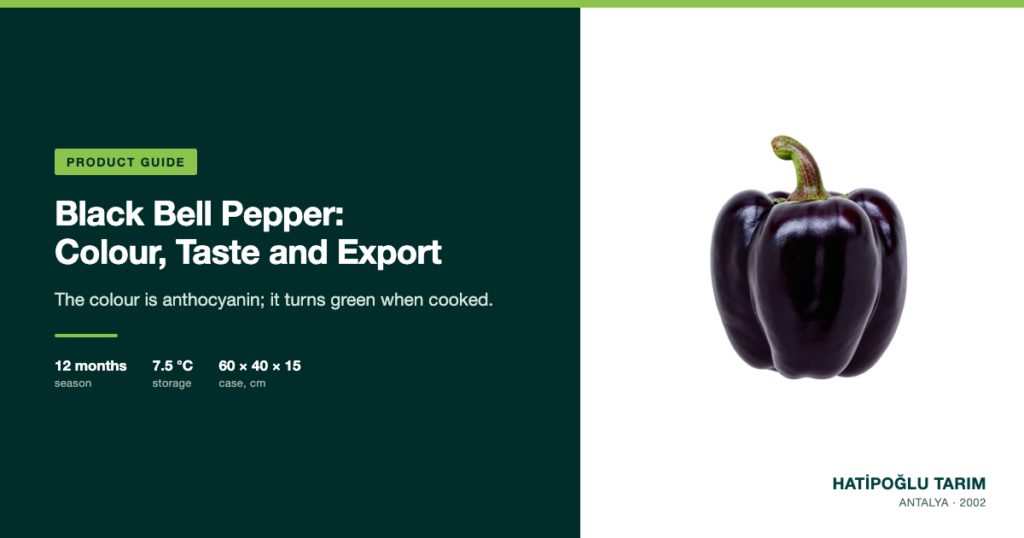
In Turkey, “California pepper” is the name given to the blocky, thick-fleshed, sweet bell pepper. The Black California pepper is the least known member of that family: during ripening its skin approaches a deep purple-black. It is searched for as “black bell pepper” or “purple bell pepper” in English and as “schwarze” or “lila Paprika” in German. This guide explains where the colour comes from, how the pepper tastes, how it behaves in the kitchen and the conditions for export. Hatipoğlu Tarım is a fresh pepper exporter based in Antalya, Turkey, and ships black bell pepper all year round; what follows reflects the criteria applied every day in Turkish pepper export.
Where the colour comes from
The substance behind the purple-black colour is anthocyanin. It belongs to the same group of pigments that colour blueberries and red cabbage. In peppers, anthocyanin builds up in the skin during the unripe stage of the fruit. The flesh beneath the skin is green, as you can see when you cut the pepper open.
If the fruit is left on the plant to ripen fully, the anthocyanin disappears and the pepper turns red, depending on the variety. A black pepper is thus, just like a green bell pepper, a product harvested before ripening is complete. That is why harvest timing matters: in fruit picked too early the colour has not fully set, and in fruit picked too late the turn to red has already begun.
Why it turns green when cooked
Anthocyanin is not heat-stable. When a black pepper is cooked, the purple pigment breaks down and the green underneath shows through. This is not a defect of the product but the nature of the pigment. Buyers need to explain it to their customers:
- Used raw, the colour is kept: salads, mezze platters, crudités, sandwiches.
- In cooking, the colour turns green; flavour and texture are the same as in other bell peppers.
The real value of the black pepper in the kitchen is the colour contrast it creates in raw presentation.
Purple bell pepper taste: what to expect
Because it is harvested at the unripe stage, its taste is close to that of a green bell pepper: sweet, slightly sharp, with less sugar than a red pepper. It is not hot. The flesh is thick and crisp.
Which buyers it suits
The Black California pepper is not a volume product but a line that rounds off a select product range:
- Retailers who want to add a fourth colour to their mixed colour packs
- Wholesalers supplying restaurants and hotels that care about plate presentation
- Food shops that stock speciality and unusual vegetables
For buyers who already run a green, red and yellow pepper programme, it is an easy way to widen the range: it travels in the same carton, on the same pallet and at the same temperature. For the standard colours, see our bell pepper guide.
Selection criteria
Hatipoğlu Tarım selects its Black California peppers for colour development, shape, skin integrity and freshness:
- Colour development: the whole skin must be dark and uniform. Fruit with areas that have stayed green or started to redden is sorted out.
- Shape: a regular blocky form is required.
- Skin: glossy and taut. Scratches and rub marks show more clearly on dark skin than on a pale pepper, so handling is more careful.
- Uniform appearance: during harvest and sorting, care is taken that the lot looks uniform.
Storage, season and packing
The conditions are the same as for other bell peppers: 7.5 °C and a relative humidity above 95%. Under these conditions shelf life is 3–5 weeks; peppers held below 7 °C for long show chilling injury. The black bell pepper is supplied all year and packed in 60 × 40 × 15 cm cartons, in a lot arrangement suited to the retail or wholesale needs of the destination market. The details are in our pepper storage guide.
Black bell pepper export: from harvest to loading
Exporting black bell pepper from Turkey runs in six steps: harvest, same-day cooling, grading, packing, cold storage and dispatch by refrigerated truck. At Hatipoğlu Tarım all of these are handled in house, in the company’s own facilities. When export-grade peppers are allocated, the buyer’s market, sales channel and transit time are considered together, and every lot bound for Europe is also analysed for residues.
As a Turkish pepper exporter we need six details to quote: variety, size or calibre, packaging, weekly volume, delivery week and destination country. With these in hand, we prepare a loading plan and a quotation.
Hatipoğlu Tarım has exported fresh fruit and vegetables from Antalya since 2002. Under the FİNİKE brand it ships 128 product lines to 42 countries, with harvest, grading, cold storage and dispatch handled in house across five facilities in Serik, Kepez, Mavikent, Yenişehir and Alaşehir.
Tell us the volume and delivery week you need for Black California peppers, and we will prepare a sample and a price.
