


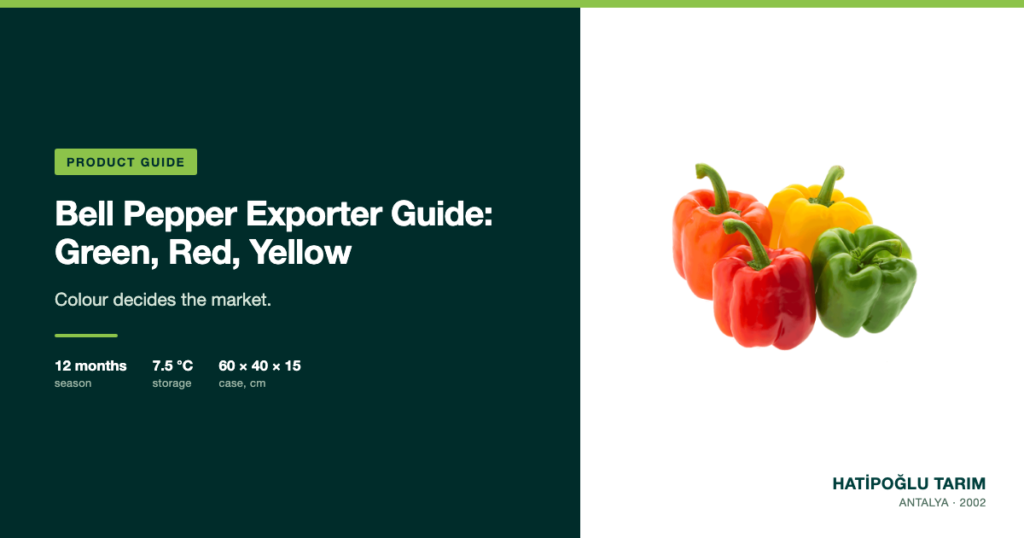
With its four-lobed blocky shape, thick flesh and sweet flavour, the bell pepper is the most widely traded pepper type in the world. In Turkish it is called dolmalık biber, “the pepper for stuffing”; in German, “Blockpaprika”. It is sold green, red and yellow, and the market is driven largely by colour. Written from the standpoint of a bell pepper supplier, this guide explains the difference between the colours, the selection criteria and the conditions for export. Hatipoğlu Tarım is a fresh pepper exporter based in Antalya, Turkey, and ships bell pepper all year round; what follows reflects the criteria applied every day in Turkish pepper export.
Are green, red and yellow peppers the same plant?
A green bell pepper is unripe fruit. Left on the plant it turns red or yellow, depending on the variety. Green and red peppers are therefore in most cases two maturity stages of the same plant, whereas yellow peppers come from separate varieties that ripen to yellow.
Ripening changes the flavour too. Green peppers are sharper and slightly astringent; red and yellow peppers are sweeter. Because coloured peppers stay on the plant longer, their production cost and their price are higher.
The rule in trade is this: a coloured pepper can complete its colour if it is picked when at least 50% coloured. Fruit picked earlier stays partly coloured and does not go into a retail lot.
Colour drives the market
In European retail, bell peppers are sold mostly by colour. The three-colour mixed pack (“traffic light”) is a familiar presentation and requires all three colours in the same size. In markets where Turkish and Balkan cooking dominates, by contrast, the demand is for green, medium-sized, thin-walled peppers for stuffing. The market the buyer sells into determines which colour and which size is prepared.
Selection criteria
Hatipoğlu Tarım selects its bell peppers for shape, colour, skin integrity and freshness:
- Shape: a regular four-lobed blocky form is the basic criterion. Regular shape determines both shelf appearance and packing efficiency; misshapen fruit leaves gaps in the carton.
- Colour: uniform and bright. Partly coloured fruit is sorted out.
- Skin: glossy and taut, free of cracks, bruises and sunscald.
- Firmness: the firmness of a pepper is the measure of its water loss. Soft fruit is fruit that has been waiting.
Why a short stem matters
Bell peppers are harvested with a short stem. A long stem punctures the skin of the neighbouring pepper in the carton; the punctured skin both spoils the appearance and opens the door to decay. A stem cut short protects the calyx end of the fruit and helps it stay fresh for longer. Mechanical damage is the most common defect in peppers, and most of it occurs between harvest and packing.
Storage: 7.5 °C and high humidity
Bell peppers achieve their longest shelf life at 7.5 °C; under this condition it is 3–5 weeks. Relative humidity must be kept above 95%. Peppers can be held at 5 °C for about two weeks, but beyond that chilling injury begins: pitting of the skin, darkening of the seed cavity and decay. Ripe, coloured peppers tolerate chilling better than green ones.
Peppers are sensitive to high carbon dioxide; levels above 5% cause pitting of the skin and discolouration. To ethylene they respond very little. Temperature management is covered in detail in our cold chain article.
Season and packing
Bell peppers are supplied all year from greenhouse production. The product is packed in 60 × 40 × 15 cm cartons. How protected cultivation makes year-round supply possible is explained in our article on year-round loading. For the speciality type with a dark purple-black skin, see our Black California pepper page.
Bell pepper export: from harvest to loading
Exporting bell pepper from Turkey runs in six steps: harvest, same-day cooling, grading, packing, cold storage and dispatch by refrigerated truck. At Hatipoğlu Tarım all of these are handled in house, in the company’s own facilities. When export-grade peppers are allocated, the buyer’s market, sales channel and transit time are considered together, and every lot bound for Europe is also analysed for residues.
As a Turkish pepper exporter we need six details to quote: variety, size or calibre, packaging, weekly volume, delivery week and destination country. With these in hand, we prepare a loading plan and a quotation.
Hatipoğlu Tarım has exported fresh fruit and vegetables from Antalya since 2002. Under the FİNİKE brand it ships 128 product lines to 42 countries, with harvest, grading, cold storage and dispatch handled in house across five facilities in Serik, Kepez, Mavikent, Yenişehir and Alaşehir.
Tell us the colour, size and delivery week for your Turkish bell pepper programme, and we will send back a plan and a price.
