


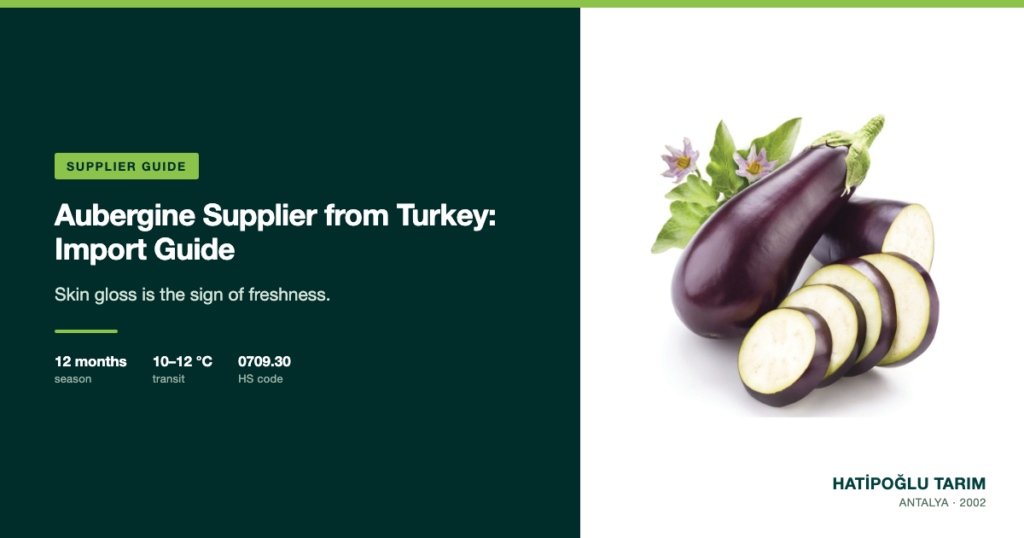
An aubergine supplier from Turkey can load in every month of the year, because the crop is grown in glasshouses. What differs from one supplier to the next is the condition of the skin on arrival: glossy and unmarked, or dull and bruised. Hatipoğlu Tarım is an Antalya-based exporter of fresh fruit and vegetables, established in 2002, and aubergine, sold in some markets as eggplant, is one of its year-round lines. Buyers searching for an eggplant exporter in Turkey will find the same product and the same programme here. The guide addresses importers, wholesalers and retail buyers. It covers the product, the calendar, quality criteria, harvest and handling, transport temperature and ethylene, packaging, the HS code, documents and how to get a quote.
Turkish aubergine: what buyers look for
Aubergine is a greenhouse product in demand throughout the year. A good Turkish aubergine has a glossy skin, a regular shape and firm flesh. It is harvested immature, before the seeds enlarge and harden. Overmature fruit becomes spongy and bitter. Firmness and skin gloss are the two signs that the fruit was picked at the right moment. Other greenhouse lines, such as peppers, have their own guide: import peppers from Turkey.
Season: aubergines from Turkey in all twelve months
Glasshouse production keeps aubergine available in all twelve months; our article on protected cultivation explains how Antalya keeps harvesting through the winter. Winter quantities are more limited. A buyer who states the weekly requirement in advance has the programme planned around it.
Quality criteria for export aubergines
Aubergines are selected for export on:
- Size: the pieces in one carton are close to one another; the size you need is stated in the order.
- Skin gloss: a bright, glossy skin. A dull skin points to age or to fruit harvested too late.
- Colour: uniform across the fruit and across the carton.
- Surface: free of bruises, scratches and pressure marks.
- Calyx: attached. A calyx that drops or browns points to ethylene exposure.
Cut at the stem: why greenhouse eggplant is handled so carefully
The surface of an aubergine is delicate and bruises easily. To limit this, the fruit is cut at the stem during harvest, and it is handled with care from the greenhouse to the carton. Skin gloss is the buyer’s quickest check on all of this. In glasshouse aubergines it is one of the main indicators of freshness and of correct harvest timing.
Transport temperature, shelf life and ethylene
The optimum for aubergine is 10–12 °C at a relative humidity of 90–95%. Storage life is generally less than 14 days. Lower temperatures are sometimes used to reduce weight loss, but they cause chilling injury within a few days. Rapid cooling after harvest is recommended to limit water loss.
Aubergine is moderately to highly sensitive to ethylene. Above 1 ppm, ethylene causes the calyx to drop and the fruit to brown. Aubergines and cucumbers travel at a similar temperature and can be loaded together. Tomatoes produce ethylene, so they are not put on the same vehicle as aubergines or cucumbers. Courgettes prefer it a little cooler, at 5–10 °C, and none of these vegetables travels with fruit carried at 0 °C. For the principles, see the cold chain in fresh produce export article.
Packaging for aubergine wholesale, and the HS code
Aubergines are packed in cartons of 60 × 40 × 15 cm, arranged to suit the loading plan. For aubergine wholesale and for retail programmes alike, state the size range in the enquiry. The cartons are stacked on 80 × 120 cm euro pallets; pallet patterns are covered in our guide to loading a reefer and pallet patterns.
Fresh aubergines fall under HS code 0709.30; please confirm the classification with your customs broker before shipment.
Documents when you import aubergines from Turkey
Hatipoğlu Tarım is certified to ISO 9001, ISO 22000 and ISO 10002 and holds GLOBALG.A.P. IFA and GRASP. Each lot of aubergines bound for Europe goes through residue analysis. How the limits apply is explained in our article on EU pesticide MRLs; the usual paperwork is listed in which certificates European buyers require.
Import process: from the glasshouse to your warehouse
The six steps for aubergines are harvest by cutting at the stem, cooling, grading, packing, cold storage and dispatch, and each of them is carried out in house. Shipments are planned by the truck, and a standard 13.60 m refrigerated truck takes 33 euro pallets.
How to get a quote
To quote we need six details: type, size, packaging, weekly volume, delivery week and destination country. A loading plan and a quotation follow from these details. We can be reached by phone on +90 242 339 55 25, on WhatsApp on +90 534 260 07 25 and by e-mail at info@hatipoglutarim.com.
Hatipoğlu Tarım has exported fresh fruit and vegetables from Antalya since 2002. Under the FİNİKE brand it ships 128 product lines to 42 countries, with harvest, grading, cold storage and dispatch handled in house across five facilities in Serik, Kepez, Mavikent, Yenişehir and Alaşehir.
Tell us the size, weekly volume and destination for your aubergine programme, and we will prepare a loading plan and a quotation.
