


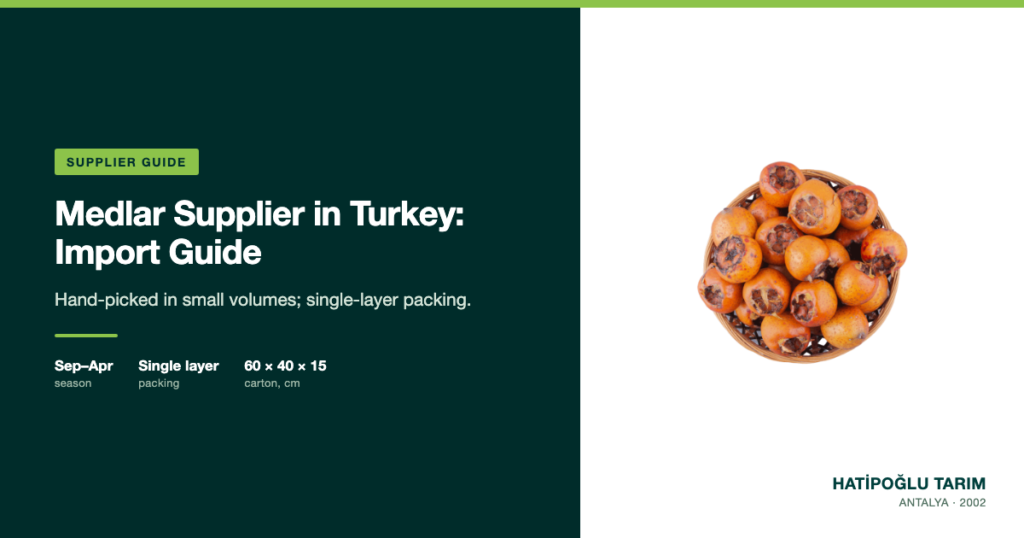
A medlar supplier deals with a fruit unlike the rest of the pome range: it is picked by hand in small volumes, and it becomes ready to eat only after it has softened. Hatipoğlu Tarım, a fresh produce exporter based in Antalya and active since 2002, lists medlar in its range from September to April. This guide is for importers, wholesalers and retail buyers who want to import medlars from Turkey and need to know how the fruit behaves, how it is packed and how to ask for a quotation.
First, the right fruit: medlar is not loquat
The medlar described here is Mespilus germanica, a traditional fruit of autumn and winter. It is a different fruit from the loquat, and the two should not be confused. When you see medlar fruit for sale from an exporter, check the botanical name before you order, so that the fruit you receive is the one your customers expect.
What makes Turkish medlar unusual
Two things set the fruit apart: a distinctive aroma, and a texture that develops only after harvest. Turkish medlar is picked by hand. After harvest, the flesh softens and the balance of flavour develops, and it is at that point that the fruit becomes ready to eat. Stage of ripening is one of our selection criteria, so it helps to mention your expectation in the enquiry.
Season and volumes
Our calendar shows medlar in eight months of the year: September, October, November and December, then January, February, March and April. The fruit is harvested by hand and in small volumes, so it is sensible to raise volumes early in the conversation.
Other autumn fruits in the same family of guides are quince, supplied from September to January, and the Deveci pear, supplied from September to April. The full picture is in the season calendar.
Selection criteria
We prepare medlar for export by selecting on four points:
- Size: uniform fruit within the carton.
- Skin integrity: whole, undamaged skin.
- Firmness: judged fruit by fruit, because firmness changes as the medlar softens.
- Stage of ripening: the criterion that is particular to this fruit.
Why the pack is shallow and single-layer
As medlar softens it becomes sensitive to pressure. To prevent crushing, transport is planned in a shallow, single-layer packing arrangement: no fruit lies on top of another. The pack is a 60 × 40 × 15 cm carton, prepared according to the shipment plan.
For medlar fruit wholesale orders the consequence is practical: the pack is single-layer, so state the volume you need in cartons or pallets. The logic of carton footprints on a pallet is explained in packaging and case sizes in export.
Pallets and shipment planning
Cartons are palletised on euro pallets of 80 × 120 cm. Our shipments are organised by the truck, and the standard 13.60 m refrigerated truck has room for 33 such pallets. Since medlar is harvested in small volumes, tell us in your enquiry how many pallets you have in mind, so that the shipment can be planned around that figure.
Customs classification
Medlar has no subheading of its own in the Harmonised System. It is generally declared under HS 0810.90, which covers other fresh fruit. As always, the full tariff line is something to confirm with your customs broker before the shipment.
Certificates and residue analysis
On the certification side, the company holds ISO 9001, ISO 22000, ISO 10002, GLOBALG.A.P. IFA and GRASP. A lot that is going to Europe is always put through residue analysis. If you are preparing a supplier file, two articles help: which certificates European buyers require and EU pesticide MRLs. General questions to put to any exporter are collected in our guide to Turkish fruit and vegetable suppliers.
Import process: six steps, one company
The chain consists of harvest by hand, cooling, grading by size, firmness and stage of ripening, packing in shallow single-layer cartons, cold storage and dispatch by refrigerated truck. Each of these six steps stays in house.
How to ask for a quotation
To quote, we need to know six things: the variety, the size, the packaging, the weekly volume, the delivery week and the destination country. Our telephone is +90 242 339 55 25 and our WhatsApp number +90 534 260 07 25; enquiries by email reach us at info@hatipoglutarim.com.
Hatipoğlu Tarım has exported fresh fruit and vegetables from Antalya since 2002. Under the FİNİKE brand it ships 128 product lines to 42 countries, with harvest, grading, cold storage and dispatch handled in house across five facilities in Serik, Kepez, Mavikent, Yenişehir and Alaşehir.
Get in touch with the volume and delivery weeks you need for medlar, and we will reply with availability and a quotation.
