


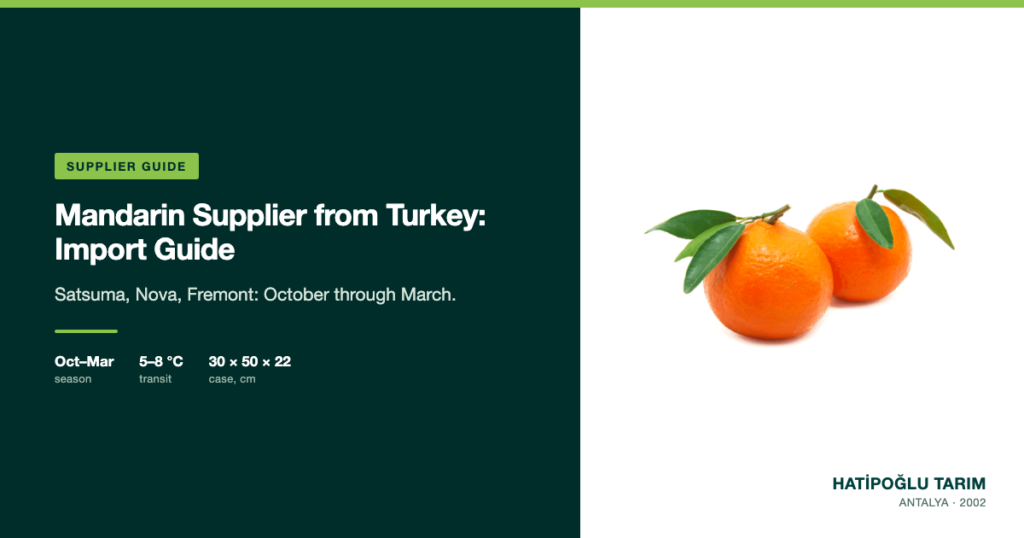
Choosing a mandarin supplier from Turkey comes down to a short list of questions: which variety is loading in which part of the season, how the loose skin is protected on the road, and what temperature the truck runs at. Hatipoğlu Tarım is a fresh produce exporter based in Antalya, in business since 2002, and it prepares mandarins for export from October to March. This guide is written for importers, wholesalers and retail buyers who want to import mandarins from Turkey.
What Turkish mandarins bring to a citrus range
The mandarin is a table fruit: the skin comes away easily, the flesh is juicy and the aroma is balanced. A skin that peels easily sits loosely on the fruit, and a loose skin marks under pressure. Turkish mandarins suit retail programmes and the mandarin wholesale trade alike, provided the packing and stacking are planned around that skin.
Satsuma, Nova, Fremont: three varieties in sequence
Our mandarin programme is built on three varieties that follow one another through the season: Satsuma comes first, Nova follows and Fremont closes. When you ask for a quotation, state the variety you want or the weeks you need covered.
Where mandarins sit in the Turkish citrus export season
Mandarins are shipped from October to March. Within the Turkish citrus export season they start a month ahead of oranges, which begin in November. How the citrus lines overlap is set out in our article on citrus export and harvest seasons. Buyers who take oranges alongside mandarins will find the details in our guide to choosing an orange supplier from Turkey. For a seedless table orange in the same winter window, see the Washington navel guide.
Quality criteria for export mandarins
- Size: fruit in one crate is uniform; the size range is fixed in the order.
- Colour: even skin colour across the crate. The maturity index cited by UC Davis postharvest research is colour on 75% of the fruit surface.
- Skin integrity: no cuts, punctures or pressure marks; the stem is kept short.
- Maturity: the same research gives a soluble solids to acid ratio of at least 6.5 as the threshold for harvest.
Short stems, loose skin and controlled stacking
Mandarins are harvested with care, leaving a short stem. A second risk at picking is oil spotting (oleocellosis): when turgid fruit is picked and handled, the oil glands in the skin rupture and the released oil damages the surrounding tissue.
Because the skin is loose, crate stacking is controlled so that the fruit is not bruised in transit.
Storage and transport temperature
The optimum temperature for mandarins is 5–8 °C at 90–95% relative humidity. Depending on variety, maturity and the decay-control treatments applied, storage life is 2 to 6 weeks, a good deal shorter than for oranges.
Below 5 °C mandarins suffer chilling injury: pitting and brown discolouration of the skin, followed by greater susceptibility to decay. The longer the fruit stays below 5 °C, the more severe the damage. Removing ethylene from the store and from the vehicle helps to reduce decay. See also our article on the cold chain in fresh produce export.
Packaging, mixed loads and customs classification
Depending on market demand, mandarins are packed loose or in nets. The standard pack is a 30 × 50 × 22 cm plastic crate, palletised on 80 × 120 cm euro pallets. Crate footprints and pallet patterns are explained in packaging and case sizes in export.
Shipments are planned by the truck: a standard 13.60 m refrigerated truck takes 33 euro pallets. Mandarins and oranges travel in a similar temperature range and can be loaded together. Lemons need warmer conditions (12–14 °C, see our lemon guide); in a mixed load with lemons the temperature must be set for the lemons. Mandarins do not share a vehicle with fruit carried at 0 °C.
In the Harmonised System, mandarins fall under the 0805.2 subheadings. Please confirm the full tariff line with your customs broker before shipment.
Documents and residue analysis
Hatipoğlu Tarım holds ISO 9001, ISO 22000, ISO 10002, GLOBALG.A.P. IFA and GRASP certification. Every lot bound for Europe goes through residue analysis. Background reading: EU pesticide MRLs.
Import process: from the grove to your warehouse
As a mandarin exporter in Turkey we run the process in six steps: harvest with a short stem, cooling, grading by size and colour, packing loose or in nets, cold storage and dispatch by refrigerated truck. All six steps are handled in house.
How to get a quote
We need six details to quote: variety, size, packaging, weekly volume, delivery week and destination country. You can reach us by phone on +90 242 339 55 25, by WhatsApp on +90 534 260 07 25 or by email at info@hatipoglutarim.com.
Hatipoğlu Tarım has exported fresh fruit and vegetables from Antalya since 2002. Under the FİNİKE brand it ships 128 product lines to 42 countries, with harvest, grading, cold storage and dispatch handled in house across five facilities in Serik, Kepez, Mavikent, Yenişehir and Alaşehir.
Send us the variety, pack type and weekly volume for your mandarin programme, and we will reply with a loading plan and a quotation.
