


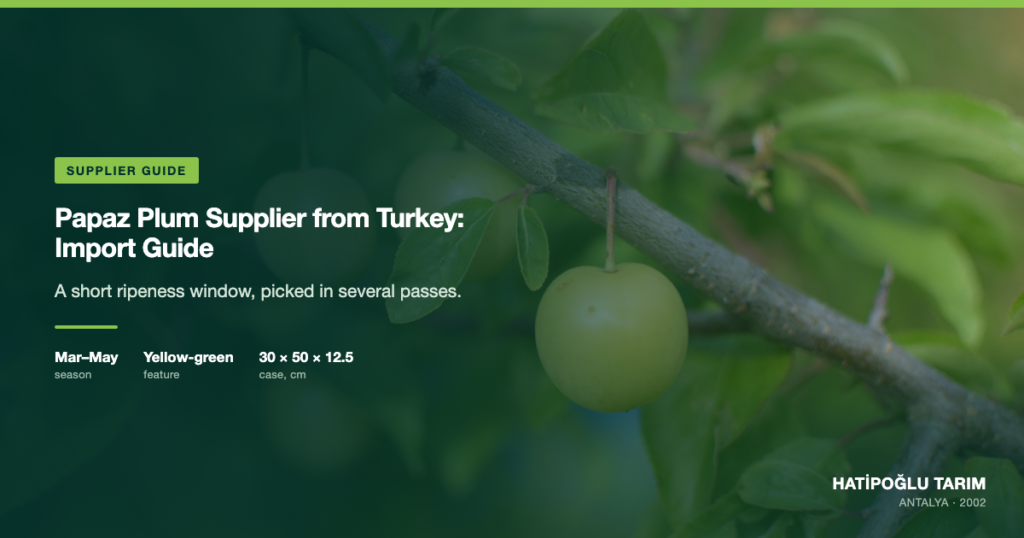
Choosing a Papaz plum supplier comes down to one question: will every lot taste and feel like the one before it? This plum has a short ideal maturity window on the tree, and the difference between suppliers lies in how that window is caught. Hatipoğlu Tarım is a fresh produce exporter based in Antalya, founded in 2002, and it prepares Papaz plums for export each spring. This guide is for importers and wholesalers who want to import Papaz plums from Turkey. It explains what the fruit is, who buys it, when it is available, how it is harvested and packed, and what we need from you to quote.
What the Papaz plum is
The Papaz plum is a large spring plum with yellow-green skin and a flavour balanced between sour and sweet. It is often mentioned together with can eriği, the Turkish green plum, but it is a different product. Can eriği is sold for its sharp sourness and hard bite. The Papaz plum is larger and is bought for the balance between acidity and sweetness.
Who buys it
Outside Turkey the Papaz plum is a speciality product. It is asked for mainly by retailers and greengrocers whose customers know Turkish, Middle Eastern and Iranian cooking, and by the wholesalers who supply those shops. In a Papaz plum wholesale programme the end customer knows what the fruit should taste like, so inconsistency between deliveries is noticed at once.
Papaz plum season: March to May
The fruit is harvested from March to May. The season opens after can eriği has started and closes before summer stone fruit begins in June, so it fills the spring gap in a plum range. The wider picture is in our season calendar for Turkish fresh produce. Because the window is limited, weekly volumes are best agreed before the season opens.
Harvest in several passes: how consistency is kept
Fruit on the same tree does not reach the ideal maturity range on the same day. For that reason the same orchard is picked in several passes. Each pass takes only the fruit that has reached the agreed stage and leaves the rest for the next one. Picking everything in one pass would put hard, sour fruit and soft, sweet fruit in the same carton. Picking in passes is what keeps firmness and flavour balance similar in every shipment lot. When you compare offers, it is fair to ask any supplier how many times an orchard is picked.
Quality criteria
Fruit is selected against four criteria:
- Size: the Papaz plum is a large-fruited plum; size is uniform within the carton and the range is fixed in the order.
- Colour: yellow-green skin, even across the lot.
- Firmness: firm enough to travel, similar from fruit to fruit.
- Maturity: the stage at which acidity and sweetness are in balance. Agree the stage you expect with your supplier before the first load.
Cooling and transport
After harvest the fruit is cooled, graded and held in cold storage until loading, and it travels by refrigerated truck. We do not publish a general storage temperature or shelf-life figure for the Papaz plum here, and we do not carry over figures for ripe summer plums. The set point, the transport conditions and the transit time are agreed with you for each order, together with the maturity stage you want on arrival. See our guide to the cold chain in fresh produce export.
Packaging and HS code
Papaz plums are packed in cartons of two sizes: 30 × 50 × 12.5 cm and 60 × 40 × 15 cm. Cartons are stacked on 80 × 120 cm euro pallets. Shipments are planned by the truck, and a standard 13.60 m refrigerated truck takes 33 euro pallets. Carton footprints and pallet patterns are covered in packaging and case sizes in export. Loading is covered in pallet patterns and reefer loading.
Fresh plums are classified under HS code 0809.40. Please confirm the full tariff line with your customs broker before shipment.
Documents and residue analysis
As a Turkish plum exporter selling into regulated markets, Hatipoğlu Tarım holds ISO 9001, ISO 22000, ISO 10002, GLOBALG.A.P. IFA and GRASP certification. Every lot is analysed for pesticide residues and the results are compared with European Union limits. See our articles on EU pesticide MRLs and on which certificates European buyers require.
Import process in six steps
The process runs in six steps: harvest in several passes, cooling, grading by size, colour, firmness and maturity, packing into cartons, cold storage and dispatch by refrigerated truck. All six are carried out in house, from the orchard to the loading dock.
How to get a quote
We need six details to quote: variety, size, packaging, weekly volume, delivery week and destination country. You can reach us by phone on +90 242 339 55 25, by WhatsApp on +90 534 260 07 25 or by email at info@hatipoglutarim.com.
Hatipoğlu Tarım has exported fresh fruit and vegetables from Antalya since 2002. Under the FİNİKE brand it ships 128 product lines to 42 countries, with harvest, grading, cold storage and dispatch handled in house across five facilities in Serik, Kepez, Mavikent, Yenişehir and Alaşehir.
Contact us with your weekly volume and delivery week for Papaz plums, and we will prepare a loading plan and a quotation.
