


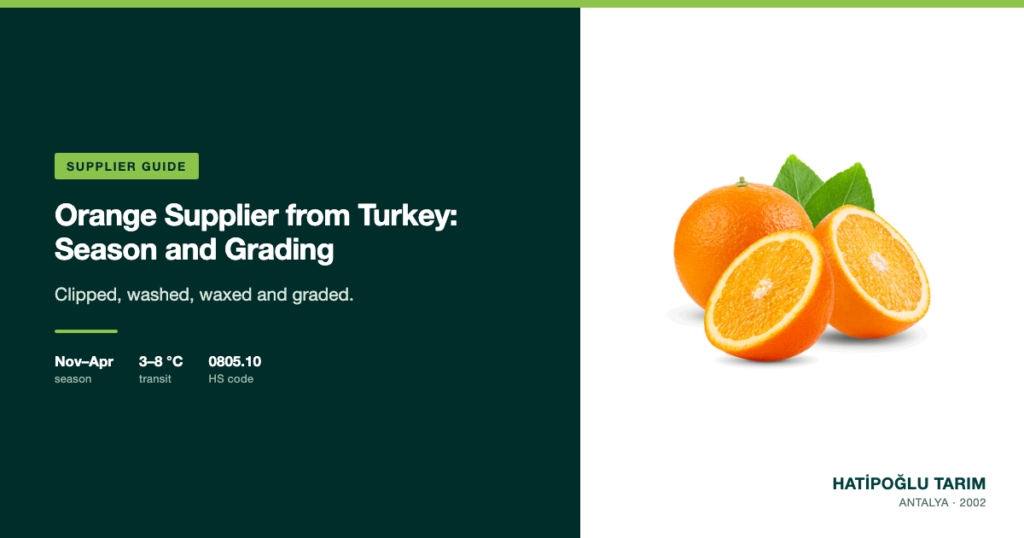
An orange supplier from Turkey should be able to answer one question before any other: how was the harvest date decided? Skin colour alone does not tell a buyer what is inside an orange. Hatipoğlu Tarım is a fresh produce exporter based in Antalya, in business since 2002, and it prepares oranges for export from November to April. This guide is for importers, wholesalers and retail buyers who plan to import oranges from Turkey.
Turkish oranges: table navels and Valencia in one programme
The orange is one of the staple citrus crops of the Mediterranean coast: bright skin colour, high juice content and a balanced sugar-acid profile. Our programme has two parts. Navel varieties are table fruit for the winter months; Valencia is the late variety that carries supply into spring. Each has its own guide: the Washington navel for buyers of seedless table fruit, and the Valencia orange for late-season and juicing demand. This page covers what the two have in common, for retail programmes and the orange wholesale trade alike.
Season: November to April
Oranges are shipped from November to April. Navels fill the first part of that window and Valencia the last. Where oranges stand among the other Turkish citrus lines, with mandarins opening a month earlier in October, is shown in our article on citrus export and harvest seasons. For a programme that runs the length of the season, tell us your weekly volume before it opens.
Harvest is decided by measurement, not by colour
The decision to harvest is not taken on skin colour alone; the sugar-acid balance is measured.
The maturity index given by UC Davis postharvest research shows why colour and taste have to be read together: a soluble solids to acid ratio of at least 8 with yellow-orange colour on at least 25% of the fruit surface, or a ratio of at least 10 with green-yellow colour on 25% of the surface. ## Clipped, washed, waxed and sized
Oranges are cut with clippers, not pulled from the branch. In the packhouse they are then washed, waxed and sized. The main storage diseases of oranges are green mould (Penicillium digitatum), blue mould (P. italicum), stem-end rots, brown rot and sour rot, and the protection named by the research is to keep physical damage during harvest and handling to a minimum. Wax reduces water loss, and where water loss is reduced the symptoms of chilling injury are milder.
Quality criteria
- Size: uniform within the crate; the range is fixed in the order.
- Colour: intensity and uniformity of the skin colour.
- Skin integrity: smooth rind, free of cuts and pressure marks.
- Firmness and shape: firm, well-formed fruit.
- Freedom from decay: no mould or rot in the lot.
- Maturity: confirmed by the sugar-acid measurement made before harvest.
Storage, transport and degreening
The optimum temperature for oranges is 3–8 °C at 90–95% relative humidity. Depending on variety, maturity at harvest and growing area, storage life can reach three months. Chilling injury shows as pitting and brown staining of the rind and as an increase in decay; the lowest safe temperature depends on variety, growing area and maturity.
A note on degreening: the treatment described in the research is 1–10 ppm ethylene for 1–3 days at 20–30 °C. It does not change internal quality, but it can speed up deterioration and decay. Our article on the cold chain in fresh produce export explains how the temperature is held from packhouse to destination.
Packaging, truck loads and HS code
Oranges are packed in 30 × 50 × 22 cm plastic crates on 80 × 120 cm euro pallets; see packaging and case sizes in export. A standard 13.60 m refrigerated truck takes 33 euro pallets. Oranges and mandarins are carried in a similar temperature range and can share a truck. Lemons want 12–14 °C, so in a load mixed with lemons the setting follows the lemons. Oranges are not loaded with fruit that travels at 0 °C.
Fresh oranges are classified under HS code 0805.10. Please confirm the full tariff line with your customs broker before shipment.
Documents and residue analysis
Hatipoğlu Tarım holds ISO 9001, ISO 22000, ISO 10002, GLOBALG.A.P. IFA and GRASP certification. Every lot bound for Europe goes through residue analysis. What a buyer can reasonably ask to see is listed in which certificates European buyers require.
Import process: six steps in one company
As an orange exporter in Turkey we keep six steps under one roof: harvest with clippers, cooling, grading (washing, waxing and sizing), packing, cold storage and dispatch by refrigerated truck.
How to get a quote
Six details are enough for a quotation: variety, size, packaging, weekly volume, delivery week and destination country. Phone +90 242 339 55 25, WhatsApp +90 534 260 07 25, email info@hatipoglutarim.com.
Hatipoğlu Tarım has exported fresh fruit and vegetables from Antalya since 2002. Under the FİNİKE brand it ships 128 product lines to 42 countries, with harvest, grading, cold storage and dispatch handled in house across five facilities in Serik, Kepez, Mavikent, Yenişehir and Alaşehir.
Tell us whether you need navel or Valencia, the size and the weekly volume through our contact page, and we will come back with a quotation.
