


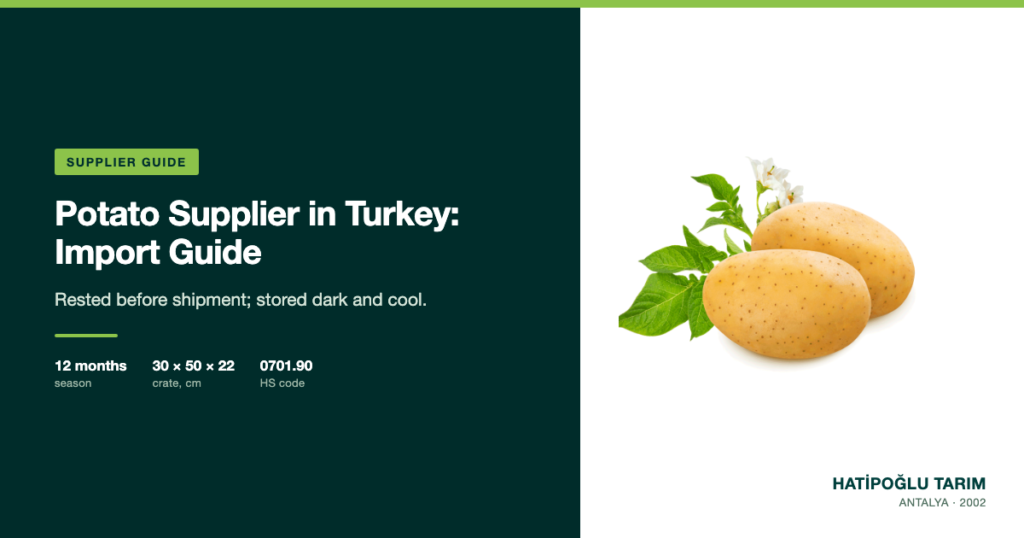
Choosing a potato supplier in Turkey comes down to a question that is easy to overlook: what happened to the tuber between lifting and loading. Hatipoğlu Tarım, an Antalya-based exporter of fresh fruit and vegetables founded in 2002, lists potato in all twelve months of its calendar. The pages below are written for importers, wholesalers and retail buyers, and they follow the tuber from the field to the crate: the rest period, the store, the published research on skin and temperature, the pack, the customs heading and the enquiry.
Potatoes from Turkey: what the buyer is paying for
Potato is one of the staple export products, preferred for a sound skin, balanced sizes and its quality in use. It sits in the company’s range beside two other storable lines, onions and, from March to August, fresh garlic.
A product for every month
The product calendar shows potato from January to December; weekly volumes are agreed in the enquiry. A potato wholesale programme can therefore be discussed for any part of the year. What changes through the year is covered for other crops in the Türkiye fresh produce season calendar.
Selection before dispatch
Potatoes are prepared for shipment against three criteria:
- Size: the size range follows your order.
- Skin integrity: a whole skin without scuffed or peeled patches.
- General quality: the tuber judged as a whole.
Skin comes second in that list for a reason. UC Davis, in the sheet it publishes for early-crop potatoes, points out that the skin of an immature potato is thin, bruises easily and peels off, a defect known as skinning, and that this leads to shrivelling and decay. The same sheet counts greening, which is caused by light, as a defect. Both are simple to look for when the first crates arrive.
Resting after harvest, then a dark and cool store
Here is what the company states about its own handling. After harvest the potatoes are rested before shipment. They spend this period in a dark and warm place, which helps the skin to mature and makes the tuber more resistant during handling. Storage then takes place in dark and cool conditions, and care is taken that the temperature does not fall below 4 °C.
What UC Davis publishes for early-crop potatoes
The following figures are research data and refer to early-crop potatoes; they are a separate source from the company’s statement above. For table use UC Davis gives 7 °C at 98% relative humidity, for frying 10–15 °C at 95% and for chipping 15–20 °C at 95%. Under the best conditions good quality lasts 3–5 weeks. For curing the skin the published regime is 15 °C and 95% humidity for 8 days, after which storage at 4 °C and 95–98% humidity is possible for up to 5 months, depending on the variety.
Buyers who supply fryers should note one more line from the same data. Holding immature potatoes below 10–13 °C, even for 3 days, can cause reducing sugars to build up and the product to darken too much when fried. Potatoes are not very sensitive to external ethylene.
Table potatoes travel at around 7 °C. That sets them apart from cabbage, carrots and the other vegetables carried near 0 °C, a point explained further in cold chain in fresh produce export.
Plastic crates and pallets
The pack is a plastic crate measuring 30 × 50 × 22 cm, and the crates are built up on euro pallets of 80 × 120 cm. An enquiry is easiest to answer when the quantity is given in pallets per week. Export crate formats in general are described in packaging and case sizes in export.
At six digits, potatoes other than seed potatoes fall under HS 0701.90. Ask your customs broker to confirm the full tariff line before the goods are shipped.
Paperwork on the supplier’s side
The certificates on file are ISO 9001, ISO 22000, ISO 10002, GLOBALG.A.P. IFA and GRASP. Lots going to Europe are put through residue analysis without exception. If you need to match this against your own intake requirements, read which certificates European buyers require.
Working with a potato exporter in Turkey: the chain
For potatoes the chain runs in six stages: harvest, a rest period in a dark and warm place, grading, packing, dark and cool storage kept at or above 4 °C, and dispatch. As a potato exporter in Turkey the company handles all six in house. Dispatch is organised truck by truck, and one standard 13.60 m temperature-controlled truck holds 33 euro pallets.
What to put in your enquiry
Buyers who wish to import potatoes from Turkey can speed things up by listing six points: the type of potato, the size range, the packaging, the quantity per week, the week of delivery and the country of destination. Call +90 242 339 55 25, message us on WhatsApp at +90 534 260 07 25 or e-mail info@hatipoglutarim.com.
Hatipoğlu Tarım has exported fresh fruit and vegetables from Antalya since 2002. Under the FİNİKE brand it ships 128 product lines to 42 countries, with harvest, grading, cold storage and dispatch handled in house across five facilities in Serik, Kepez, Mavikent, Yenişehir and Alaşehir.
Contact us with your size range, pallets per week and delivery weeks for potatoes, and let us prepare the season plan and the price quotation.
