


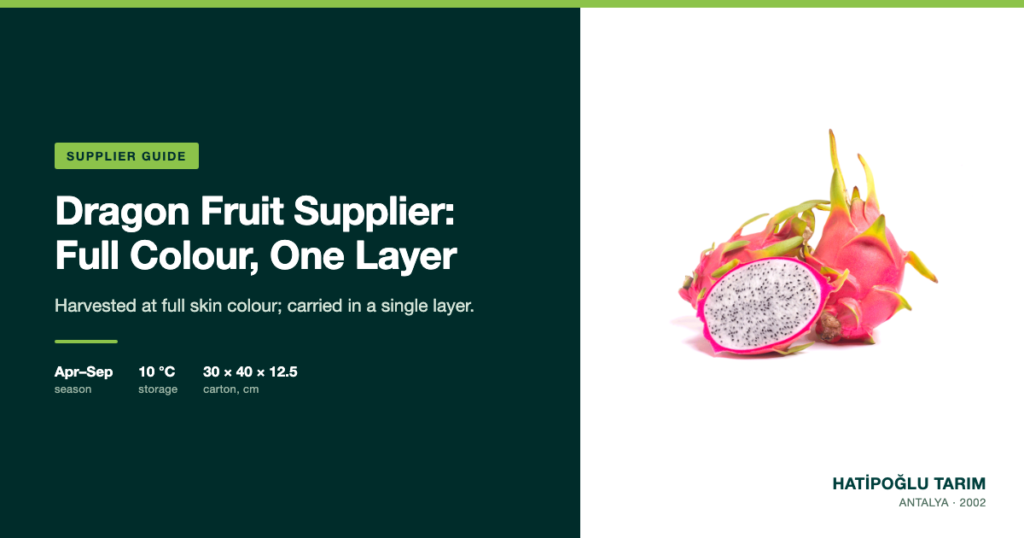
Ask a dragon fruit supplier when the fruit was cut, because nothing improves afterwards: the fruit does not go on ripening once it is off the plant. Hatipoğlu Tarım, based in Antalya and exporting fresh fruit and vegetables since 2002, harvests dragon fruit from protected cultivation between April and September, only when the skin colour has turned completely, and moves it in a single layer. Importers, wholesalers and retail buyers will find here the season, the selection criteria, the published research, the carton, the customs heading and the route to a quotation.
A Mediterranean product with an exotic look
The company calls dragon fruit a Mediterranean product, notable for its vivid skin colour, its firm flesh and its exotic appearance. It is grown under cover. Buyers who know the fruit as pitaya are looking at the same product; whatever name you use with your pitaya supplier, the questions are when it is picked, how it is carried and what it looks like on arrival.
April to September
Harvest runs from April to September, which places dragon fruit from Turkey in the summer half of the year, and the product calendar marks the same six months. A dragon fruit wholesale programme is best discussed before April, with the first and last delivery week on the table, so that the volumes can be talked through for the whole harvest. For the products that share those months, consult the season calendar.
Why harvest timing decides everything
The product text is direct about it: the fruit does not continue to ripen after it has been cut, and the right harvest time is therefore decisive. Research supports the statement. UC Davis reports that dragon fruit is not climacteric, that ethylene has no effect on its ripening and that it is harvested near full ripeness. As maturity indices the source lists the number of days after flowering, a minimum of 27–33 depending on cultivar and region, and the intensity of the skin colour. The company’s own rule is the second of these: the fruit is harvested when the skin colour has turned completely.
Selection criteria
Hatipoğlu Tarım selects the fruit on four points:
- Size: state the size you need in the enquiry.
- Colour: a vivid skin colour, fully turned at harvest.
- Skin integrity: a skin without damage.
- Ripeness: judged at harvest, since it cannot be corrected later.
The UC Davis quality description runs along similar lines: size, skin colour and freedom from defects such as skin splitting, mechanical damage, chilling injury, water loss and decay. In the best fruit the scales, or bracts, are firm, fleshy and green, and the flesh is firm. Green bracts are thus a fair thing to look for when a consignment arrives.
Single layer, and a carton to match
To reduce pressure on the surface of the fruit, the company carries dragon fruit in a single layer. The carton in the product table measures 30 × 40 × 12.5 cm. Footprints and pallet arithmetic are covered in packaging and case sizes in export.
Temperature: 10 °C in the literature
The following is research data and not a description of the company’s rooms. For red pitaya, UC Davis gives 10 °C and 85–90% relative humidity. Fruit held for about five weeks at 10 °C in modified atmosphere bags showed less water loss and less wilting of the scales. Chilling injury is among the defects the source lists, and the loading rule follows from it: dragon fruit does not go into a 0 °C load. Bananas and pineapples are chilling-sensitive too, but their published temperatures differ from this one.
Customs heading, certificates, residues
There is no separate six-digit subheading for dragon fruit; it is generally declared under HS 0810.90, other fresh fruit. Confirm the full tariff line with your customs broker before shipment. Hatipoğlu Tarım is certified to ISO 9001, ISO 22000 and ISO 10002 and holds GLOBALG.A.P. IFA and GRASP, and residue analysis is performed on all lots for Europe. Further reading: EU pesticide MRLs.
From plant to truck
The steps fit the fruit and not a chilled-produce template: harvest at full skin colour, selection by size, colour, skin and ripeness, packing in a single layer, holding under suitable conditions and dispatch in a temperature-controlled truck. Everything is handled in house. Road shipments are planned by the truck, and the standard 13.60 m vehicle takes 33 euro pallets, each 80 × 120 cm.
Asking for a quotation
Buyers who want to import dragon fruit for the coming season can start with six details: the type, the size, the packaging, the weekly volume, the delivery week and the destination country. Phone +90 242 339 55 25, WhatsApp +90 534 260 07 25 or e-mail info@hatipoglutarim.com.
Hatipoğlu Tarım has exported fresh fruit and vegetables from Antalya since 2002. Under the FİNİKE brand it ships 128 product lines to 42 countries, with harvest, grading, cold storage and dispatch handled in house across five facilities in Serik, Kepez, Mavikent, Yenişehir and Alaşehir.
Before the harvest opens in April, let us know your size, weekly volume and delivery weeks, and we will prepare a season plan and a price quotation for dragon fruit.
