


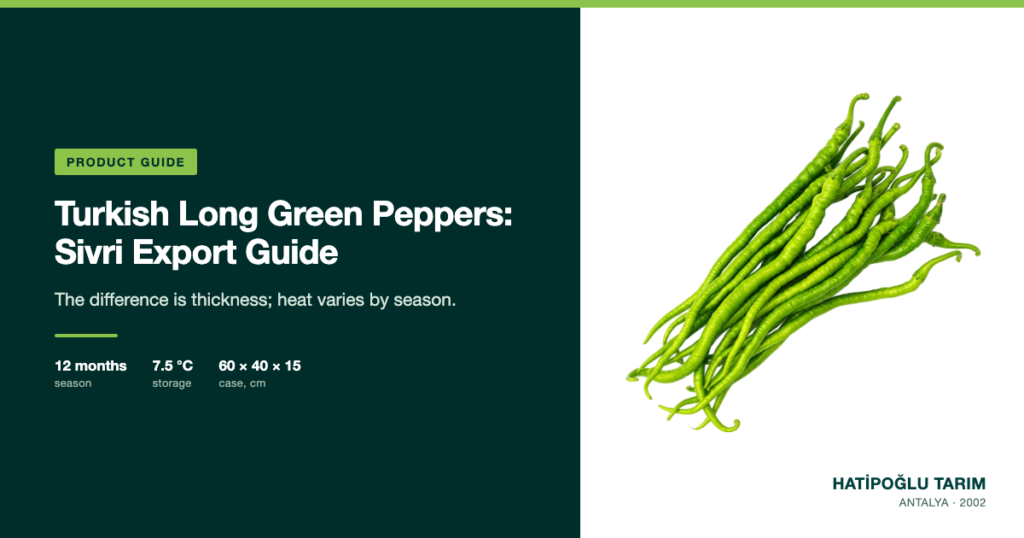
The Sivri (sivri biber, literally “pointed pepper”) is the most widely eaten green pepper in Turkish cooking. The Kıl Sivri is the thinnest and longest member of the same family. Abroad both are searched for as “Turkish long green peppers”, and in Germany as “türkische Paprika Sivri”. This guide explains the difference between the two, answers the most frequent question, which is heat, and sets out the conditions for export. Hatipoğlu Tarım is a fresh pepper exporter based in Antalya, Turkey, and ships Sivri and Kıl Sivri pepper all year round; what follows reflects the criteria applied every day in Turkish pepper export.
The difference between Sivri and Kıl Sivri
The difference is thickness. The Sivri is about as thick as a finger, of medium length, with a pointed tip. The Kıl Sivri is pencil-thin, longer and more delicate; its name, “hair-thin pointed pepper”, refers to exactly that. Its skin and flesh are thinner, which makes it particularly suitable for eating raw, for grilling and for pickling.
In trade the difference matters. If a buyer writes only “Turkish sivri pepper”, it is not clear which thickness is wanted. The order should state the expected length and thickness alongside the variety name.
Are Sivri peppers hot?
Sivri and Kıl Sivri range in flavour from sweet to mildly hot. The heat is not constant; it varies with the season, the temperature and the water status of the plant. Peppers grown in summer heat and under water stress are hotter. Of two peppers from the same carton, one may be sweet and the other mildly hot.
For the buyer the conclusion is this: if a product with no heat at all is required, the right variety is the Charleston or the bell pepper. If distinct heat is required, the green chili pepper is a separate product and is kept apart in the growing area. The Sivri sits between the two.
Harvest and sizing
Kıl Sivri peppers are harvested daily. The longer the fruit stays on the plant, the thicker and tougher it becomes, and it loses its hair-thin character; picking intervals are therefore kept short. After harvest the peppers are graded by length.
The selection criteria are length, thinness, colour, skin integrity and freshness. Straight fruit is preferred; a curved pepper does not count as defective, but because it will not lie neatly in the carton it is sorted out of retail lots. The colour must be a bright, uniform green.
Because of its slender build, the Kıl Sivri is handled with care at harvest and in packing. Fruit that is snapped or has lost its stem loses water quickly and becomes prone to decay.
Retail or wholesale?
The arrangement inside the carton is planned around the buyer’s sales channel. A retail chain wants fruit of similar length, straight and laid in the same direction. The wholesale and food service channel accepts a wider size range. The distinction also sets the price; naming the channel in the order saves time on both sides.
Storage and shipping
The best conditions for peppers are 7.5 °C and a relative humidity above 95%. With thin-fleshed varieties the real danger is water loss: if humidity drops, a Kıl Sivri shrivels within a few days. Green peppers held below 7 °C for long show chilling injury, which starts with pitting of the skin and darkening of the seed cavity.
Peppers respond very little to ethylene, so in a mixed load the point to watch is temperature, not ethylene. The details are in our cold chain article.
Season and packing
Thanks to protected cultivation, Kıl Sivri is supplied twelve months a year. The product is packed in 60 × 40 × 15 cm cartons. Residue control on peppers is strict; every lot of these Turkish green peppers bound for Europe is analysed. The subject is covered in detail in our MRL article.
Sivri and Kıl Sivri pepper export: from harvest to loading
Exporting Sivri and Kıl Sivri pepper from Turkey runs in six steps: harvest, same-day cooling, grading, packing, cold storage and dispatch by refrigerated truck. At Hatipoğlu Tarım all of these are handled in house, in the company’s own facilities. When export-grade peppers are allocated, the buyer’s market, sales channel and transit time are considered together, and every lot bound for Europe is also analysed for residues.
As a Turkish pepper exporter we need six details to quote: variety, size or calibre, packaging, weekly volume, delivery week and destination country. With these in hand, we prepare a loading plan and a quotation.
Hatipoğlu Tarım has exported fresh fruit and vegetables from Antalya since 2002. Under the FİNİKE brand it ships 128 product lines to 42 countries, with harvest, grading, cold storage and dispatch handled in house across five facilities in Serik, Kepez, Mavikent, Yenişehir and Alaşehir.
Tell us the size, sales channel and delivery week for your Sivri and Kıl Sivri programme, and we will send back a plan and a price.
