


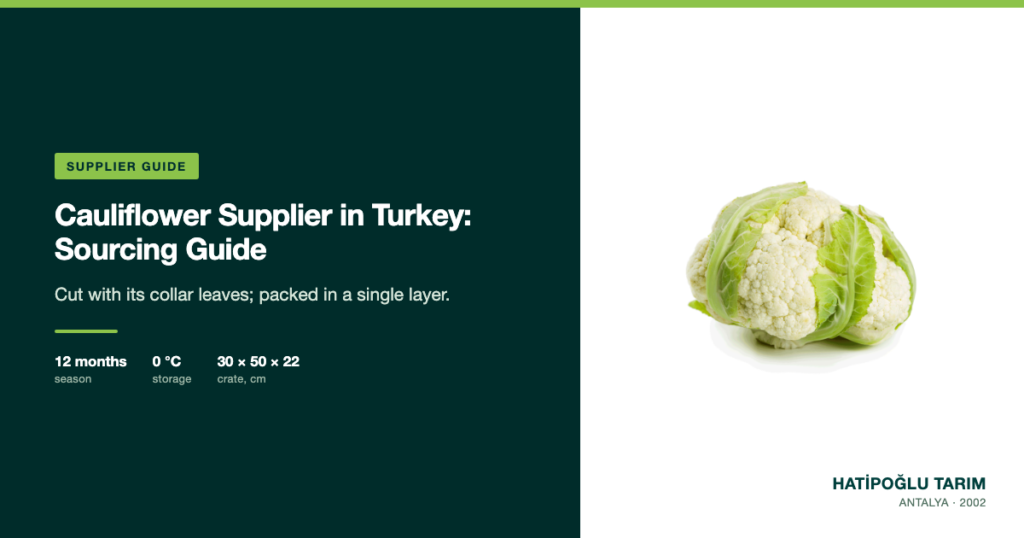
Choosing a cauliflower supplier comes down to whiteness: the curd has to leave the field white and still be white when your customer sees it. Hatipoğlu Tarım, established in 2002, exports fresh fruit and vegetables from its base in Antalya, and cauliflower is on its calendar in all twelve months. What follows is written for importers, wholesalers and the buying teams of retail chains. It deals with how the white colour is protected, how the heads are cut and packed, what research says about storage, and what an enquiry should contain.
Cauliflower from Turkey: white curd, fresh leaves
Cauliflower is a delicate vegetable assessed on its white head, its tight floret structure and its fresh leaves. It belongs to the same family as broccoli, travels at the same temperature and is declared under the same customs heading, so the two fit into a single enquiry.
Keeping the curd white in the field
To keep the head white, it is shielded from the sun by its own leaves while it develops. That is a field practice, and head colour is the first of the company’s selection criteria. Whiteness is decided in the field, before the head reaches a packhouse.
Calendar
The product calendar marks every month from January to December. Weekly volumes are best discussed ahead of the delivery period; the Türkiye fresh produce season calendar shows which other vegetables are available alongside.
Selection criteria
Cauliflower is chosen for export on the following:
- Head colour: white, without yellowing.
- Tightness: florets closed and compact.
- Leaf integrity: fresh, undamaged leaves around the head.
- General quality: the head judged as a whole.
UC Davis describes a good head in its published data as firm and compact, white to cream-white, with a well-trimmed crown of turgid green leaves and no yellowing from the sun. It gives a diameter of at least 15 cm for a mature head and names loose or protruding floral parts, known as riciness, as a sign of over-maturity.
Harvest with collar leaves, single-layer packing
At harvest the heads are cut together with their protective collar leaves and are cooled quickly. They are then packed in a single layer so that the heads are not crushed. In one layer, no head carries the weight of another.
What the research says about storage
UC Davis publishes 0 °C and a relative humidity of 95–98% for cauliflower. The same data note that storage of more than 3 weeks is generally not recommended if good visual and sensory quality is to be kept. These are research values; they are quoted here so that you can plan stock, and they do not describe the company’s procedures.
Cauliflower is very sensitive to ethylene. The gas discolours the curd and makes the wrapper leaves yellow and detach, so cauliflower should not be loaded together with apples, melons or tomatoes. It does combine with cabbage, broccoli, radish, carrot and sweet corn, which move at about 0 °C in high humidity. If your order also includes red cabbage, the two can share a vehicle. For the principles, see the cold chain in fresh produce export.
Crate and customs code for cauliflower wholesale
The heads go into plastic crates of 30 × 50 × 22 cm, one layer per crate, and the crates are stacked on euro pallets of 80 × 120 cm. Because of the single layer, a cauliflower wholesale order is best expressed in crates or pallets. Our overview of packaging and case sizes in export covers crate formats in general.
The HS code is 0704.10 at six digits. Before the shipment leaves, your customs broker should confirm the complete tariff line.
Certificates and residues
Hatipoğlu Tarım is certified to ISO 9001, ISO 22000, ISO 10002, GLOBALG.A.P. IFA and GRASP. Lots for Europe are residue-analysed one by one. The background for buyers is in which certificates European buyers require.
The import process, step by step
A cauliflower exporter in Turkey has six steps to manage, and here they run as follows: the head is cut with its collar leaves, cooled quickly, graded on colour and tightness, packed in one layer, held in cold storage and dispatched. Dispatch is organised in truckloads, with 33 euro pallets to a standard 13.60 m refrigerated truck.
Information needed for a quotation
Anyone wishing to import cauliflower from Turkey can speed things up by sending six details at once: type, head size, packaging, weekly quantity, delivery week, destination country. We answer on +90 242 339 55 25 by phone, on +90 534 260 07 25 by WhatsApp and at info@hatipoglutarim.com by e-mail.
Hatipoğlu Tarım has exported fresh fruit and vegetables from Antalya since 2002. Under the FİNİKE brand it ships 128 product lines to 42 countries, with harvest, grading, cold storage and dispatch handled in house across five facilities in Serik, Kepez, Mavikent, Yenişehir and Alaşehir.
Get in touch with the head size, the number of crates per week and your delivery weeks, and let us prepare the season plan and the price quotation.
