


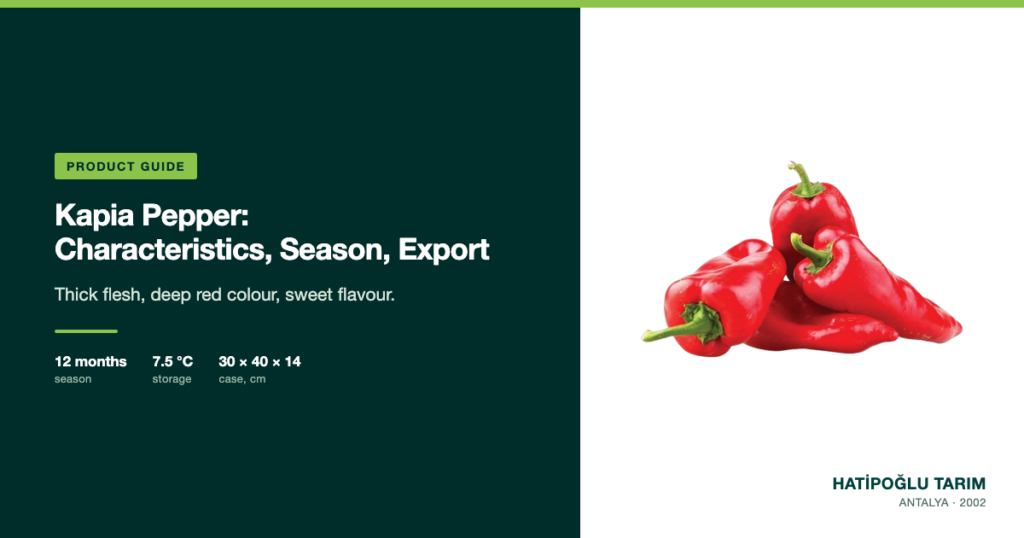
The Kapya, sold abroad as the kapia pepper, is the variety people in Turkey mean when they say red pepper. The fruit is long, flat and conical, with thick flesh, a deep red colour and a sweet flavour. It is not hot. Those four traits together are why it is the pepper of choice for roasting, for pepper paste and for drying. This guide takes importers and wholesalers through the variety’s characteristics, its season, the quality criteria and the shipping conditions. Hatipoğlu Tarım is a fresh pepper exporter based in Antalya, Turkey, and ships Kapya (kapia) pepper all year round; what follows reflects the criteria applied every day in Turkish pepper export.
What sets the kapia pepper apart
The commercial value of a kapia pepper lies in the thickness of its flesh. Thick flesh holds together when roasted, the skin peels away easily and the yield in paste is high. In a kapia pepper vs bell pepper comparison, both have thick walls, but the bell pepper is blocky, whereas the kapia is flat and long and so sits more neatly on a grill, on an oven tray and in a jar. A large share of what European retail sells as red pointed pepper is of this type.
In English the variety is written “kapia” or “capia pepper”, in German “Kapia-Paprika”. When ordering, stating the expected colour, length and flesh thickness alongside the variety name prevents misunderstandings.
When kapia peppers are available
Hatipoğlu Tarım’s Kapya pepper programme runs all year thanks to protected cultivation. The peak comes in late summer, when the open-field crop comes in as well. In those months volume is at its highest and prices at their most favourable, which is why purchases for paste and roasting are concentrated in August and September.
In the winter months the crop comes from greenhouses. Quantities are more limited than in late summer, but supply does not stop. For a buyer who wants a year-round programme, the important step is to notify winter weekly volumes in advance. How protected cultivation changes the calendar is explained in our article on year-round loading.
Quality criteria: colour, flesh, maturity
Kapia peppers are selected against the following criteria:
- Colour: the whole fruit must be deep red. Partly coloured fruit does not go into a fresh table lot.
- Flesh thickness: the key criterion for lots going to the processing industry. Thin-fleshed fruit lowers the yield in roasting and in paste.
- Skin integrity: no cracks, bruises or sunscald.
- Maturity: the fruit must be firm and crisp. A pepper that has begun to shrivel has lost water and has a short shelf life.
- Stem: green and fresh; a darkened stem shows how long the fruit has been waiting.
In a retail lot for fresh consumption, uniformity of size comes first. In a processing lot, size is secondary; flesh and colour decide. Stating the intended use in the order ensures that grading is done accordingly.
Storage and shipping: 7.5 °C
Peppers are sensitive to cold. The longest shelf life is achieved at 7.5 °C and a relative humidity above 95%; under these conditions it is 3–5 weeks. If the temperature rises, the fruit loses water and shrivels. If it falls, chilling injury begins: pitting of the skin, darkening of the seed cavity and softening without water loss.
The kapia pepper has one advantage: a fully coloured, ripe pepper tolerates chilling better than a green one. Even so, setting the temperature of a mixed load for apples or grapes will ruin the peppers. The details are in our pepper storage guide, and the course of the season in our article on the pepper season in Turkey.
Packing
Kapia peppers are packed in 30 × 40 × 14 cm cartons. The 30 × 40 cm footprint fits an 80 × 120 cm Euro pallet exactly, at 8 cartons per layer.
Residues on shipments to Europe
Peppers are among the products most frequently checked for residues at the European Union border. Every lot is analysed and the result is compared with the limits of the destination market. How the limits work is set out in our MRL article.
Kapya (kapia) pepper export: from harvest to loading
Exporting Kapya (kapia) pepper from Turkey runs in six steps: harvest, same-day cooling, grading, packing, cold storage and dispatch by refrigerated truck. At Hatipoğlu Tarım all of these are handled in house, in the company’s own facilities. When export-grade peppers are allocated, the buyer’s market, sales channel and transit time are considered together, and every lot bound for Europe is also analysed for residues.
As a Turkish pepper exporter we need six details to quote: variety, size or calibre, packaging, weekly volume, delivery week and destination country. With these in hand, we prepare a loading plan and a quotation.
Hatipoğlu Tarım has exported fresh fruit and vegetables from Antalya since 2002. Under the FİNİKE brand it ships 128 product lines to 42 countries, with harvest, grading, cold storage and dispatch handled in house across five facilities in Serik, Kepez, Mavikent, Yenişehir and Alaşehir.
Tell us the intended use, volume and delivery week for your kapia pepper programme, and we will send back a plan and a price.
