


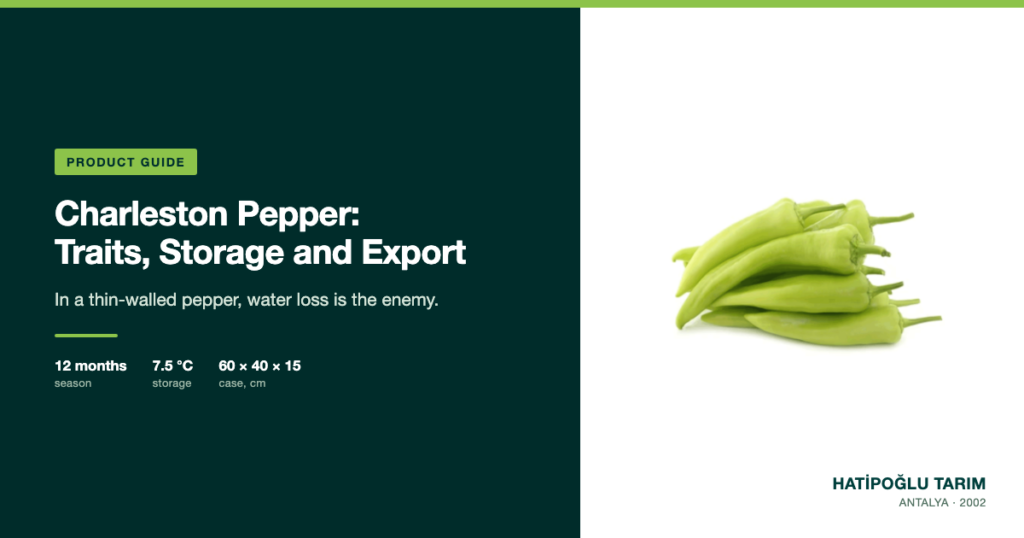
The Charleston pepper, Çarliston in Turkish, is a long, pale yellow-green, thin-fleshed and sweet variety. In Turkey it is one of the most widely used peppers: eaten raw at breakfast, roasted, fried or stuffed. Abroad it is searched for as “Charleston pepper” or, in German, “Carliston Paprika”, and it enjoys steady demand in markets familiar with Turkish cooking. This guide covers the variety’s characteristics, the questions buyers ask most often and the conditions for export. Hatipoğlu Tarım is a fresh pepper exporter based in Antalya, Turkey, and ships Charleston pepper all year round; what follows reflects the criteria applied every day in Turkish pepper export.
Is the Charleston pepper hot?
No. The Charleston is a sweet variety. Its shape resembles that of the Sivri, the Turkish long green pepper, so the two are often confused. But while heat in a Sivri can vary with the season and the plant, no noticeable heat is expected in a Charleston. That makes it suitable for households with children and for ready-meal manufacturers.
Why it turns red
The Charleston is harvested while pale yellow-green; this is the variety’s commercial maturity stage. Left on the plant, the fruit goes on ripening and turns red. A red Charleston is not a spoiled pepper but a ripe one, and it tastes slightly sweeter. In an export lot, however, uniform colour is required, so pale and red fruit are not packed in the same carton. If a buyer wants red Charleston, it is planned as a separate order.
Selection criteria
Hatipoğlu Tarım selects its Charleston peppers for size, colour, skin integrity and freshness:
- Size: the fruit within a carton is of similar length.
- Colour: pale yellow-green and uniform; fruit that is dark green or starting to redden is sorted out.
- Shape: straight, regular fruit is preferred both for shelf appearance and for packing.
- Skin: glossy and taut, free of cracks and bruises.
The most sensitive point: water loss
The flesh of a Charleston is thin. A thin-fleshed pepper loses water far faster than thick-fleshed varieties; the skin first turns dull and then shrivels. For that reason the fruit is cooled within the first two hours after cutting. Time spent in the sun in the field is deducted from the days on the buyer’s shelf.
The storage target is 7.5 °C and a relative humidity above 95%. With thin-fleshed varieties humidity matters as much as temperature, because the firmness of a pepper depends directly on water loss. Holding the fruit below 7 °C for long causes chilling injury: pitting of the skin and water-soaked spots. Green and pale peppers are more sensitive to chilling than fully ripe red ones.
Temperature management is covered in detail in our pepper storage guide.
Season and supply
Thanks to greenhouse production, Charleston peppers are supplied twelve months a year. In the summer months the open-field crop comes in as well and volume rises. A buyer who wants a winter programme should notify weekly volumes in advance so that the product can be reserved.
Packing
The product is packed in 60 × 40 × 15 cm cartons. The fill height inside the carton is kept limited so that the fruit at the bottom is not crushed. How this carton size fits a pallet is set out in our article on packaging and case sizes.
Which markets buy it
The Turkish Charleston pepper is in demand in European markets where Turkish and Balkan cooking is known. There it is sold both in ethnic grocery shops and on the “Turkish pepper” shelves of supermarket chains. For a comparison with other types, see our article on pepper varieties and export standards.
Charleston pepper export: from harvest to loading
Exporting Charleston pepper from Turkey runs in six steps: harvest, same-day cooling, grading, packing, cold storage and dispatch by refrigerated truck. At Hatipoğlu Tarım all of these are handled in house, in the company’s own facilities. When export-grade peppers are allocated, the buyer’s market, sales channel and transit time are considered together, and every lot bound for Europe is also analysed for residues.
As a Turkish pepper exporter we need six details to quote: variety, size or calibre, packaging, weekly volume, delivery week and destination country. With these in hand, we prepare a loading plan and a quotation.
Hatipoğlu Tarım has exported fresh fruit and vegetables from Antalya since 2002. Under the FİNİKE brand it ships 128 product lines to 42 countries, with harvest, grading, cold storage and dispatch handled in house across five facilities in Serik, Kepez, Mavikent, Yenişehir and Alaşehir.
Tell us the size, volume and delivery week for your Charleston pepper programme, and we will send back a plan and a price.
