


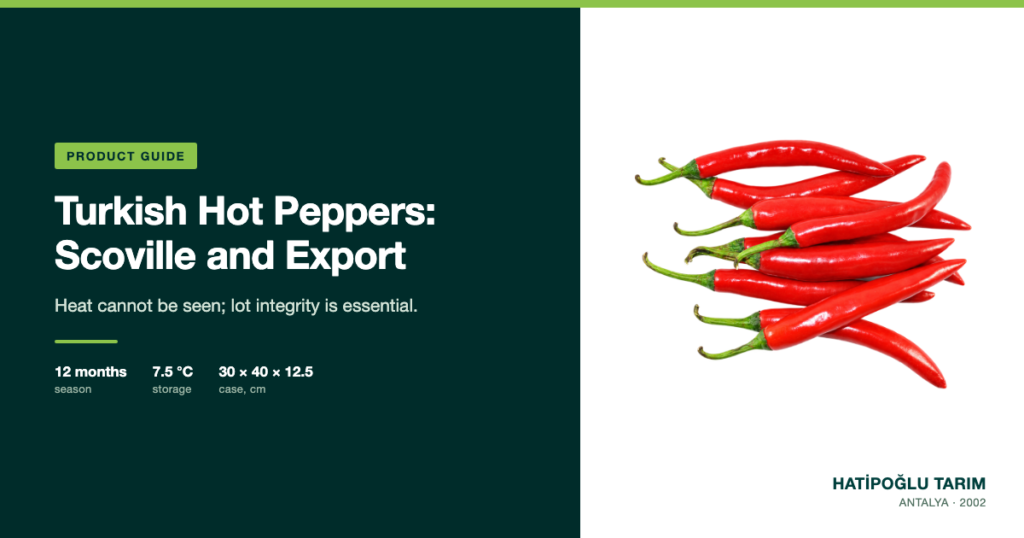
Turkish hot peppers are not a single product. They are a family of varieties that differ in colour, size and level of heat. For the buyer the real difficulty is that heat cannot be seen from the outside: two peppers can look identical, yet one may be several times hotter than the other. This guide sets out the varieties, how heat is measured and how that uncertainty is managed in export. Hatipoğlu Tarım is a fresh pepper exporter based in Antalya, Turkey, and ships hot pepper all year round; what follows reflects the criteria applied every day in Turkish pepper export.
Green and red chili pepper: one plant, two products
The green chili pepper is a long, bright green pepper with distinct heat. The red chili pepper is in most cases the same pepper ripened on the plant. During ripening the sugar content of the fruit rises, its heat becomes more pronounced and its colour turns bright red.
In trade these are two separate products. Green chili is sought for fresh consumption, pickling and grilling; red chili, besides fresh use, for sauces, drying and chili flakes. Red peppers are harvested while the skin is smooth and the flesh firm; fruit that has begun to shrivel is sorted out of the fresh shipment lot.
Small and very hot: Cin biberi
The Cin biberi is a small-fruited, glossy variety with intense heat. It is best known as a pickling pepper. The details are in our Cin biberi guide.
How heat is measured: the Scoville scale
The heat of a pepper comes from capsaicin and related compounds. The amount of these compounds is expressed in Scoville heat units (SHU). At the bottom of the scale is the bell pepper, with a heat of 0 SHU. Jalapeño generally falls in the range of 4,000–8,500 SHU, and cayenne-type peppers in the range of 30,000–50,000 SHU.
Today the measurement is made not by a tasting panel but in the laboratory, by determining the capsaicin content. In contracts that require a heat declaration, this analysis can be requested.
What determines heat
Heat depends on three factors:
- Variety: genetics decide. A sweet variety will not become very hot under any conditions.
- Growing conditions: high temperatures and water stress make the fruit hotter. The same variety can be hotter in summer than in winter.
- Maturity: the capsaicin content changes as the fruit ripens; heat is generally more pronounced in red peppers.
One fact matters to the buyer: a pepper that keeps its marketable quality also keeps its heat throughout storage. Heat is not lost in transit.
Lot integrity in export
Because heat cannot be judged from appearance, the varieties are kept apart in the growing area. Hot and sweet varieties mixed in the same lot is the most common error that ends as a complaint on the buyer’s shelf. Lot integrity is therefore maintained from harvest to carton, and the variety is stated clearly on the carton label.
When ordering, “hot pepper” or “Turkish chili pepper” on its own is not enough. Colour, length range and the desired level of heat should be specified together. Asking for a sample before the first order is the shortest way to settle expectations on heat.
Storage and packing
Hot peppers tolerate chilling slightly better than bell peppers, but the rule is the same: the longest shelf life is achieved at 7.5 °C and a relative humidity above 95%, and it is 3–5 weeks. The peppers are harvested with a short stem and cooled the same day. Packing is in 30 × 40 × 12.5 cm or 60 × 40 × 15 cm cartons.
Supply and loading are covered in detail in our article on hot pepper export.
Hot pepper export: from harvest to loading
Exporting hot pepper from Turkey runs in six steps: harvest, same-day cooling, grading, packing, cold storage and dispatch by refrigerated truck. At Hatipoğlu Tarım all of these are handled in house, in the company’s own facilities. When export-grade peppers are allocated, the buyer’s market, sales channel and transit time are considered together, and every lot bound for Europe is also analysed for residues.
As a Turkish pepper exporter we need six details to quote: variety, size or calibre, packaging, weekly volume, delivery week and destination country. With these in hand, we prepare a loading plan and a quotation.
Hatipoğlu Tarım has exported fresh fruit and vegetables from Antalya since 2002. Under the FİNİKE brand it ships 128 product lines to 42 countries, with harvest, grading, cold storage and dispatch handled in house across five facilities in Serik, Kepez, Mavikent, Yenişehir and Alaşehir.
Tell us the colour, size and level of heat you expect from your Turkish hot pepper programme, and we will prepare a sample and a price.
