


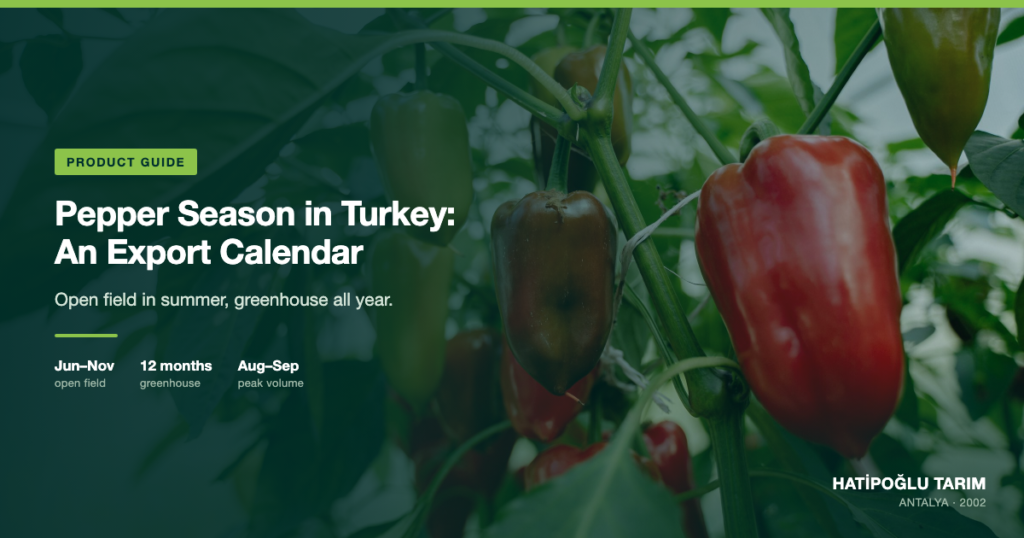
The question “when is pepper season in Turkey?” has two separate answers. For peppers grown in the open field, the season is summer and it ends in autumn. Peppers grown in greenhouses have no season; they are harvested twelve months a year. What sets price, abundance and variety on the market is the way these two calendars overlap. This guide sets out both calendars, the differences between varieties and how an importer should plan the year. Hatipoğlu Tarım is a fresh pepper exporter based in Antalya, Turkey, and ships peppers all year round; what follows reflects the criteria applied every day in Turkish pepper export.
Open-field peppers: summer and autumn
In the open field, peppers are planted in spring. Harvest begins at the end of June, peaks in August and September and ends with the first cold weather in October–November. The peppers of the Marmara, Aegean and Central Anatolia regions follow this calendar.
The features of this period are the highest volume, the lowest price and the widest choice of varieties. It is the time of year when Turkish households make their own pepper paste and pickles and when industry does its buying as well.
When paste and pickling peppers are available
Peppers for paste, that is, the thick-fleshed red Kapya pepper, need the fruit to turn fully red on the plant. Open-field Kapya is therefore abundant from mid-August to the end of September. Purchases for paste and roasting are planned around these weeks.
For pickling peppers, what is wanted is small, firm fruit. The Cin biberi for pickling, along with Sivri and Kıl Sivri, the Turkish long green peppers, is at its most plentiful in late summer and early autumn.
Greenhouse peppers: twelve months
In and around Antalya, peppers are grown under cover. The greenhouse protects the plant from winter cold and keeps the harvest going all year. When the open-field season is over, this is where the peppers for Turkey and for the export markets come from.
All of Hatipoğlu Tarım’s pepper varieties can be ordered twelve months a year: bell pepper, Charleston, Kıl Sivri, Kapya, green and red chili pepper, Cin biberi, Üçburun and Black California pepper. Which products can be loaded this month is shown on our in season now page.
What changes during the year
Year-round pepper supply does not mean the same conditions all year:
- Winter (December–February): the crop comes from greenhouses only. Because the days are short, the plant grows slowly, weekly volume falls and the price rises. Europe’s own production is at its lowest in these months and import demand at its highest.
- Spring (March–May): greenhouse production speeds up and volume increases.
- Summer (June–August): the open field comes in. Volume reaches its peak. Hot weather makes cooling more critical in shipping.
- Autumn (September–November): the open field closes and new greenhouse plantings come into harvest. Volume can fluctuate in the changeover weeks.
Differences by variety
The kapia pepper is supplied all year, but its peak is late summer, when the open-field crop joins in. Üçburun is grown on small open-field plots, so its volume is limited and depends on the weather. Bell pepper, Charleston and Kıl Sivri are the varieties that flow most steadily through the year on greenhouse production.
How an importer should plan the year
- Notify your winter programme in autumn. Volume is limited in winter; product is reserved for the buyer who states weekly requirements in advance.
- Place processing purchases in late summer. For paste, roasting and pickling peppers, the best price and the highest volume are in August–September.
- Be flexible in the changeover weeks. A few weeks of fluctuation between greenhouse and open field is normal in the Turkish pepper season.
For the month-by-month position of all products, see our Türkiye fresh produce season calendar; for the details of protected cultivation, see our article on year-round loading.
Fresh pepper export: from harvest to loading
Exporting peppers from Turkey runs in six steps: harvest, same-day cooling, grading, packing, cold storage and dispatch by refrigerated truck. At Hatipoğlu Tarım all of these are handled in house, in the company’s own facilities. When export-grade peppers are allocated, the buyer’s market, sales channel and transit time are considered together, and every lot bound for Europe is also analysed for residues.
As a Turkish pepper exporter we need six details to quote: variety, size or calibre, packaging, weekly volume, delivery week and destination country. With these in hand, we prepare a loading plan and a quotation.
Hatipoğlu Tarım has exported fresh fruit and vegetables from Antalya since 2002. Under the FİNİKE brand it ships 128 product lines to 42 countries, with harvest, grading, cold storage and dispatch handled in house across five facilities in Serik, Kepez, Mavikent, Yenişehir and Alaşehir.
Tell us the varieties, weekly volume and period for your pepper programme, and we will send back an annual plan and a price.
